Open Memory | Miracles Docs #3 | 20240523

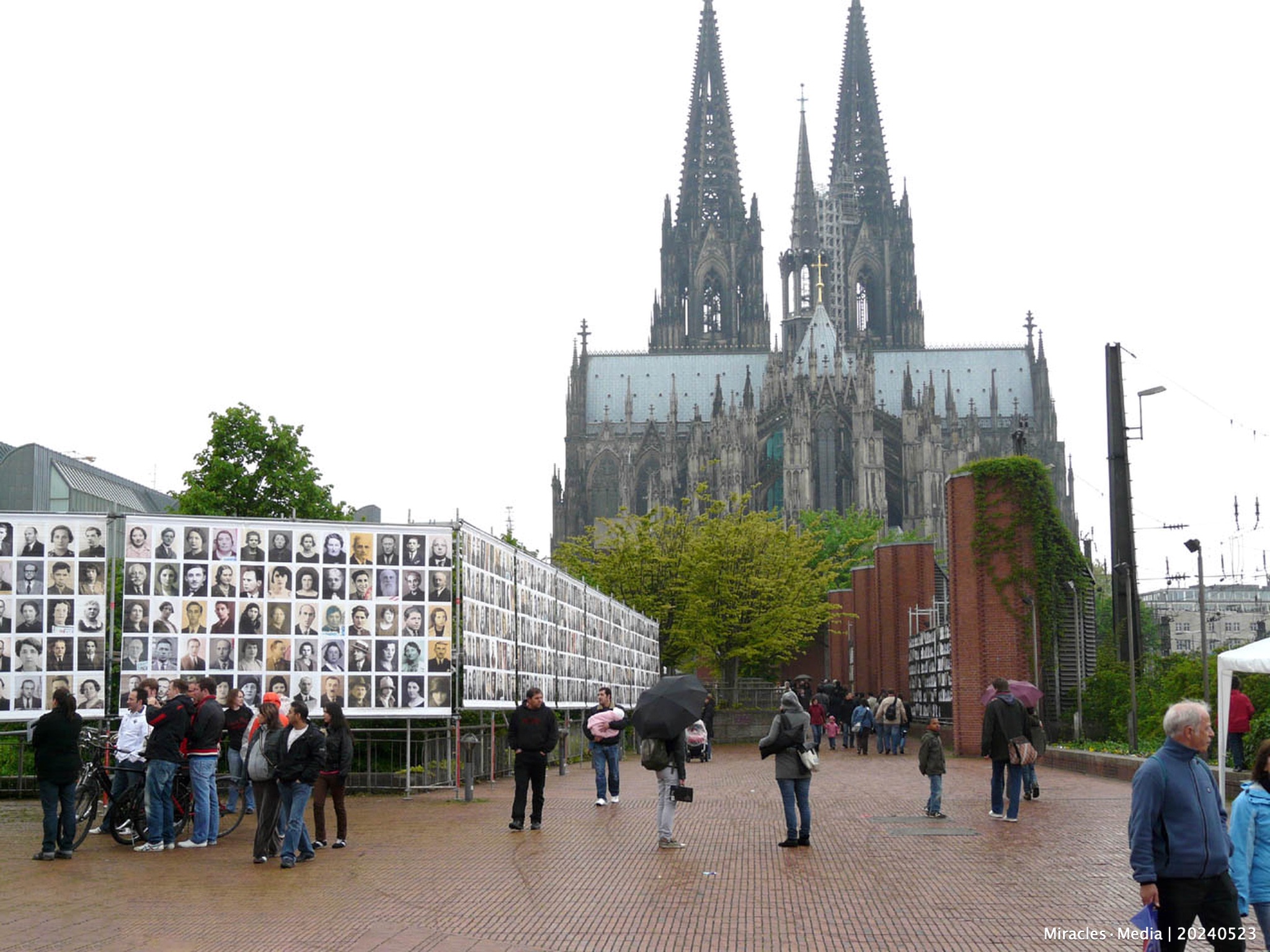
Open Memory , Cologne, May 2010. Transport XX (left) and Transport Z (right) in front of the with Cologne Cathedral. Still : Open Memory | Miracles Docs #3 | Miracles•Media | 20240523

From May 8th to May 24th, 2010, the memorial installation “Open Memory” was on display in a prominent location in Köln (Cologne, Germany) — in front of the Hohenzollern Bridge, at the left bank of the Rhine river, parallel to the railway tracks of the Cologne Central Station (Köln Hauptbahnhof), with the Cologne Cathedral (Kölner Dom) in the background.

It consisted of 26 large canvases on which portraits of more than 1,500 people were depicted. This open-air exhibition was intended to commemorate three events that occurred during this period: the end of the Second World War in Europe on May 8th and 9th, 1945, the 70th anniversary of the attack by the German Wehrmacht on the Benelux countries and France, and the 70th anniversary of the deportation of the Sinti and Roma from Cologne and the Rhineland (Western Germany).

The Museum La Coupole had created six canvases with photographs or silhouettes of 351 Sinti and Roma from Northern France and Belgium, deported with “Transport Z” in January 1944 from Kazerne Dossin in Mechelen, Belgium to the Auschwitz-Birkenau extermination camp.

On 20 other canvases were the portraits of 1,200 Jewish people deported with “Transport XX” in April 1943 from Kazerne Dossin in Mechelen to Auschwitz. This exhibition was created by the Jewish Deportation and Resistance Museum (Kazerne Dossin) in Mechelen. “Transport XX” is the only deportation train in Europe that was stopped by a resistance group.

The exhibition lined the route Roma and Sinti from Köln had to take from May 1940 en route across the Rhine via the Hohenzollern Bridge to the Cologne Fair (Köln Messe) transit camp for deportation to the extermination camps. The route was marked May 6, 1990, by the artist Gunter Demnig (later known for his Stolperstein project) by printing the writing “May 1940 – 1000 Sinti and Roma” on the streets in Cologne, using a wheel for painting with white paint.

The Open Memory installation was presented by : the Jewish Deportation and Resistance Museum (Kazerne Dossin) in Mechelen, Belgium • La Coupole – History Centre in Wizernes, France • NS Documentation Center Cologne • AK Memorial Centers NRW • Yavne Memorial and Educational Center • EL-DE-Haus Cologne.

Film by : Michel van der Burg, thanks to an amateur (2010) slide presentation by A. Lototsky

Citation info : Open Memory | Miracles Docs #3 | Miracles•Media | 20240523 | ISAN 0000-0007-329C-0003-M-0000-0000-8 | TakeNode 4e398109-d461-4a41-84d7-8d74756c82d8

First Stolperstein | 20240520

First Stolperstein. Installed on 16 Dec 1992 in front of the City Hall in Cologne , Germany.

Over the past 30 years the team of German artist Gunter Demnig installed over 100,000 Stumbling Stones – ‘Stolpersteine’ – across 26 countries in Europe – the world’s largest memorial.

Demnig’s Stolpersteine are small, cobblestone-sized brass memorials for the victims of National Socialism. Set into the pavement of sidewalks in front of the buildings where Nazi victims once lived or worked, they call attention both to the individual victim and the scope of the Nazi war crimes.

The very first Stolperstein, was installed on 16 December 1992 in front of Cologne City Hall , with Heinrich Himmler’s order for the initiation of deportations of all Roma (Gypsies) :

„Auf Befehl des Reichsführers SS vom 16.12.42 – Tgb. Nr. I 2652/42 Ad./RF/V. – sind Zigeunermischlinge, Rom-Zigeuner und nicht deutschblütige Angehörige zigeunerischer Sippen balkanischer Herkunft nach bestimmten Richtlinien auszuwählen und in einer Aktion von wenigen Wochen in ein Konzentrationslager einzuweisen. Dieser Personenkreis wird im nachstehenden kurz als ‚zigeunerische Personen‘ bezeichnet. Die Einweisung erfolgt ohne Rücksicht auf den Mischlingsgrad familienweise in das Konzentrationslager (Zigeunerlager) Auschwitz.“

Notes

Photo : First Stolperstein at the Cologne City Hall, Germany. Photo Jan. 1, 2008, by Willy Horsch, CC-BY .

Citation info : First Stolperstein | @1MEMO 20240520

Stefan & Ursula Breslauer in Westerborkfilm | 20240305

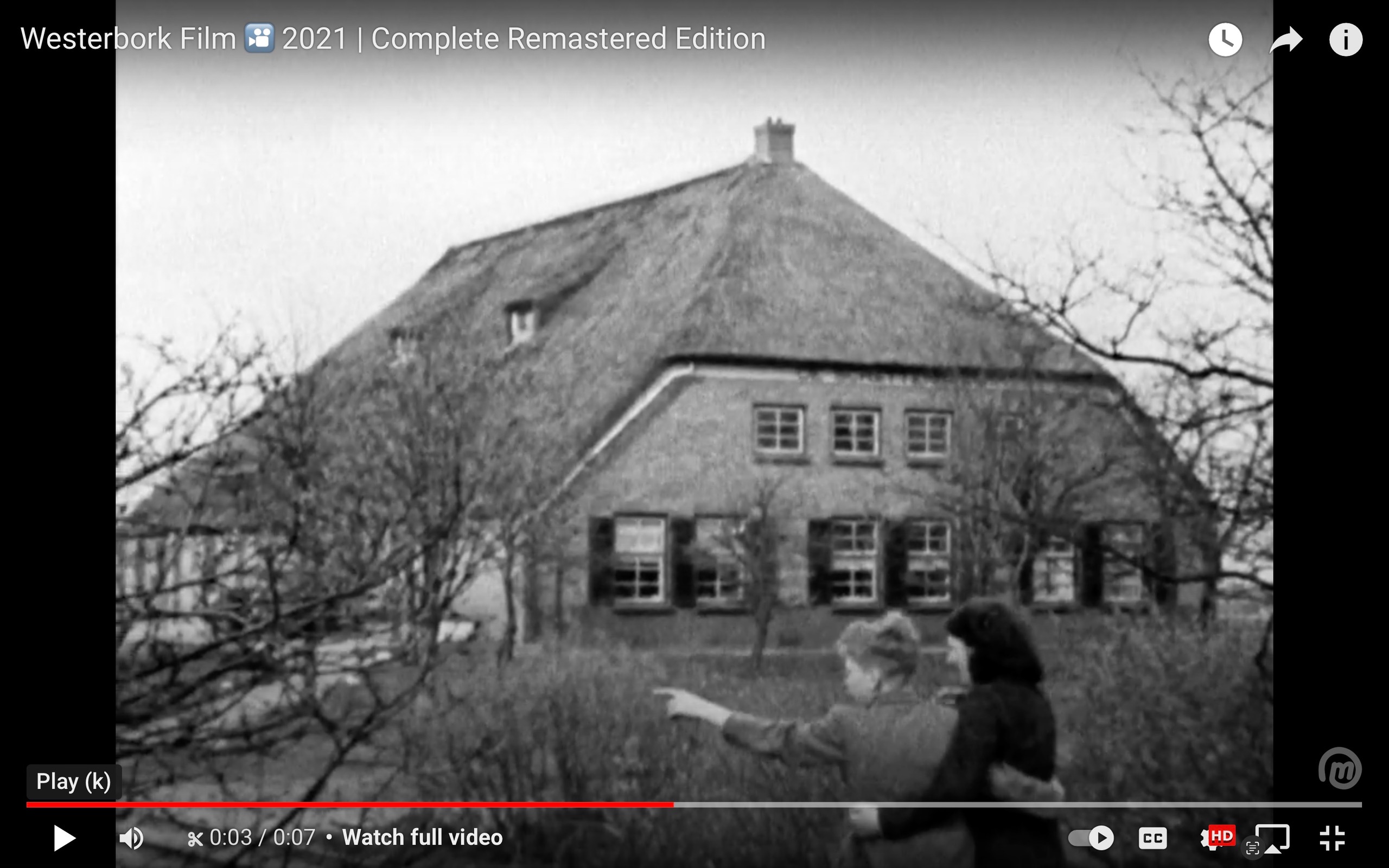
Stefan & Ursula Breslauer in Westerborkfilm | 20240305 – Clip from : Westerbork Film 🎦 2021 | 20220302 | Settela•Com | URL https://youtube.com/clip/UgkxdcMjzZQcH8jOtp1j2xFwrPxyAoHMcdFr

Filmmaker Rudolf Breslauer also filmed two of his children in the Westerborkfilm…

Stefan (left) & Ursula Breslauer, children of Rudolf Breslauer, the filmmaker of the Westerbork film at the farm of Camp Westerbork in 1944 – identified by the dutch photographer Sake Elzinga, who received Breslauer’s family photo albums last year when the family of Ursula – the only survivor – visited an expo on Breslauer in the Westerbork museum in the Netherlands.

Camp commander (SS-Obersturmführer) Albert Gemmeker ordered the Westerbork film , made by the German Jewish prisoner, photographer, Rudolf Breslauer in the spring of 1944.

Today 80 years ago – March 5, 1944 – the camp is an ‘Arbeitslager’ – a work camp – when Rudolf Breslauer starts filming the daily life of the Westerbork prisoners — inside : in the barracks, for example a religious service, cabaret, workshops, factories, aircraft and battery recycling, medical care, and outside the barracks : construction of a greenhouse, a football match, women working out, chopping wood, incoming transports, and eventually also the departure of a deportation train. After Breslauer films the deportation of Jews, Roma and Sinti to Bergen-Belsen and Auschwitz on May 19, 1944 the filming stops.
The haunting image of the 9-year-old dutch Sinti-girl Settela, standing in the closing doors of the goods train, and the unique footage of that deportation train that leaves the Westerbork camp, became iconic after the war.

Deportation Breslauer family

Werner Rudolf Breslauer , his wife Bella Weihsmann, sons Stefan and Max Michael (Mischa), and daughter Ursula were deported autumn 1944 from Westerbork to Theresienstadt and Auschwitz. Only Ursula survived.

Stefan & Ursula Breslauer in Westerborkfilm | 20240305 | Settela•Com | Frame 127475 from Westerbork Film 🎦 2021 | 20220302 | Settela•Com | ISSN 2949 9313 | Footage filmed by Rudolf Breslauer in 1944, courtesy of NIOD | Sound and Vision

Notes

Clip from : Westerbork Film 🎦 2021 | Complete Remastered Edition | YouTube https://youtu.be/ZiLNDziwEtc

Westerbork Film 🎦 2021 | 20220302 | Settela•Com | URL https://settela.com/2022/03/02/westerbork-film-🎦-2021-complete-remastered-edition-20220302/

Kinderen van filmmaker Breslauer herkend in historische Westerborkfilm. Dutch national news broadcaster NOS Nieuws, in cooperation with RTV Drenthe, 13:18 Monday 4 March 2024 | URL https://nos.nl/artikel/2511414-kinderen-van-filmmaker-breslauer-herkend-in-historische-westerborkfilm

Scene with Stefan & Ursula Breslauer, starting at 56:13 in the 1986 RVD edition of the Westerborkfilm:
Stefan & Ursula Breslauer in Westerbork Film RVD | 20240305 | Settela•Com | URL https://youtube.com/clip/UgkxfNzA72JeGgVoOFp_VTI4EQQr3yTwXu6_

Settela Film | 20220630 | Michel van der Burg | Settela•Com

Deportation Westerbork Film | 20210719 | Michel van der Burg | Settela•Com

English introduction to Westerborkfilm :
Westerborkfilm Introduction | 20220507 | Michel van der Burg | Settela•Com | URL https://settela.com/2022/05/07/westerborkfilm-introduction-20220507/

Citation info : Stefan & Ursula Breslauer in Westerborkfilm | 20240305 | Settela•Com | ISSN 2949-9313 | URL https://settela.com/2024/03/05

Encounter TRANSPORT XX … | 20240228

TRANSPORT XX — installation Brussels
February 28th, 2009, Brussels. Day two, of my encounter with the TRANSPORT XX installation outside in the Royal park in Brussels, that presented 1200 photographic portraits of Jews deported from Malines (Belgium) to Auschwitz in 1943. One of the stills and establising video shots made that Saturday morning after finishing long take video recordings of the installation, during a walk from our hotel in the Leopold (European) Quarter via the Royal park direction the historic centre of Brussels. That weekend break in Brussels, today 15 years ago, turned out to be a turning point in my life. Two months later – April 19, 2009 – the film TRANSPORT XX — installation Brussels was published.

Notes

1. Original film : TRANSPORT XX — installation Brussels | 20090419 | Michel van der Burg | michelvanderburg•com | ISAN 0000-0006-C208-0000-D-0000-0000-Z | https://michelvanderburg.com/2009/04/19/transport-xx-installation-brussels-imichelcom-20090419/

2. Original post : TRANSPORT XX — installation Brussels | 20090419 | Michel van der Burg | imichel.com | https://www.imichel.com/2009/04/transport-xx-installation-brussels.html

3. The one minute film (2010) : Transport XX – face to face | ISAN 0000-0006-C208-0000-D-0000-0002-V | https://miracles.media

4. All editions : TRANSPORT XX – installation Brussels | 20090419 | Michel van der Burg | michelvanderburg•com | https://michelvanderburg.com/2009/04/19/transport-xx-installation-brussels/

6. Vlog – The One Minutes – De Waar Geschiedenis Begint Show | 20101130 | michelvanderburg•com | URL https://michelvanderburg.com/2010/11/30/vlog-the-one-minutes-de-waar-geschiedenis-begint-show-imichelcom-20101130/

7. Kazerne Dossin Frontpage 2012 | 20171130 | michelvanderburg•com | URL https://michelvanderburg.com/2017/11/30/kazerne-dossin-frontpage-2012/

8. First Encounter TRANSPORT XX … | 20240227 | Michel van der Burg | Miracles•Media | URL https://michelvanderburg.com/2024/02/27 | TakeNode cf0dd64d-4512-4846-8bce-6b2d8cca24ef

9. Camera used for both photo and video (720p HD video) of the TRANSPORT XX installation in Brussels is the Sony DSC-T500 which has a CCD sensor – with global shutter – thus not affected by rolling shutter distortion while panning the installation.

Citation info : Encounter TRANSPORT XX … | 20240228 | Michel van der Burg | Miracles•Media | URL https://michelvanderburg.com/2024/02/28 | TakeNode a8317838-7470-4538-b788-40e6cc07b55a

Update

20240423 – Text update.

First Encounter TRANSPORT XX … | 20240227

TRANSPORT XX — Installation Brussels

February 28th, 2009, Brussels — my first encounter with the TRANSPORT XX installation in Brussels, that presented 1200 photographic portraits of Jews deported from Malines (Belgium) to Auschwitz in 1943. Turning point in my life. Two months later – April 19, 2009 – the film was published.

Notes

1. Original film : TRANSPORT XX — installation Brussels | 20090419 | Michel van der Burg | michelvanderburg•com | ISAN 0000-0006-C208-0000-D-0000-0000-Z | https://michelvanderburg.com/2009/04/19/transport-xx-installation-brussels-imichelcom-20090419/

2. Original post : TRANSPORT XX — installation Brussels | 20090419 | Michel van der Burg | imichel.com | https://www.imichel.com/2009/04/transport-xx-installation-brussels.html

3. The one minute film (2010) : Transport XX – face to face | ISAN 0000-0006-C208-0000-D-0000-0002-V | https://miracles.media

4. All editions : TRANSPORT XX – installation Brussels | 20090419 | Michel van der Burg | michelvanderburg•com | https://michelvanderburg.com/2009/04/19/transport-xx-installation-brussels/

Citation info : First Encounter TRANSPORT XX … | 20240227 | Michel van der Burg | Miracles•Media | URL https://michelvanderburg.com/2024/02/27 | TakeNode cf0dd64d-4512-4846-8bce-6b2d8cca24ef

Deportation | 20240226

Camp commander (SS-Obersturmführer) Albert Gemmeker oversees the deportation of Jews, Sinti, and Roma from the Westerbork transit camp May 19, 1944 .

Gemmeker is the producer of the Westerborkfilm — he ordered the film. Cameraman is the German Jewish prisoner Rudolf Breslauer.

Source : Frame 2608 from Westerborkfilm Introduction | 20220507 | Settela•Com | ISSN 2949-9313 | URL https://settela.com/2022/05/07/westerborkfilm-introduction-20220507/

Citation info : Deportation | 20240226 | Settela•Com | ISSN 2949-9313 | URL https://settela.com/2024/02/26 | TakeNode 3b14bb27-07aa-4b34-9fab-0b5da0bb8580

PUSH Opera Epilogue 2020 | Westerborkfilm Images #2 | 20230728

PUSH Opera Epilogue 2020 | Westerborkfilm Images #2 | 20230728 | URL https://youtube.com/clip/UgkxsM6Rj_HB0xEh4TksbjhIm4EzY81dc4H0

Images from the Westerborkfilm have been used countless times in documentaries and films about the Second World War. Here images screening in the virtual opera PUSH – based on the story of Simon Gronowski – an 11 year old Jewish boy who was pushed from the train – Transport XX – by his mother on the way to Auschwitz — Video clip https://youtube.com/clip/UgkxsM6Rj_HB0xEh4TksbjhIm4EzY81dc4H0

A virtual performance, during the April 2020 Corona virus lockdown, of the epilogue of the community opera PUSH , entitled : Ma Vie N’est Que Miracles | My life is only miracles – hosted by composer Howard Moody. It premiered on the night of the 19th April 2020, exactly 77 years after three Brussels resistance heroes stopped the Nazi train Transport XX, transporting 1600 Jewish deportees to Auschwitz, and more than 200 prisoners escaped from the train before the German border. Info : michelvanderburg.com/2020/04/19 .

PUSH Opera Epilogue 2020 | Westerborkfilm Images #2 | 20230728 | Settela•Com | ISSN 2949-9313 | URL https://settela.com/2023/07/28 | TakeNode d78e87e2-589f-437e-b11b-ab666aa7f1af

#Westerborkfilm #footage #PUSH #Miracle #virtual #child #community #opera #online #Simon Gronowski #Transport #XX #music #premiere #Howard #Moody #Sarah #Ehrlich #Shogo #Hino #liberation #Brussels #Corona #covid #virus #home #lockdown #performance #Adrian #Zolotuhin #Belgium #Mechelen #Kazerne #Dossin #Westerbork #Holland #Netherlands #transit #camp #deportation #train #car #film #screening #holocaust #shoah #genocide #discrimination #diversity #rights #art #war #Jew #Sinti #Roma #nazi #survival #collaboration #SettelaCom #ISSN29499313 #TakeNode #1Memo #MiraclesMedia #michelvanderburg