Westerbork Film Plan
Spring 1944 a film is being made in the Westerbork camp, ordered and produced by camp commander SS-Obersturmführer Albert Gemmeker. A Film Plan propasal – 1.5 page – is written by his personal assistant the German prisoner Dienstleiter Heinz Todtmann – a journalist before WW2. Cameraman is the German Jewish prisoner Rudolf Breslauer – the camp photographer – who may have contributed to this filmplan too. In addition to the film plan , more detailed scripts were made with camera instructions and edit instructions. The film was never really finished or edited.
Westerbork Films Dossier
In 2017 the complete film dossier enters the UNESCO Memory of the World Register — including the film footage, the scripts, the drawn title cards, and the camp correspondence on the film (REF 1) . The final part of the UNESCO registry (Le film de Westerbork – édité le 8 mai 2017 – ID code 2016-118 ) lists all the documents on the Westerbork Film at the NIOD Institute for War, Holocaust and Genocide Studies.
That NIOD archive file — called (translated) : Directing, texts and correspondence of the film “Westerbork” consists of a file containing the original screenplay or script for the film, title cards, notes, correspondence and administration . That entire file has been scanned (total of 60 black and white scans) and is available online.
Westerbork Film
May 7, 2022 the complete remastered 2021 edition of the Westerbork Film – a compilation of digitally restored footage – was posted with annotations as optional closed captions – CC (REF 2) .
Westerborkfilm Introduction
May 7, 2022 also a short film ‘Westerborkfilm Introduction’ was posted (REF 3) that addresses briefly the history, context, and contents of the film dossier, camp and film crew, postwar route of the film footage, including a glimpse of the film plan, title cards and correspondence.
Title Cards
The title cards were posted in detail May 2021 (REF 4).
Film Scripts
Likewise now the film scripts (REF 5) are detailed in this short silent film Westerbork Film Scripts | 20220508 .
9 – Settela, het meisje heeft haar naam terug (1995-2007) by Aad Wagenaar ISBN 9789089751898 / English translation by Janna Eliot ‘Settela’ (2005-2016) ISBN 978-0-9933898-2-5 .
Westerborkfilm Introduction | 20220507 | Michel van der Burg | Settela•Com | Introduction by Michel van der Burg on the Westerborkfilm first showing May 7, 2022 in cinema METRO Kinokulturhaus , Vienna , Austria at the DOCUMENTS OF DESTRUCTION | DOKUMENTE DER VERNICHTUNG Symposium 6-7 May, 2022 curated by Florian Widegger. Presented by Filmarchiv Austria in cooperation with the Vienna Jewish Film Festival and the Mauthausen Memorial.
This introduction is now screening via YouTube , and embedded above.
Westerborkfilm with introduction – DOKUMENTE DER VERNICHTUNG Symposium 6-7 May, 2022 curated by Florian Widegger. Presented by Filmarchiv Austria in cooperation with the Vienna Jewish Film Festival and the Mauthausen Memorial URL https://www.filmarchiv.at/en/program/special/dokumente-der-vernichtung/
CREDITS & REFERENCES
Special thanks to Valentine Kuypers , curator at Sound and Vision, image researcher Gerard Nijssen, and the Westerbork Memorial Center researchers Bas Kortholt , Koert Broersma and Gerard Rossing. Aad Wagenaar, research journalist and author of book Settela.
Work on the 2021 Westerbork film edition has been a joint effort of four dutch organizations : the Dutch media archive Sound & Vision, Camp Westerbork Memorial Centre , the NIOD Institute for War, Holocaust and Genocide Studies, and the Jewish Cultural Quarter in Amsterdam.
The Westerbork film, May 7, 2022 at the symposium DOKUMENTE DER VERNICHTUNG of the Jüdischen Filmfestival Wien , the Mauthausen Memorial , and Filmarchiv Austria.
Settela, het meisje heeft haar naam terug (1995-2007) by Aad Wagenaar ISBN 9789089751898 / English translation by Janna Eliot ‘Settela’ (2005-2016) ISBN 978-0-9933898-2-5 .
Documentary film Settela, gezicht van het verleden by Cherry Duyns (VPRO, 1994).
De Westerborkfilm 📽️🎞️ | Nederlands Instituut voor Beeld & Geluid | YouTube Apr 8, 2021 URL https://youtu.be/8Y-A4BkWY18
Gerestaureerde filmbeelden Westerbork (1944) (May 18, 2021) Nederlands Instituut voor Beeld en Geluid | Youtube (accessed 2021 Jul 19) URL: https://youtu.be/-zCmr6PSNcI
Kamp Westerbork gefilmd (May 2021) Koert Broersma, Gerard Rossing (editor Gorcum B.V., Koninklijke van) ISBN 9789023257622.
‘Kamp Westerbork gefilmd’ by Koert Broersma and Gerard Rossing (editors Dirk Mulder and Ben Prinsen) ISBN 9023232658
Dawn Skorczewski & Bettine Siertsema (2018): ‘The kind of spirit that people still kept’: VHA testimonies of Amsterdam’s Diamond Jews, Holocaust Studies URL: https://doi.org/10.1080/17504902.2018.1516361
Diamantkinderen: Amsterdamse Diamantjoden en de Holocaust . Translated title of the contribution: Diamond Children: Amsterdam’s Diamond Jews and the Holocaust. Siertsema, Bettine (2020) Uitgeverij Verbum ISBN 9789493028340
Fabian Schmidt (2020): The Westerbork Film Revisited: Provenance, the Re-Use of Archive Material and Holocaust Remembrances, Historical Journal of Film, Radio and Television, URL : https://doi.org/10.1080/01439685.2020.1730033
Westerbork Film Scripts | 20220508 | Michel van der Burg | Settela•Com
Westerbork Film Correspondence | 20220509 | Michel van der Burg | Settela•Com
ANONYM | Girl with the headscarf … | 20210416 | Michel van der Burg | Settela•Com
Westerbork Film in ‘Proces Rauter’ 1948 | 20190520 | Michel van der Burg | Settela•Com
Westerbork Film 🎦 2021 | 20220302 | Michel van der Burg | Settela•Com | Display edition annotated online in CC.
Westerborkfilm Introduction | 20220507 | Michel van der Burg | Settela•Com | Introduction by Michel van der Burg on the Westerborkfilm screening in METRO Kinokulturhaus , Vienna , Austria at the DOCUMENTS OF DESTRUCTION | DOKUMENTE DER VERNICHTUNG Symposium 6-7 May, 2022 curated by Florian Widegger. Presented by Filmarchiv Austria in cooperation with the Vienna Jewish Film Festival and the Mauthausen Memorial.
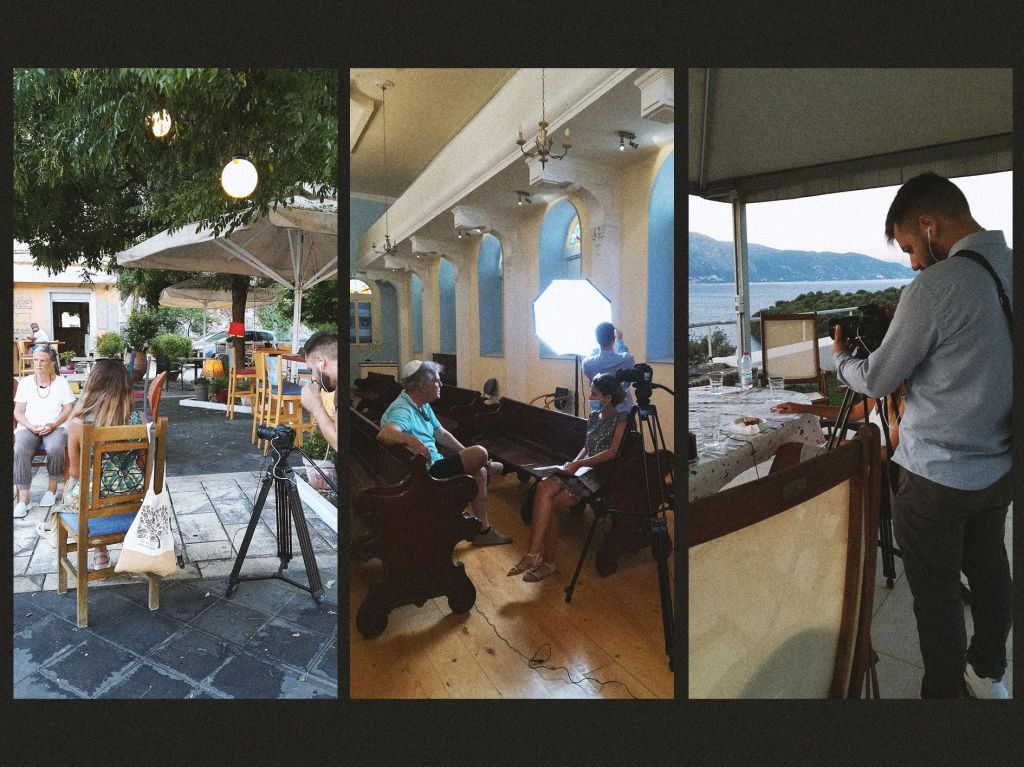
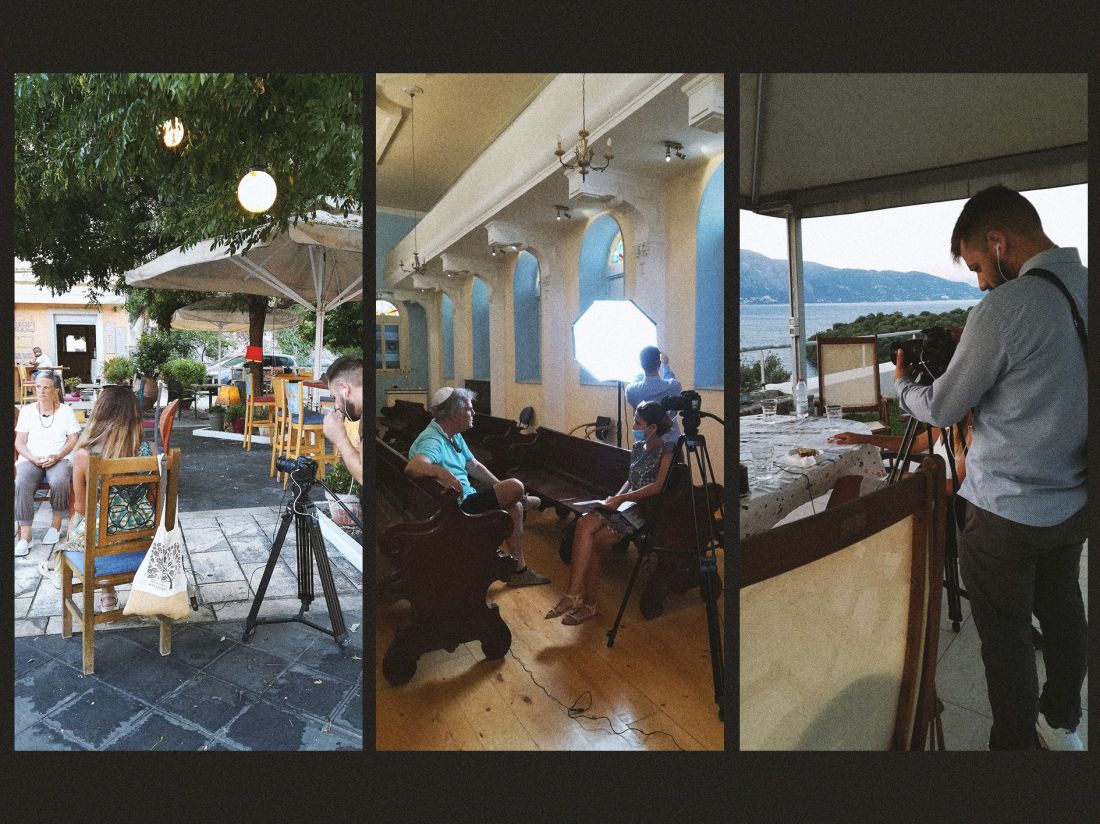
Production Still | The Jews of Corfu (2022) by Mirjan Gjergjevica & Maria Boua. Currently screening at the Thessaloniki Documentary Festival – more in post The Jews Of Corfu | 20220310 – URL : https://michelvanderburg.com/2022/03/10/the-jews-of-corfu/
Review The Jews of Corfu
The Jews of Corfu – a population group that was an important part of the island, contributed to the formation of its history. But the tragic events that befell them were added to the black page of human history.
The film The Jews of Corfu (2022) is a powerful documentary by Mirjan Gjergjevica (direction, cinematography, editing, production) & Maria Boua (script, music, sound, production) with narration by Yannis Andriotis and stories told by Zaharias Matathias • Linos Sousis • Nina Vital.
Powerful — both visually and the sound — filmed in an innovative way, combining ambient sound and stories told outdoors with the Mediterranean background, in public spaces, the streets, and Corfu synagogue – with an excellent film score – that is especially impressive how it manages to accompany the viewer in scenes of holocaust atrocities.
The history of the Corfiot Jews – a mixture of Pugliese (from south Italy) and Romaniote (from Greece) is told in vivid detail from the Middle Ages to today.
I watched this fast paced film twice, last premiere weekend, to fully grasp the whole picture ~ Michel van der Burg – Monday , March 14, 2022.
Review The Jews of Corfu | 20220314 | Michel van der Burg | Miracles•Media
Jews of Corfu: A population group that was an important part of the island, participated in the formation of its history, and contributed to the development of trade and economy. But the tragic events that befell them were added to the black pages of human history.
The Jews of Corfu a film by Mirjan Gjergjevica (direction, cinematography, editing, production) & Maria Boua (script, music, sound, production). Narration by Yannis Andriotis, with Zaharias Matathias • Linos Sousis • Nina Vital.
‘Helping this production was absolutely worth it …’ – Michel van der Burg ;)
The Jews Of Corfu | 20220310 | 1-memo•com
News
Monday , March 14, 2022 – Review ‘The Jews of Corfu ‘
Powerful documentary , both visually and the sound – filmed in an innovative way, combining ambient sound and stories told outdoors with the Mediterranean background – in public spaces, the streets and Corfu synagogue – with an excellent film score – that is especially impressive how it manages to accompany the viewer in scenes of holocaust atrocities. The history of the Corfiot Jews – a mixture of Pugliese (from south Italy) and Romaniote (from Greece) is told in vivid detail from the Middle Ages to today. I watched this fast paced film twice, last premiere weekend, to fully grasp the whole picture.
Westerbork Film 🎦 2021 | The complete remastered edition of the Westerbork Film , here annotated online in CC – by Michel van der Burg as an ongoing integrating resource.
The original display edition of the restored Westerbork film was edited only for black bar removal conform 4:3 format and insertion of a title card intro and outro. Annotations are added as CC – closed captions.
Source : digital display edition of the restored Westerbork film compilation made available in Public Domain by Sound and Vision from May 18, 2021. Courtesy of Collection NIOD held at the Netherlands Institute for Sound and Vision. Source File : Westerbork (gerestaureerd) | Display edition. Retrieved (20210518) PID: URN:NBN:NL:IN:20-ZCRLTUSICOSDILNR .
Credit line :
Westerbork Film 🎦 2021 | 20220302 | Michel van der Burg | Settela•Com – CC BY 4.0
Description & Introduction film
The Westerbork Film – a silent film – is unique…the only authentic documentary footage filmed in a Nazi camp – a waiting room for death in the Netherlands for more than 100,000 Jews, and Roma, Sinti, and resistance workers. A documentary filmed spring 1944, in the Westerbork camp, by the German-Jewish camp prisoner Rudolf Werner Breslauer – the camp photographer, and commissioned by camp commander, SS-Obersturmbannführer, Albert Konrad Gemmeker.
The Westerbork camp was set up in 1939 before the war in Holland, by the Dutch government, as a central refugees camp for Jewish refugees from Nazi-Germany.
July 1942 , when the Nazi’s decided to start ‘Entjüdung’ of the Netherlands, they took over the camp for use as transit camp for deportation of mainly Jews, and Roma, Sinti, and resistance people to eastern Europe.
March 2, 1944 , SS leader Rauter in the Netherlands reports to Germany’s SS Reichsführer Himmler : the Netherlands are ‘Judenfrei’. March 5, 1944 the camp is ‘Arbeitslager’ – a work camp – when
Rudolf Breslauer starts filming the daily life of the Westerbork prisoners. After Breslauer films the deportation of Jews, Roma and Sinti to Bergen-Belsen and Auschwitz on May 19, 1944 the filming stops. The film is also not edited. In 1986 the dutch RVD Information Center makes a first montage in 4 acts of the footage into what is known now as the Westerborkfilm. In 2017 the film dossier – film and production documents – enter the UNESCO Memory of the World Register. Spring 2019 the Westerbork Film – full version (RVD) was published online and annotated – https://settela.com/2019/06/05/westerbork-film-full-version-rvd/ .
Spring 2019 the dutch Sound & Vision , EYE Filmmuseum and NIOD (former RIOD) started a major restauration project and search for all footage of the Westerbork film in all archives.
Two reels with original negative film were discovered by image researcher Gerard Nijssen.
All restored unique shots using both the camera original film and film copies (prints – when no original is known) were used for the new restored Westerbork film compilation made available as ‘display edition’ – with no title actually – by Sound and Vision | NIOD on May 18, 2021.
This newly restored 2021 version of the Westerbork film , 145 min long – was prepared for presentation here in 4:3 format (black bars removed) with a 6 seconds title card superimposed both at the start and the end of the film (superimposed on the originally 30 sec intro text and 17 sec outro text sections by Sound & Vision), in order not to change the length of the film – to allow exact reference to the original file’s timeline.
Westerbork Film 🎦 2021 | 20220302 was first uploaded March 2, 2022, and is now after annotation of the online film made public May 7, 2022 together with a short introductory film : Westerborkfilm Introduction | 20220507 | Michel van der Burg | Settela•Com | An introduction film by Michel van der Burg on the Westerbork film with a first showing May 7, 2022 in METRO Kinokulturhaus , Vienna , Austria at the DOCUMENTS OF DESTRUCTION | DOKUMENTE DER VERNICHTUNG Symposium 6-7 May, 2022 curated by Florian Widegger. Presented by Filmarchiv Austria in cooperation with the Vienna Jewish Film Festival and the Mauthausen Memorial.
Annotations
On YouTube called Chapters – there limited number due to limit number of characters in description
NOTE : for this shot right after the Degen toddlers, Breslauer had to move all the way back to last cars of the transport to Auschwitz – May 19, 1944 – E198 Roll 2/4
00:17:03 Outbound transport to Bergen-Belsen and Auschwitz – May 19, 1944 – Original Reel E198 Roll 2/4
00:17:49 Gemmeker group passing camera in the middle
00:17:55 Outbound transport to Bergen-Belsen and Auschwitz – May 19, 1944 – Original Reel E198 Roll 2/4
Original Reel E198 Roll 3/4
00:18:13 Outbound transport to Bergen-Belsen and Auschwitz – May 19, 1944 – Original Reel E198 Roll 3/4
00:18:51 On the right : SS-Obersturmführer Albert Gemmeker , Commander of Westerbork transit camp
00:18:56 Outbound transport to Bergen-Belsen and Auschwitz – May 19, 1944 – Original Reel E198 Roll 3/4
Special thanks to Valentine Kuypers , curator at Sound and Vision, image researcher Gerard Nijssen, and the Westerbork Memorial Center researchers Bas Kortholt , Koert Broersma and Gerard Rossing. Aad Wagenaar, research journalist and author of book Settela.
Work on the 2021 Westerbork film edition has been a joint effort of four dutch organizations : the Dutch media archive Sound & Vision, Camp Westerbork Memorial Centre , the NIOD Institute for War, Holocaust and Genocide Studies, and the Jewish Cultural Quarter in Amsterdam.
The Westerbork film, May 7, 2022 at the symposium DOKUMENTE DER VERNICHTUNG of the Jüdischen Filmfestival Wien , the Mauthausen Memorial , and Filmarchiv Austria.
Settela, het meisje heeft haar naam terug (1995-2007) by Aad Wagenaar ISBN 9789089751898 / English translation by Janna Eliot ‘Settela’ (2005-2016) ISBN 978-0-9933898-2-5 .
Documentary film Settela, gezicht van het verleden by Cherry Duyns (VPRO, 1994).
De Westerborkfilm 📽️🎞️ | Nederlands Instituut voor Beeld & Geluid | YouTube Apr 8, 2021 URL https://youtu.be/8Y-A4BkWY18
Gerestaureerde filmbeelden Westerbork (1944) (May 18, 2021) Nederlands Instituut voor Beeld en Geluid | Youtube (accessed 2021 Jul 19) URL: https://youtu.be/-zCmr6PSNcI
Kamp Westerbork gefilmd (May 2021) Koert Broersma, Gerard Rossing (editor Gorcum B.V., Koninklijke van) ISBN 9789023257622.
‘Kamp Westerbork gefilmd’ by Koert Broersma and Gerard Rossing (editors Dirk Mulder and Ben Prinsen) ISBN 9023232658
Dawn Skorczewski & Bettine Siertsema (2018): ‘The kind of spirit that people still kept’: VHA testimonies of Amsterdam’s Diamond Jews, Holocaust Studies URL: https://doi.org/10.1080/17504902.2018.1516361
Diamantkinderen: Amsterdamse Diamantjoden en de Holocaust . Translated title of the contribution: Diamond Children: Amsterdam’s Diamond Jews and the Holocaust. Siertsema, Bettine (2020) Uitgeverij Verbum ISBN 9789493028340
Fabian Schmidt (2020): The Westerbork Film Revisited: Provenance, the Re-Use of Archive Material and Holocaust Remembrances, Historical Journal of Film, Radio and Television, URL : https://doi.org/10.1080/01439685.2020.1730033
Westerbork Film Scripts | 20220508 | Michel van der Burg | Settela•Com
Westerbork Film Correspondence | 20220509 | Michel van der Burg | Settela•Com
ANONYM | Girl with the headscarf … | 20210416 | Michel van der Burg | Settela•Com
Westerbork Film in ‘Proces Rauter’ 1948 (20190520) Michel van der Burg | Settela•Com
Westerbork Film 🎦 2021 | 20220302 | Michel van der Burg | Settela•Com | Display edition film annotated online in CC
Westerborkfilm Introduction | 20220507 | Michel van der Burg | Settela•Com | Introduction by Michel van der Burg on the Westerborkfilm screening in METRO Kinokulturhaus , Vienna , Austria at the DOCUMENTS OF DESTRUCTION | DOKUMENTE DER VERNICHTUNG Symposium 6-7 May, 2022 curated by Florian Widegger. Presented by Filmarchiv Austria in cooperation with the Vienna Jewish Film Festival and the Mauthausen Memorial.
20220511 Info on order of shots added in post Westerbork Film Shots Order | 20220511 . Based on that info , here the Annotations list now has sub-headings like ‘Original Reel E325’ etc.
20220604 – Format changes credit line , references
In 1935 the nomadic Sinti families Steinbach were photographed by Dutch photographer Jan de Jong in their caravan camp on the heath around the Heksenberg hill in the southern Netherlands. Jan de Jong was working for De Spaarnestad publishing house of the dutch weekly, catholic, illustrated magazine “Katholieke Illustratie” , that used his high quality pictures in this May 1936 spread (REF 1), with a somewhat simple romanticized short story on their origin and culture – entitled ‘Zwervers van geboorte’ or ‘Born nomad’ (my translation).
Members of other Steinbach families, I recognized in this magazine spread in the caravan window image with caption ‘Buurpraatje’ (my tr. ‘Neighbor chat’), are Anna Steinbach in the window (born 24 March 1916 – killed 31 July 1944 in Auschwitz) talking with Maria Steinbach (born 6 Nov 1912 – killed 31 July 1944 in Auschwitz) .
The 15 year old Willy (Celestinus) Steinbach (born 13 Feb 1929 in Heerlen) was deported together with his 9-year old sister Settela ((Anna Maria) Steinbach (born 23 Dec 1934 in Buchten), their brothers, sisters (Willem, Elisabeth, Johanna, Philibert, Florentina, Willem, Anna), and mother Toetela (Emilia) Steinbach (born 23 March 1902 in Antwerp, Belgium), with other Steinbach and other nomad families – all together ca 245 Sinti and Roma and ca 450 Jews – on May 19th 1944 from the dutch Camp Westerbork to Auschwitz — and some, like Willy, later to other camps.
Toetela’s eldest child Moekela (Magdalena; born 14 Sep 1922) had gone to Belgium and had been deported earlier – 15 Jan 1944 – with her 6 months old baby Jeanette – Toetela’s granddaughter – on the Z-Transport from Mechelen to Auschwitz, were they were murdered on arrival.
Note : I found Jeanette on the Transport lists in the image bank of Kazerne Dossin, Mechelen – but not yet her mother Magdalena.
Settela’s father Moeselman (Heinrich) Steinbach (born Nov 11, 1901 in Gründorf in Germany) died alone of grief June 6, 1946 in Maastricht in the Netherlands – his wife and 10 children had not survived the camps.
Their deporatation was filmed for the Westerbork Film by Rudolf Breslauer (REF 2).
This post is based on the story of the Steinbach families as researched in detail and published in book (REF 3) and film (REF 4) by Rob Hendrikx and Marouska Steinbach.
Update May 20, 2021 – Minor corrections in text , plus more detailed family information added. Poster image film replaced with clearer portrait image of Willy.
Below – because of space and linking constraints on social media – the references, source and full credits on websites only – eg. of Settela•Com
CREDITS & REFERENCES
1 – Source – photography Jan de Jong – in ‘Zwervers van Geboorte’ | Katholieke Illustratie 7 mei 1936 No 32 (Haarlem, Spaarnestad) via Delpher archive URL https://bit.ly/3f1jv90
2 – Westerbork Film | Full version RVD 1986 | 20190605 | Michel van der Burg | Settela•Com (accessed 2021 May 19) URL: https://wp.me/p91enH-1x
3 – Story based on book : Settela en Willy en Het geheim van de Heksenberg (2e druk) by Rob Hendrikx and Marouska Steinbach (Heerlen : Historisch Goud – Rijckheyt, centrum voor regionale geschiedenis en Stichting Historische Kring “Het Land van Herle”, April 2017) ISBN 9789082241686. URL https://www.landvanherle.nl/product/settela-en-willy-en-het-geheim-van-de-heksenberg-2e-druk/
4 – Story based on Films : ‘Settela en Willy’ by Rob Hendrikx & Marouska Steinbach | lifepowervideo YouTube user | (accessed 2021 May 19) Deel 1 Historische Gebeurtenissen link https://youtu.be/1wI9_vt9RlY | Deel 4 Holocaust Slachtoffers https://youtu.be/wVta6g6Mo1o
Willy & Settela | Born Nomad | 20210519 | Michel van der Burg | Settela•Com
Updates
20220604 – Format changes credit line , references
Westerbork Film Football Edit | Edition 2021 | 20210517
SILENT FILM
The UNESCO – Memory of the World – ‘ Westerbork films’ dossier (REF 1) consists of both the actual film footage, as well as a dossier with the 1944 film plan, film script, title cards (intertitles), and a file with correspondence between the camp and the outside world on obtaining camera’s , film and film processing. That film footage was researched and presented before on Settela•com.
In a recent post (Westerbork Film Intertitles | 20210515; REF 2) the drawings for the title cards were shown in a short film I made, that also showed a few seconds of Breslauer’s archive film footage demonstrating that not all of his Westerbork Film is a compilation of rushes only -he also had done some experiments filming and animating title cards. Aside from that, the film was not edited, and title cards were not yet inserted.
Today, working on presenting that 1944 film plan and script, I noticed in that editing script (all written in the German language) the instruction “Untertitel: ( in einen rollenden Fussball einkopiert ) Appelplatz am Sonntag Nachmittag.” , in English : ‘Subtitle: copied into a rolling football – roll call area on Sunday afternoon’. That is the text on one of these title cards I worked with, and I had seen Breslauer’s filming and slow-motion experiments with a rolling football, on that same F1014 reel that was used for his animation tests (REF 3). This has been described also in the 1997 dutch Westerbork film dossier analysis by Broersma & Rossing (REF 4) – a book I studied 2 years ago – and details I re-discovered later today. Tomorrow these authors will present a new edition (dutch), available later this month.
Breslauer never got the chance to try copying that title card on the rolling ball – I did today : a little digital experiment of copying that title card Appellplatz am Sonntag Nachmittag on the rolling ball. Just 4 seconds, repeated 4 times in this little film : Westerbork Film Football Edit.
2- Westerbork Film Intertitles | 20210515 | Michel van der Burg | Settela•Com (accessed 2021 May 17) URL: https://wp.me/p91enH-3e
3 – Unknown Westerbork Film Reel…F1014 | 20190616 | Michel van der Burg | Settela•Com (accessed 2021 May 15) URL: https://wp.me/p91enH-2b
4 – ‘Kamp Westerbork gefilmd’ by Koert Broersma and Gerard Rossing (editors Dirk Mulder and Ben Prinsen; ISBN 9023232658). Note, a new edition will be available May 2021 (editor Gorcum B.V., Koninklijke van; ISBN 9789023257622 ) – not yet published.
Notes : Both Appelplatz and Appellplatz are used in German and in script and title card
Credit
Thanks to ‘Kamp Westerbork gefilmd’ by Koert Broersma and Gerard Rossing (editors Dirk Mulder and Ben Prinsen; ISBN 9023232658). Note, a new edition will be available May 2021 (editor Gorcum B.V., Koninklijke van; ISBN 9789023257622 )
Film footage source : Filmed by Rudolf Breslauer, retrieved from : Unknown Westerbork Film Reel…F1014 | 20190616 | Michel van der Burg | Settela•Com (accessed 2021 May 17) URL: https://wp.me/p91enH-2b
Westerbork Film Football Edit | Edition 2021 | 20210517 | Michel van der Burg | Settela•Com
Updates
20220604 – Format changes credit line , references