Westerbork Girls – From left to right: Catharina Frank, Hannelore Cahn, Beatrice Lissauer, Ulla Gross, Lotte Heider-Lehmann and Ruth Pagener. (Source : Westerbork Memorial)
The documentary ‘Westerbork Girl’ (2007), directed by Steffie van den Oord, tells the story of Hannelore Cahn (later Eisinger-Cahn), a Jewish woman imprisoned in Camp Westerbork for more than two years during World War II. She performed as a dancer in the camp revue, attracting the attention of many, including camp commander Gemmeker and Jewish camp policeman Hans Eisinger, member of the Jewish Order Service—also known as “the Jewish SS”.
Westerbork Girl (VPRO 2007)
Hannelore had earlier met actor and resistance fighter Rob de Vries, with whom she was close. Rob smuggled her out of Westerbork by disguising himself as a train stoker and taking her to Amsterdam, where she briefly went into hiding. Hans Eisinger manages to track her down and one week after her escape Hannelore voluntarily accompanies him back to the camp…possibly due to loneliness, Rob’s existing relationship, or pressure from the Order Service to prevent others being deported to Auschwitz. Shortly thereafter, Hannelore and Hans get married in Westerbork.
Hannelore survived the war and avoided punishment after her return. The film reconstructs her story through interviews, archival footage, and music, presenting it as one of survival, love, and the difficult choices faced under Nazi persecution.
Hannelore sings and is still intensely sung about by Louis de Wijze, who witnessed her escape and remembered the revue songs from Westerbork: Ich hab es bei Nacht den Sternen erzählt, Ich liebe Dich.
Powerful documentary—this story, with close-ups of this Westerbork Girl, that resonate with me. Beautiful surprise while researching the use of the Westerborkfilm. Review by Michel van der Burg , editor Settela.Com
Citation info : Westerbork Girl • 20250916 | Michel van der Burg | Settela•Com | ISSN 2949-9313 | URL https://settela.com/2025/09/16
From Buchenwald to Hollywood, The Robert Clary Story : The Documentary (Extended Version) • 20250419 • A film by Karen and Richard Bloom and Michel van der Burg
Today 80 years ago , April 19, 1945 – the Buchenwald band ‘Rhythmus’ – with Jiří Žák & Robert Clary – gave a jazz concert in the Nazi concentration camp Buchenwald for their comrades and US soldiers that liberated the camp .
We , today, present the extended version of our Robert Clary documentary, now featuring also Robert Clary’s desire that Jiří Žák be nominated as a Righteous Among the Nations at Yad Vashem…
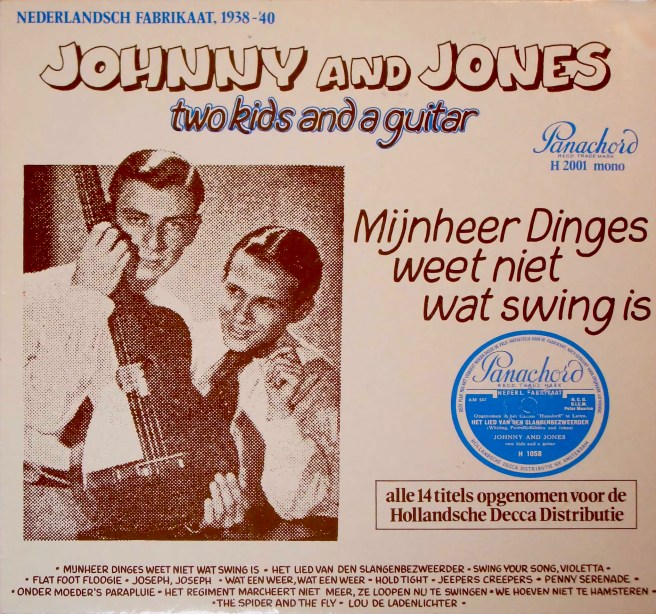
‘Swing’ by jazz duo Johnny and Jones in 1938 with their biggest hit , the dutch song “Mijnheer Dinges weet niet wat Swing is” …Mister Dingus doesn’t know what Swing and Hot (jazz) is…he’s a composer and teacher with a problem : his students skip class, he thinks jazz is banal.
“Two Kids and a Guitar”
The Amsterdam duo sang jazzy Dutch songs with a mock American accent and a parody of current events. They were the first teen idols in Holland and often on the dutch radio in the 1930s …before World War 2.
Nazi victims
Because of their Jewish origins, both ‘Johnny’ (Salomon Meijer Kannewasser, born 1916 and called Max) and his second cousin, partner, ‘Jones’ (Arnold Siméon van Wesel, born Amsterdam 1918 and called Nol) were arrested together with their wives in 1943, taken to the Westerbork transit camp, and deported Sep 4, 1944 first to the Theresienstadt camp, next the Auschwitz, Sachsenhausen, Ohrdruf and Bergen-Belsen camps. They died of exhaustion in the last days of the war in 1945.
Notes
Mijnheer Dinges weet niet wat Swing is | Two Kids and a Guitar | Johnny and Jones (1938). Lyrics from Joop de Leur. Recorded in Casino Hamdorf, Laren, Holland, November 1938. Label: Panachord (78 rpm). # H 1058 (Am 546-1). URL https://youtube.com/clip/UgkxMQtbdZ26fS4zcluq6fT7NlTbbpfuxpcx
Dinges, oh Dinges Dinges, oh Dinges Meneer Dinges die is dol op componeren Hij zit eeuwig met zijn neus in de muziek Jongelieden die bij hem piano leren Houden zich na de eerste les een tijdje ziek Want hun leraar heeft een kwaal Hij vindt jazzmuziek banaal Meneer Dinges weet niet wat swing is Hij weet niet wat saxofoon voor een ding is Omdat zijn radio kapot is Wat voor de buren een genot is Weet die Dinges niet wat swing of hot is Op een dag belde aan Dinges’ deur de wasman Die zei meneer er staat muziek op uw manchet Hou hem hier of stuur hem Theo Uden Marsman Maar meneer Dinges antwoordde toen zeer ontzet Man, ga uit mijn trapportaal In mijn huis geen jazz-schandaal Meneer Dinges weet niet wat swing is Hij weet niet wat saxofoon voor een ding is Omdat zijn radio kapot is Wat voor de buren een genot is Weet die Dinges niet wat swing of hot is Meneer Dinges maakte een grote ouverture Met een slotkoor, de finale stond in mol Toen het klaar was speelde Pietje van de buren De compositie dreunde in hot style door zijn bol Toen viel hij flauw op 1 crapaud (het kunnen er ook twee geweest zijn) En Johnny and Jones zongen door de radio Meneer Dinges weet niet wat swing is Hij weet niet wat saxofoon voor een ding is Omdat zijn radio kapot is Wat voor de buren een genot is Weet die Dinges niet wat swing of hot is Domme Dinges Oh, domme Dinges Weet jij nu nog niet wat jazz voor een ding is Als jij je goed wil amuseren Moet je de hi-de-ho studeren Meneer Dinges, probeer de swing ‘s Dinges, oh Dinges Dinges, oh Dinges.
Short impression of Viviane telling her story April 2023 in Boortmeerbeek, Belgium, at the 80th anniversary of the attack on Transport XX near Boortmeerbeek — the Twentieth Train heading for Auschwitz, the night of April 19-20, 1943. Viviane escaped from Transport XX in the womb of her pregnant mother Isabella Weinreb-Castegnier who jumped from this death train, with the help of Elias Gnazik, shortly after the 2nd attack on this train near Bierbeek, Belgium. Viviane was born 6 months later October 30, 1943 in Brussels … and celebrates her 80th birthday today, October 30, 2023, in LA, USA ;) Music : Al Kol Ele by Crescendo Boortmeerbeek Choir .
Full story available in free e-Book download :
Viviane Yarom-Castegnier & Michel van der Burg. Viviane’s Story: Escape from Transport XX… Born 6 Months Later [e-Book]. Boskoop, Miracles.Media, 2019. Distribution [ISBN (ePUB) : 978-94-93147-00-3 | ISBN (pdf) : 978-94-93147-01-0]. URL https://miracles.media/vivianesstory/
Citation : Viviane – 80 Years After Escape From Transport XX | 20231030 | Michel van der Burg | Miracles•Media | TakeNode 84175450-c147-4fd9-9039-8ca85995ff46
From the old forest They dragged the night, And the wind danced in your hair.
Your fingers die in the evening, Already in your sky the stars wander.
From “Far-away-from-love” they dragged the night.
My shadow dances in your dream.
Yves Darriet (Pseudonym Jean Roland)
Berceuse by Yves Darriet , from Anthologie des poèmes de Buchenwald , collected by André Verdet in Buchenwald (Ref 1), in a 2013 German translation by Wulf Kirsten and Annette Seemann : Wiegenlied (Ref 2).
Wiegenlied – Reading by Susanne Marie Wrage — an actor with a background in Documentary theater – in the June 2013 Passage – Lyrik aktuell broadcast by Radio SRF 2 Kultur (Ref 3, 4) .
Berceuse
De la vieille forêt Ils ont portè la nuit, Et le vent a dansé dans tes cheveux.
Tes doigts meurent au soir, Dans ton ciel déjà Les ètoiles cheminent.
De plus loin que l’amour Ils ont porté la nuit.
Mon ombre danse dans ton rêve.
Wiegenlied
Aus dem alten Wald Schleppten sie die Nacht her, Und der Wind tanzte in deinem Haar.
Deine Finger sterben am Abend, Schon in deinem Himmel Wandern die Sterne.
Von «Weit-weg-von-der-Liebe» Schleppten sie die Nacht her.
Mein Schatten tanzt in deinem Traum.
REFS
1. Anthologie des poèmes de Buchenwald by André Verdet (R. Laffont) 1946
2. Wulf Kirsten und Annette Seemann, Hrsg. und Übers., Der gefesselte Wald: Gedichte aus Buchenwald, Französisch-Deutsche Ausgabe, Mainzer Reihe N.F. 11 (Göttingen: Wallstein Verlag 2013).
Rhythmus was a jazz orchestra in the Buchenwald concentration camp in which a total of 23 musicians from 9 different countries played together from 1943 until the liberation. Czech prisoners around Jiří Žák took the initiative to found this orchestra in the summer of 1943.
Among the French prisoners that later joined, were Yves Darriet – the bandleader , who wrote most arrangements , and Robert Widerman – the band’s singer , who made a career as Robert Clary on Broadway after the war.
Two programs are known to have been performed in November 1944 and April 19, 1945, i.e. 8 days after the liberation of the camp (Ref 1) , including compositions by Duke Ellington, Lionel Hampton and pieces by Cole Porter, Fats Waller, Glenn Miller and Louis Armstrong. In The Mood was performed even though this music was banned in Nazi Germany.
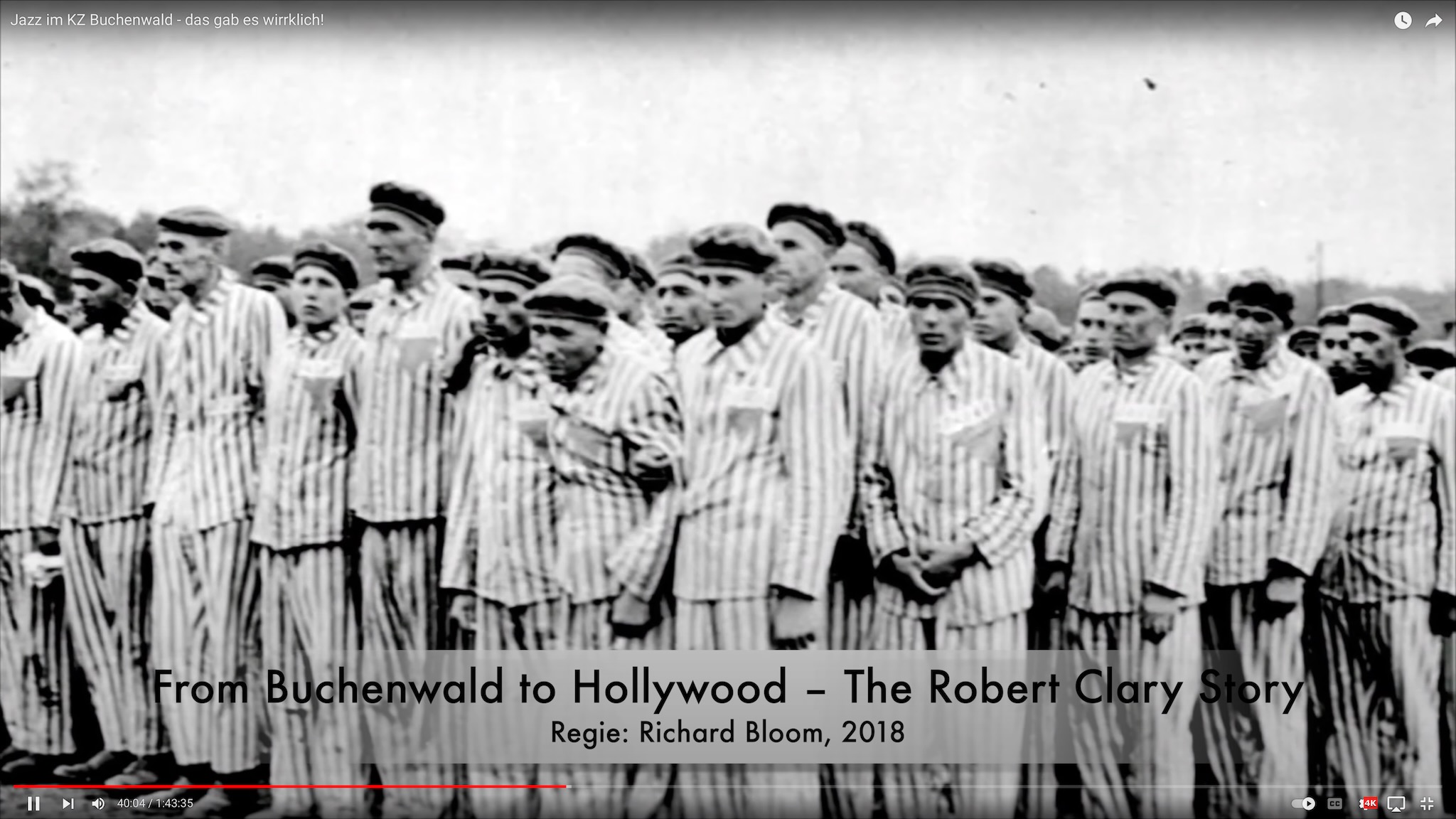
Ref. 3 – Jazz im KZ Buchenwald – das gab es wirrklich! | weimarer-rendezvous | Sep 25, 2022 https://youtu.be/HX4X7TJ19nQ
„Rhythmus“ – Jazz im Konzentrationslager Buchenwald
At the April 11, 2022 event ‘„Rhythmus“ – Jazz im Konzentrationslager Buchenwald’ — in the Notenbank in Weimar, Germany (Ref 2, 3) — the Big Band and a jazz ensemble of the Hochschule für Musik under the direction of Prof. Gero Schmidt-Oberländer performed 9 or 10 pieces from the programs. In addition biographies of the prisoners in the Buchenwald Jazz Orchestra were made visible using excerpts from their letters and reports.
The French singer Robert Widerman ( Robert Clary ) was shown in a clip (Ref 4) from the documentary film From Buchenwald to Hollywood, The Robert Clary Story (Ref 5). Robert Clary (March 1, 1926 – Nov 16, 2022) survived thanks to several prisoners, including Yves Darriet (pseudonym Jan Rolan, Jean Roland), Claude Francis-Boeuf, and Jiří Žák. (Ref 6)
5. From Buchenwald to Hollywood, The Robert Clary Story by Karen and Richard Bloom and Michel van der Burg | 2023 Edition | 20230202 | URL https://youtu.be/0tKc5T-Sw-E