Propaganda on the windows of the shop ‘Goedkoope Winkel’ (Cheap Shop) at Lange Elisabethstraat 2 in Utrecht, Holland, photographed by Wim Bruschwiler , ca 1943.
Nazi anti-semitic slogan ‘JOOD’ (Jew) on one window.
On the other window, the “V” symbol — standing for the English (Anti-Nazi) “Victory” slogan or the later Nazi edition “Victorie”.
On top of that window on the left a small pamphlet showing O…Z…O – W… – V…V – … … … … .
OZO originally was the anti-Nazi slogan ‘Oranje Zal Overwinnen’ (transl. : Holland Will Win). Here probably the Nazi version of OZO was posted (compare image in Notes 1) :
Orde Zal Overwinnen – Want – V=Victorie – Duitschland Wint Voor Europa! .
Translation :
Order Will Win – Because – V=Victory – Germany Wins For Europe!
Clandestine camera shot during World War 2 occupation of Holland from amateur film ‘Bezet Gebied’ (transl. ‘Occupied Territory’ by Ben Postema (Filmpost) of the shop ‘Goedkoope Winkel’ (Cheap Shop) at Lange Elisabethstraat 2 in Utrecht, Holland, the window of which is defaced with the anti-Semitic slogan ‘JOOD’ (Jew) , Aug 14, 1941.
Credits
Source: Bezet Gebied by Ben Postema (1941, Filmpost) courtesy of Netherlands Institute for Sound and Vision (Open Images).
Citation info : Slogan JOOD • Miracles•Media • 20250621 • License : Creative Commons CC BY SA • TakeNode 9e898c3a-04d9-4949-9b22-b6ab6f4f89db
Dutch cinema news reel from November 1945 reporting on Palestine soldiers of the Jewish Brigade, stationed in the Dutch port city of IJmuiden, and taking a course at the municipal fishing school there, where they learned to navigate and fish, practicing at the Dutch IJsselmeer lake, in order to settle in Palestine as fishermen after completing their service.
Notes
After the German surrender in 1945, soldiers of the Jewish Brigade, the “Jewish Fighting Unit”, a unit of around 5,000 Jewish volunteers from Mandatory Palestine serving in the British Army, were stationed in northwestern Europe, including the Netherlands.
Members of the Jewish Brigade in the Dutch port town IJmuiden (port to Amsterdam) and its surroundings were involved in: guarding German POWs , displaced persons support, and facilitating Jewish refugees’ clandestine departure to Palestine. Seafaring skills were directly relevant to both commercial livelihoods and the clandestine immigration (Aliyah Bet) efforts by sea. The British disbanded the brigade in July 1946.
Credits
Source: Dutch cinema news Polygoon-Profilti (Producer | Nov 1945) courtesy of Netherlands Institute for Sound and Vision (Open Images).
Citation info : Jewish Brigade 1945 • Dutch Seamanship Training | 20250615 | Michel van der Burg | Miracles•Media | Settela•Com | ISSN 2949-9313 | TakeNode a24a6599-dd79-47e3-a106-51289a480995 | URL https://settela.com/2025/06/15/
From Buchenwald to Hollywood, The Robert Clary Story : The Documentary (Extended Version) • 20250419 • A film by Karen and Richard Bloom and Michel van der Burg
Today 80 years ago , April 19, 1945 – the Buchenwald band ‘Rhythmus’ – with Jiří Žák & Robert Clary – gave a jazz concert in the Nazi concentration camp Buchenwald for their comrades and US soldiers that liberated the camp .
We , today, present the extended version of our Robert Clary documentary, now featuring also Robert Clary’s desire that Jiří Žák be nominated as a Righteous Among the Nations at Yad Vashem…
Short impression (some clips) of my visit on Friday evening, April 11, 2025, to the Atelier Marcel Hastir in Brussels, at the start and closing of ‘Auschwitz, our story’ — documentary and lecture by Herman Teerhöfer, with the participation of Natalia and Julia Kotarba of the Karski Quartet. Herman Teerhöfer of the Smolinski Foundation interviewed 91 Auschwitz survivors over the past fourteen years. Through his documentary Auschwitz, Our Story, he explains how they managed to survive Auschwitz spiritually, oscillating between hope and fear.
Citation info : Auschwitz Survivors In Brussels • Michel van der Burg • Miracles•Media • @1MEMO 20250418 • TakeNode 9eeb9646-f769-41d6-9b97-ccf27bf5c7a5
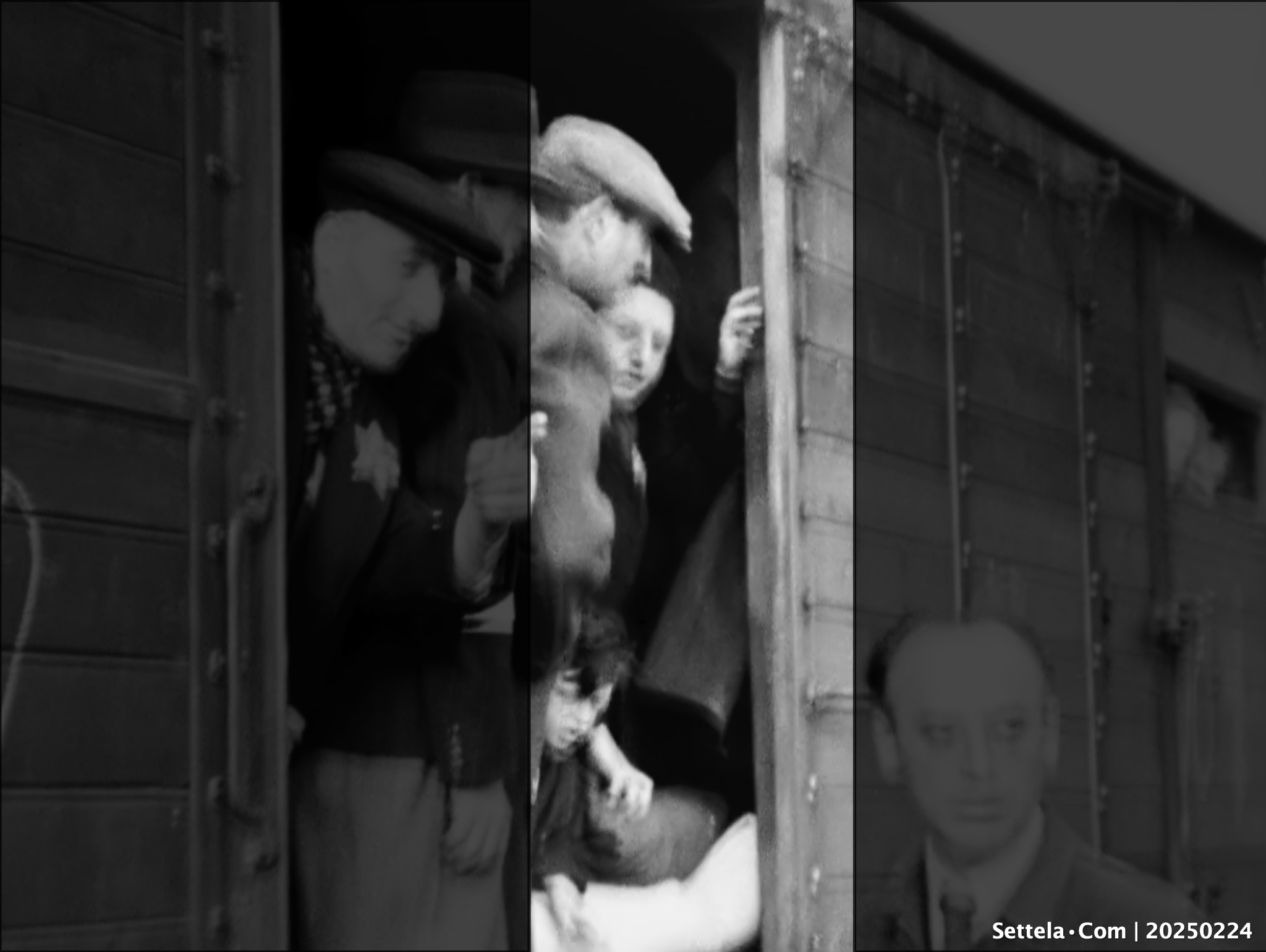
Almost certainly, three Jewish people have been recognized in the unique Westerbork film from 1944 (1). This time it concerns the 9-year-old boy Israël Wijnschenk, his father Max Wijnschenk, and his grandmother Betje Kokernoot-van Furth, who all lived in Utrecht (Holland).
Last week, the Dutch public broadcaster NOS (2) reported the news from the Utrecht (Dutch) news site Nieuws030 (3) that it is very likely that three people were recognized again in this film made by the Jewish prisoner and filmmaker Rudolf Breslauer showing the deportation of Jews, Roma and Sinti by train in Camp Westerbork on May 19, 1944.
Image researcher Koen Hulsbos — who previously identified an Amsterdam couple in this deportation train (4) — thought he recognized the young Israël Wijnschenk, a pupil at the time of the Joodse (Jewish) School Utrecht, and presented this to Victor Frederik, researcher of the Joodse School (5,6). The boy, the man, and the woman seem to belong together, and were recognized from family photos, also by family members.
It is certain that Max and his wife Chel (not in the images) returned to Utrecht after the war, their children Israël and his sister Kitty were murdered. Grandma Betje was also gassed in Auschwitz.
A portrait of Israël Wijnschenk is shown at the site of Joods Monument (7).
According to the transport list, there were two other children in that wagon, Joseph Beugeltas (11 years old) and Manfred Studzinsky (7 years old). Joseph Beugeltas appeared to have blond hair, and could not have been it (6). To be completely sure, the researchers are still looking for a photo of Manfred Studzinsky, for comparison…