Gouwe River 1657 – Waddinxveen – Gouda | 20231213 | 1-memo•com | @michelvanderburg
The Gouwe canalized river in Holland from Waddinxveen bridge to the “Stats herberch” (city inn) of Gouda – with the plots located eastward thereof — on a 1657 manuscript map (1 : ca. 3000). Animation of scan from SAMH museum, Gouda.
Gouwe River 1657 – Boskoop – Waddinxveen | 20231212 | 1-memo•com | @michelvanderburg
The Gouwe river in Holland from Boskoop bridge to Waddinxveen bridge – with the plots located eastward thereof — on a 1657 manuscript map (1 : ca. 3525). Animation of scan from SAMH museum, Gouda.
NL – Windmolens ca 1915 aan de Noordkade langs de Gouwe in Waddinxveen. Rechts (achteraan) de Oranjeboom trasmolen voor het malen van tufsteen, kort voor de sloop in 1916. Daar voor de ‘Bijenkorf’, een van de vele papiermolens uit de 18-19e eeuw in Waddinxveen, na 1890 in gebruik genomen als korenmolen, en afgebrand in 1923.
Bijzonder : vooral bij de Bijenkorf is zichtbaar hoe de molen gebouwd lijkt bovenop/in een groter gebouw. Bewerking van scan SAMH museum, Gouda.
EN – Windmills around 1915 on the Noordkade quay along the Gouwe river in Waddinxveen. On the right (at the back) is the Oranjeboom trass mill for grinding tuff stone, shortly before its demolition in 1916. At the front is the Bijenkorf (‘Beehive’) windmill, one of the many paper mills from the 18-19th century in Waddinxveen, used as a grist mill after 1890, and burned down in 1923.
Special: especially at the Bijenkorf it is visible how the mill seems to be built on top of/in a larger building. Editing from scan SAMH museum, Gouda.
Girls’ Gym Suit 1930 Cycling in Waddinxveen along Gouwe River | 20231210_1 | 1-memo•com
– (nederlands beneden / dutch below) –
EN – Confusing in this historical picture…those bare female legs on the bicycle! While looking for another picture of the De Schoone Haas windmill from the paper factory along the Gouwe in Waddinxveen, I found a photo in the archives of the SAMH museum in Gouda with the mention ‘Freight ship in front of the Alblas timber trade, windmill in the background, after 1905.’ — above (20231210_1) an edited version with sharpening, and brightness adjustments.
At first glance I miss the sawmill of Alblas, and next to it the Remonstrant church – of which I previously posted moving images (1). Watching that film again shows that both buildings are further back – the Remonstrant church probably because it was a clandestine church – and therefore kept out of sight here. The film also shows this second Alblas building, on the water and close to the sawmill. Not far from the De Schoone Haas paper-wind-mill there was another windmill – De Nijverheid, of which an overview photo was recently posted (2). That windmill – De Nijverheid – is recognized here in the background of the photo. The Schoone Haas windmill, which was closer to the Alblas company, appears to have disappeared at this time. The blades of the De Nijverheid windmill are missing here. The Dutch windmill database mentions (info from Jacob Stolp) that the sails of De Nijverheid were removed in 1929, and the mill was demolished in 1932 (3). So this photo was taken around 1930.
At image analysis for dating, those cyclists with bare legs are initially confusing in such a historical picture. Closer inspection reveals that posing is taking place: the cyclist on the right in the picture is perhaps a boy, and is still standing next to the bicycle, which suggests that the others have just started cycling, with the young woman (girl) on the left not yet sitting straight. Over the past month I saw a lot of photographic images of life and work along the Gouwe up to about 1920, and I almost always saw the women in skirts down to the ankles, some down to mid-calf (4).
Above is an enlargement of the cyclists (20231210_2). The woman on the bicycle in the middle wears unusual clothing with short legs with elastic on the thighs, and over that a cardigan and large (shoulder) bag. Such fashion was found in women’s magazines from around 1930…such as the Modern Gym Suit in the American magazine The Delineator Aug. 1931, for juniors (5), with option to purchase a Butterick sewing pattern. Below is a collage of clippings (edited image) from this magazine of the one-piece v-neck gym suit… “One just steps into it from the top and fastens it on the shoulders. Simple to make.”.
Modern Gym Suit | 20231210_3 | 1-memo•com | @michelvanderburg | Edited montage of cuttings from The Delineator Aug. 1931
Such a One-Piece Gym Suit is also recommended in the 1932 catalog of the American Sears Roebuck with: “You will now find this suit standard equipment in many colleges and high schools, also used by dancers …. ” (6).
Bloomer – Women’s Rights
The ‘Bloomer’ – usually larger, see also that page in the Sears Roebuck 1932 Catalog (6) – goes back – in longer versions – to the 1850s.
Bloomer ca 1852 | 20231210_4 | 1-memo•com | A Poser for a Bloomer. By J L (monogram) ca 1852. | Bodleian Libraries Oxford University | Wikimedia Commons. CC BY
Satirical cartoon : In a reversal of genders, a “bloomer” asks her fiancé’s shocked father for consent to marry his son (Ref 7).
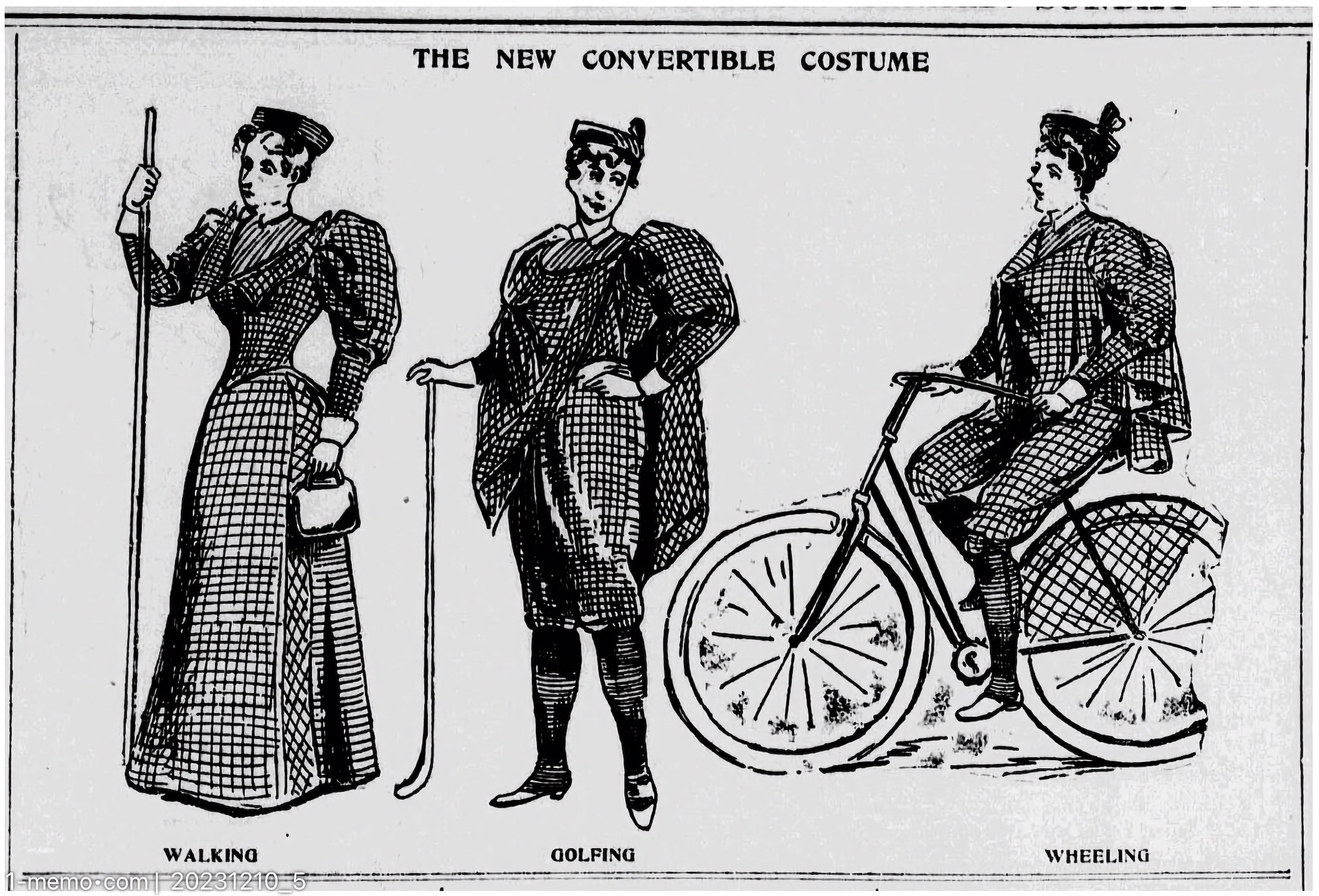
In general, women’s sport and activewear has helped emancipation (8).
John Noble’s 1895 ‘New Convertible Costume’ | 20231210_5 | 1-memo•com | Los Angeles Herald, 1895
John Noble’s 1895 ‘New Convertible Costume’ … appropriate for walking, golfing and wheeling. In: Los Angeles Herald, 1895 | Source K. Jungnickel in The Sociological Review (Ref. 8).
Dutch :
NL – Verwarrend in dat historisch plaatje boven…die blote vrouwenbenen op de fiets! Op zoek naar nog een plaatje van windmolen De Schoone Haas van de papierfabriek langs de Gouwe in Waddinxveen, vond ik in het archief van het SAMH museum te Gouda een foto, met vermelding ‘Vrachtschip voor houthandel Alblas, op de achtergrond molen, na 1905.’ Hierboven (20231210_1) een bewerkte versie (met verscherping, en helderheid aanpassingen) van die foto.
Op het eerste gezicht mis ik in die foto de houtzagerij van Alblas , en daarnaast de Remonstrantse kerk – waarvan ik eerder film beeld gepost heb (1). Bij weer bekijken van die film blijkt dat die beide gebouwen meer naar achteren staan – de Remonstrantse kerk waarschijnlijk omdat het een schuilkerk was – en daarom dus wat uit het zicht. Voorts laat die film ook dit tweede Alblas gebouw zien, aan het water en dicht bij die zagerij. Niet ver van papiermolen De Schoone Haas heeft nog een windmolen gestaan – De Nijverheid, waarvan recent een overzichts-foto is gepost (2). Die molen – De Nijverheid – wordt hier in de foto herkend op de achtergrond. De Schoone Haas molen , die dichter bij Alblas stond, blijkt dus op dit tijdstip al verdwenen. De wieken van molen De Nijverheid ontbreken hier. De Nederlandse molen database vermeld (info van Jacob Stolp) dat de wieken van De Nijverheid werden verwijderd in 1929 , en de molen in 1932 werd afgebroken (3). Deze foto is dus rond 1930 gemaakt.
Bij de beeldanalyse voor de datering zijn die fietsers met blote benen in eerste instantie verwarrend in zo’n historisch plaatje. Nadere beschouwing van de uitvergroting hierboven van de fietsers (20231210_2) leert, dat er wordt geposeerd : de fietser rechts in beeld is misschien een jongen, en staat nog naast de fiets, wat suggereert dat de anderen zojuist zijn gaan fietsen, waarbij de jonge vrouw (meisje) links, nog niet recht zit.
De afgelopen maand zag ik veel fotografisch beeld van leven en werken langs de Gouwe tot ca 1920 , en zag ik de vrouwen vrijwel altijd in rokken tot de enkels, een enkeling tot halverwege de kuit (4).
De vrouw op de fiets in het midden draagt aparte kleding met korte pijpen met elastiek op de bovenbenen, en daarover een vest, en grote (schouder-) tas.
Dergelijke mode werd teruggevonden in vrouwenbladen van rond 1930…zoals dat Modern Gym Suit in het Amerikaanse blad The Delineator Aug. 1931 , voor jongeren … ‘Juniors’ (5), met optie om een Butterick naaipatroon aan te schaffen. Hierboven ( zie Modern Gym Suit | 20231210_3 ) een collage van knipsels uit dit blad, van het gympak uit één stuk met V-hals … ” je stapt er van boven in en sluit het op de schouders – simpel te maken. “
Zo’n One-piece Gym Suit wordt ook aangeprezen in de catalogus uit 1932 van het Amerikaanse Sears Roebuck met : “Tegenwoordig is dit standaarduitrusting op veel hogescholen en middelbare scholen, alsook bij dansers…”(6).
Bloomer – Vrouwenrechten
De ‘Bloomer’ – doorgaans ruimer , zie ook die pagina in de Sears Roebuck Catalogus 1932 (6) – gaat terug – in langere versies – tot de 1850s.
Zie boven (20231210_4) de spotprent uit een krant/magazine van ca 1852 ‘A Poser for a Bloomer’ . In een omgedraaide genderrol vraagt een ‘bloomer’ de geschokte vader van haar verloofde om toestemming om met zijn zoon te trouwen (Ref 7).
In het algemeen heeft sportkleding en activewear voor vrouwen, geholpen bij de emancipatie.
John Noble’s 1895 ‘New Convertible Costume’ (beeld : 20231210_5 ) … appropriate for walking, golfing and wheeling … Los Angeles Herald, 1895 (Ref. 8).
Refs
1. Alblas Hout – 1920s Waddinxveen Works – Gouwe River | 20231117 | Michel van der Burg | 1-memo•com
2. Windmills Hoop & Nijverheid ca 1898 in Waddinxveen Along the Gouwe River | 20231208 | 1-memo•com | @michelvanderburg
7. A Poser for a Bloomer. By J L (monogram) ca 1852. | Bodleian Libraries Oxford University | Wikimedia Commons. CC-BY. URL https://commons.wikimedia.org/w/index.php?curid=40711232 . Satirical cartoon about the Bloomerism movement. Girl in bloomers seeking consent to marry from her fiance’s father. Cutting from newspaper/magazine. Shelfmark: Fashion 19 (56) (subsection: Satire and reform movements: Bloomers and Bloomerism).
8. Jungnickel, K. (2023). Convertible, multiple and hidden: The inventive lives of women’s sport and activewear 1890–1940. The Sociological Review, 0(0). https://doi.org/10.1177/00380261231153754
Citation info : Girls’ Gym Suit 1930 Cycling along Gouwe River | 20231210 | 1-memo•com | @michelvanderburg
Images
1. Girls’ Gym Suit 1930 Cycling in Waddinxveen along Gouwe River | 20231210_1 | 1-memo•com | @michelvanderburg | TakeNode 9e5188f1-2ced-458a-817c-9e8bcc221b85
3. Modern Gym Suit | 20231210_3 | 1-memo•com | @michelvanderburg | Edited montage of cuttings from The Delineator Aug. 1931 (Ref. 5) | TakeNode a1543a33-f0b0-4ba4-9bb4-70978707575a
4. Bloomer ca 1852 | 20231210_4 | 1-memo•com | A Poser for a Bloomer. By J L (monogram) ca 1852. | Bodleian Libraries Oxford University | Wikimedia Commons. CC BY | Takenode e7f54d92-800e-4e06-be2f-b54c019bbecc
5. John Noble’s 1895 ‘New Convertible Costume’ | 20231210_5 | 1-memo•com | Los Angeles Herald, 1895 | TakeNode 34a18b6c-7562-4310-ba79-713dca5bb018
NL – Molens De Hoop – op de voorgrond – en daarachter De Nijverheid, hier beide in gebruik als korenmolen, en voorheen als papiermolen. Links in de foto de rokende schoorscheen van papierfabriek De Schoone Haas waar stoom wordt gebruikt en de papiermolen De Schoone Haas is verdwenen. Omdat bekend is, dat papiermolen De Schoone Haas verdween bij de brand in de fabriek in 1897, en molen De Hoop afbrandde in 1899 (1), concludeer ik dat deze foto – die ik bewerkt heb – ca 1898 is geschoten (fotograaf onbekend | uit SAMH museum, Gouda).
EN – Windmills De Hoop – in the foreground – and behind De Nijverheid, both used here as a flour/grist mill, and previously as a paper mill. On the left in the photo the smoking chimney of the De Schoone Haas paper factory where steam is used and the De Schoone Haas paper windmill has disappeared. Because it is known, that the De Schoone Haas windmill disappeared with the fire in the paper factory in 1897, and the De Hoop mill burned down in 1899 (1), I conclude that this photo, that I edited, was shot around 1898 (photographer unknown | from AMH museum, Gouda).
Refs
1. Papierfabricage in Waddinxveen | Piet Smit | Het dorp Waddinxveen Jaargang 25 • nr. 1 • Maart 2017 | Het Historisch Genootschap Waddinxveen
Citation info : Windmills Hoop & Nijverheid ca 1898 in Waddinxveen Along the Gouwe River | 20231208 | 1-memo•com | @michelvanderburg | TakeNode e1e19e9a-1374-463d-9ece-f2d6f24d4eea
NL – Windmolens ca 1915 aan de Noordkade langs de Gouwe in Waddinxveen. Rechts langs de Gouwe het jaagpad (tegenwoordig de provinciale weg N207). Achteraan de Oranjeboom trasmolen voor het malen van tufsteen, kort voor de sloop in 1916. Daaer voor de ‘Bijenkorf’, een van de vele papiermolens uit de 18-19e eeuw in Waddinxveen, na 1890 in gebruik genomen als korenmolen, en afgebrand in 1923. Bewerking van scan SAMH museum, Gouda.
EN – Windmills around 1915 on the Noordkade quay along the Gouwe river in Waddinxveen. On the right along the Gouwe is the towpath (now the provincial road N207). At the back is the Oranjeboom trass mill for grinding tuff stone, shortly before its demolition in 1916. At the front is the Bijenkorf (‘Beehive’) windmill, one of the many paper mills from the 18-19th century in Waddinxveen, used as a grist mill after 1890, and burned down in 1923. Editing from scan SAMH museum, Gouda.
Schoone Haas papiermolen in Waddinxveen (english below)
NL – Recent werd een film van de stoom papierfabriek De Schoone Haas in Waddinxveen gepost in het kader van een serie beeld van rond 1900 over leven en werk Langs de Gouwe rivier (1) .
Hier een foto van de wind-papier-molen De Schoone Haas op de plek van de later gefilmde stoom-papierfabriek Schoone Haas – met op de voorgrond de Remonstrantse kerk , naast de houtzagerij Alblas.
Dezelfde molen en gebouwen staan ook afgebeeld op een schilderij (uit familiearchief molenaar) van de Schoone Haas molen, gepubliceerd bij het verhaal van ooggetuige, papiermaker, Albert van Os in het blad ‘Het dorp Waddinxveen’ van Het Historisch Genootschap Waddinxveen (2).
De foto toont ook een schoorsteen – die niet in het schilderij staat – en kleiner lijkt dan de schoorsteen in foto’s van de papierfabriek toen de molen verdwenen was (afgebrand bij blikseminslag in 1897). Vanaf 1879 gebruikte De Schoone Haas ook stoom voor de papierproductie, aanvankelijk een kleine installatie, later groter. De foto lijkt genomen in die periode van 1879 – 1897 toen ook al stoom werd gebruikt.
EN – Recently, a film of the Schoone Haas steam paper mill in the village of Waddinxveen was posted as part of a series of images from around 1900 about life and work along the Gouwe river in Holland (1).
Here is a photo of the windmill paper factory De Schoone Haas on the site of the later filmed steam paper factory Schoone Haas – with the Remonstrant church in the foreground, next to the Alblas sawmill.
The same mill and buildings are also depicted in a painting (from the miller’s family archive) of the Schoone Haas windmill, published with the story of eyewitness, papermaker, Albert van Os in the magazine of the Historical Society Waddinxveen – ‘Het Historisch Genootschap Waddinxveen’ (2).
The photo also shows a chimney – which is not in the painting – and appears smaller than the chimney in photos of the paper mill when the mill was gone (burned down by lightning in 1897). From 1879, De Schoone Haas also used steam for paper production, initially a small installation, later larger. The photo appears to have been taken in the period from 1879 to 1897, when steam was also used.
Citation info : Windmill Paper Mill Schoone Haas in Waddinxveen before 1900 along Gouwe River | 20231206 | 1-memo•com | @michelvanderburg | TakeNode 74e91ddb-80d7-43ec-85d9-c5728b62be2a