
Citation info : Ave • Marleen & Maria • Miracles•Media • @1MEMO 20251107 • TakeNode 8b14d0f5-4b41-42bc-b6e2-7b7a6715038a
Tag: Holland
Autumn • @1MEMO 20251106
Citation info : Autumn • Michel van der Burg • Miracles•Media • @1MEMO 20251106 • TakeNode 442f795f-e68d-435c-a2e0-2e4565a35bbb
Autumn • @1MEMO 20251105
Citation info : Autumn • Michel van der Burg • Miracles•Media • @1MEMO 20251105 • TakeNode 4cc2f04b-c835-439b-9998-dc6c3e1fd086
Iodixanol-UWS Human Islet Purification 1998 Abstract • @1MEMO 20251102

Abstract published in Acta Diabetologica 1998 of Iodixanol-UWS Human Islet Purification in 1998 at the Diabetes Research Institute in Miami. Abstracts book of the 18th Workshop of the AIDSPIT Study Group in Igls, Austria, Jan 1999.
Van der Burg MPM, Ranuncoli A, Molano R, Kirlew T, Ringers J, Bouwman E, Ricordi C. Efficacy of the novel iodixanol-UWS density gradient for human islet purification (Abstract). Acta Diabetol 1998; 35: 247.
View / Download abstract (file 1MEMO_20251102_1.pdf) below .
Notes
Abstract added in full post :
Efficacy of the novel iodixanol-UWS density gradient for human islet purification • Igls Aidspit 1999 • 20241202 • URL michelvanderburg.com/2024/12/02 •
Citation info : Iodixanol-UWS Human Islet Purification 1998 Abstract • Michel van der Burg • Miracles.Media • @1MEMO 20251102 • URL michelvanderburg.com/2025/11/02/
Phoney • @1MEMO 20251029

Alliteration … politicians image on Holland elections ;)
#news #phoney #image #unreal #holland #politics
Image : Phoney • Michel van der Burg • Miracles•Media • @1MEMO 20251029
Youtube Top 50 • Hessel & Tess • @1MEMO 20251024
Channel012 the #31 Most Viewed Today on YouTube , featuring “One Heart” – Hessel & Tess in Terschelling
April 2009, two days after the upload of “One Heart” on my Channel012 , this was the #31 Most Viewed Today Gurus channel in the Netherlands.

1MEMO 2 0 2 5 1 0 2 4 _ 1

1MEMO 2 0 2 5 1 0 2 4 _ 2
Currently this duet by father and daughter Hessel & Tess on the dutch island Terschelling has been watched alsmost 200K. Watch this original below.
“One Heart” – Hessel & Tess – Terschelling
“One Heart” by Hessel and his daughter Tess in duet on March 27, 2009 in Hessel’s café “De Groene Weide” in the village of Hoorn on the dutch islet Terschelling. Music © 2000 Hessel van der Kooy & Words: Kees Brakkee. Video © 2009 michelvanderburg
TAGS #YouTube #One #Heart #music #YouTube #Hessel #Tess #Terschelling #duet #Holland #Netherlands #@1Memo #michelvanderburg
Channel012 (@channel012) has been renamed Michel van der Burg (@michelvanderburg)
Both links work :
https://www.youtube.com/channel012
https://www.youtube.com/michelvanderburg
Citation info : Youtube Top 50 • Hessel & Tess • Michel van der Burg • Miracles•Media • @1MEMO 20251024 • TakeNode d8fa14f3-c24a-4a6d-be9b-89436045bb64 / f407ea33-2b69-43ae-93af-f8d34516bdfa
Youtube Top 15 • Agua Azul • @1MEMO 20251023
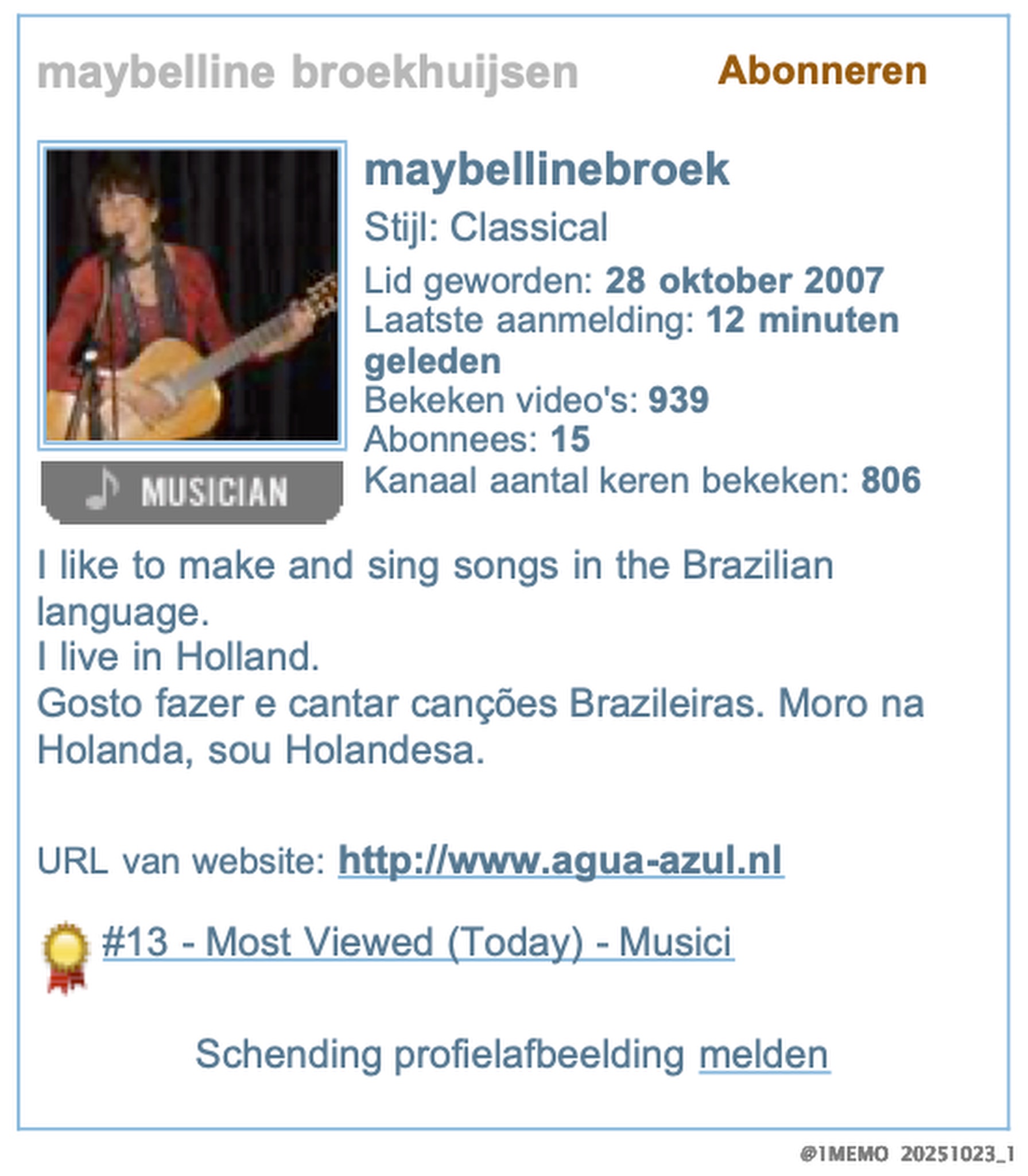
#13 Most Viewed Today Musicians on YouTube featuring Duo Agua Azul
I joined YouTube with Channel012 on June 20, 2007 , soon after YouTube was purchased by Google late 2006 . My first public video was uploaded Dec 30, 2007 : ‘Fire Breather’.
The 2nd video was a high quality video : “Tiroler Fasnacht 2008 in Igls”. Traditional carnival in the streets in Austria. This was uploaded May 7, 2008.
Some days later I was contacted by Maybelline — a friend from the early 1970s when we both studied biology at Leiden University in Holland, with whom I had not had any contact since — who was wondering whether it was me ‘the Michel of the biology study, after I had left a comment signed ‘Michel’ at her YouTube channel (@maybellinebroek) with music videos.
I learned she had just started the duo Agua Azul together with pianist Thijmen Vonk, with already about 16 performances lined up, one just completed , and an upcoming talent show in theater Agnietenhof in Tiel, Holland, next Friday 16 May, 2008.
Just in time, the afternoon before that talent show, we agreed I’d film the show, and a few hours before the performance, I received the stage setup. Unfortunately, I was late for the opening number… and then filming… and same night editing. Next day rushes were checked, and the evening of May 19 the uploads of 4 of the songs at Maybelline’s channel succeeded — just in time for a screening the next morning for an important venue, to determine if they want to book Agua Azul in Cultuurhuis Doorn…which they did.
Maybelline’s YouTube channel ranked #13 Most Viewed Today Musicians in the Netherlands within the first two days after uploading our Agua Azul videos.
Channel ranking was #58 in Most Viewed (This Week) Musicians in the Netherlands – a week after uploading (20080526).

Notes
More recently, I uploaded remastered editions of those videos , and added a new video too, a video of the interview with Agua Azul on that “Open Podium” in the Agnietenhof Theatre in Tiel , Holland on Friday 16 May, 2008.
Start Agua Azul ~ Holland • @1MEMO 20180523 • Interview 10 years ago at the flying start of Maybelline’s Agua Azul with pianist Thijmen Vonk – May 2008 – by Stefka at the “Open Podium” in the “Agnietenhof Theatre” in Tiel , Holland • URL https://youtu.be/Dlqk02QvXu8
Um Dia Novo • Agua Azul • @1MEMO 20211109 • Concert by Agua Azul on May 16, 2008 in Agnietenhof Theatre, Tiel, Netherlands ~ Percussion: Thijmen Vonk ~ Words and Music: Maybelline Broekhuijsen | agua-azul.nl | Text inspired by the story “De Rivier” by Bert Bijl ~ Film : Michel van der Burg | Miracles•Media | Remastered 2nd edition of film first published May 19, 2008 • URL https://youtu.be/W_fpcewYFZY
Reunião • Agua Azul • @1MEMO 20211108 • Concert by Agua Azul on May 16, 2008 in Agnietenhof Theatre, Tiel, Netherlands ~ Piano: Thijmen Vonk ~ Words and Music: Maybelline Broekhuijsen | agua-azul.nl ~ Film : Michel van der Burg | Miracles•Media | Remastered 2nd edition of film first published May 19, 2008 • URL https://youtu.be/_XU0OgDN4Nw
Journey • Thijmen Vonk • @1MEMO 20211107 • Thijmen Vonk – the Dutch Piano Wizard – plays (and improvises on) his own composition ‘Journey’ at the Agua Azul concert May 16, 2008 in Agnietenhof Theatre, Tiel, Netherlands | agua-azul.nl ~ Film : Michel van der Burg | Miracles•Media | Remastered 2nd edition of film first published May 19, 2008 • https://youtu.be/j5Gb6fzKePs
TAGS #Musicians #YouTube #AguaAzul #concert #reunion #MaybellineBroekhuijsen #ThijmenVonk #composer #improvisation #piano #music #Agnietenhof #theatre #brazileiro #portuguese #worldmusic #Holland #Netherlands #Tiel #@1Memo #michelvanderburg #Reunião #UmDiaNovo #Journey #talent
Channel012 has been renamed Michel van der Burg | Miracles•Media
Both usernames and links work :
@channel012
@michelvanderburg
https://www.youtube.com/channel012
https://www.youtube.com/michelvanderburg
Agua Azul is screening via channel @AguaAzulHolland
Citation info : Youtube Top 15 • Agua Azul • Michel van der Burg • Miracles•Media • @1MEMO 20251023 • TakeNode 3e68356b-e1ae-4a79-a8e4-abf513d61d0a / 29d4ed88-5551-42ff-8bd6-4c8269fe89b5
