Deportation of Dutch Roma to Auschwitz – 19 May 1944 • 9-year-old Anna Maria (Settela) Steinbach was deported together with 244 other Roma from Westerbork to Auschwitz (1,2) • Source : Settela•Com • Collection Auschwitz Museum • URL https://fb.watch/Hgg5lusc-8/
The Auschwitz Museum acquired the short film ‘Settela’ from Settela•Com (1) in the Auschwitz Memorial Collection (3), and is succesfully screening the film each year since 2019 on the 19th May at the Auschwitz Memorial / Muzeum Auschwitz facebook page .
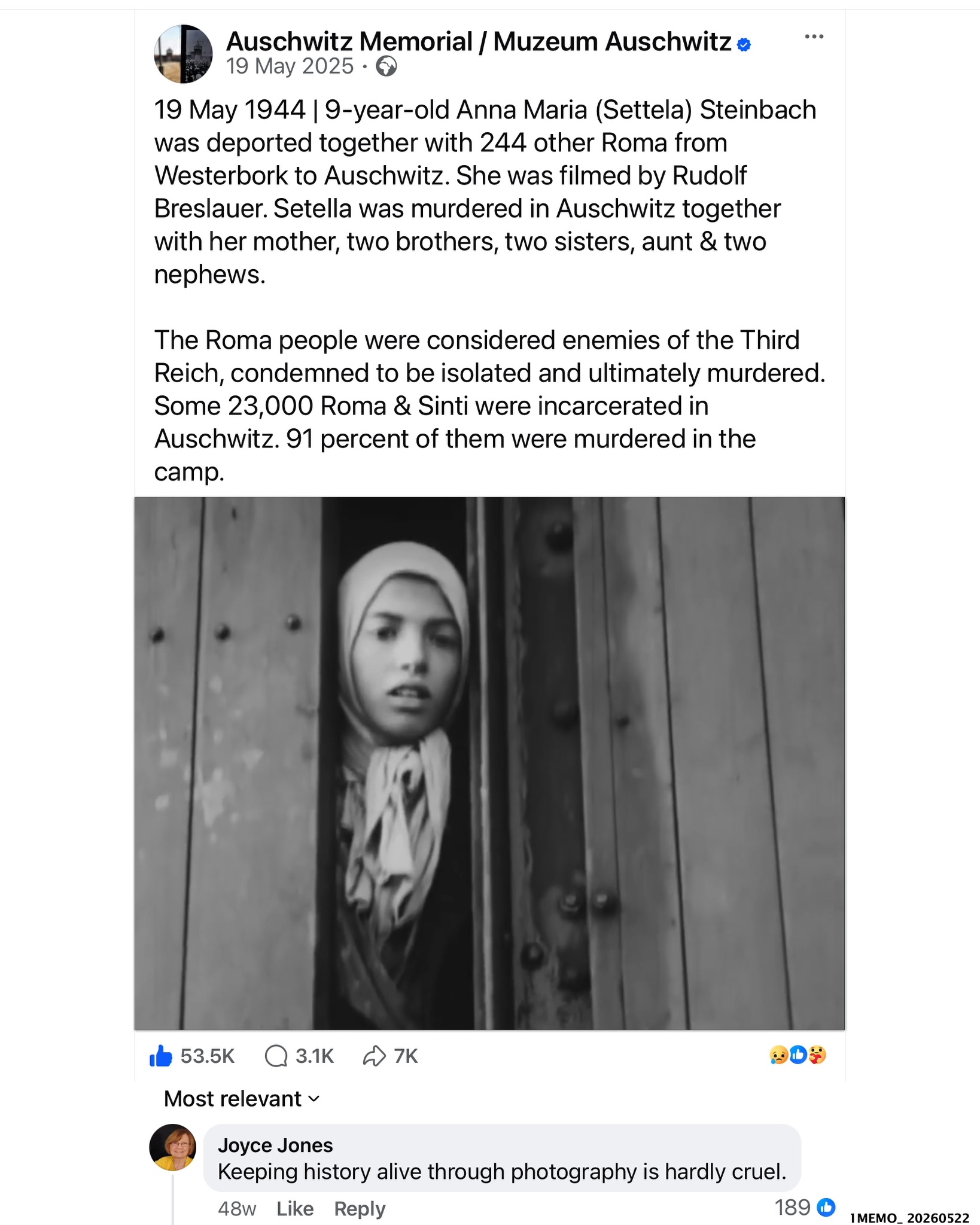
Last year’s post of the film ‘Settela’ , 19th May 2025 at the Auschwitz Memorial / Muzeum Auschwitz facebook page, accumulated by now one million views, and over 3000 comments (Image 1MEMO_20260522).
The film was created in an attempt to keep the scene on screen longer on the one hand, and to preserve the natural and historical original on the other. Thus a compilation was created, showing the same scene twice. The film ends with the original 3 seconds clip selected from the Westerbork film footage shot by Jewish prisoner Rudolf Breslauer (4), and the film starts with that same clip , digitally slowed down 10× in post-production.
This film was created and first online in 2017 (5) , and published (antedated) as the first post (1) shortly after the start May 19, 2019, of the online journal Settela•Communications — short Settela•Com (6).
More on the Roma in Auschwitz , online at the Auschwitz Museum (7).
Citation info : Settela Film Auschwitz Museum • 20260522 | Michel van der Burg | Settela•Com | ISSN 2949-9313 | CC BY 4.0 | URL https://settela.com/2026/05/22
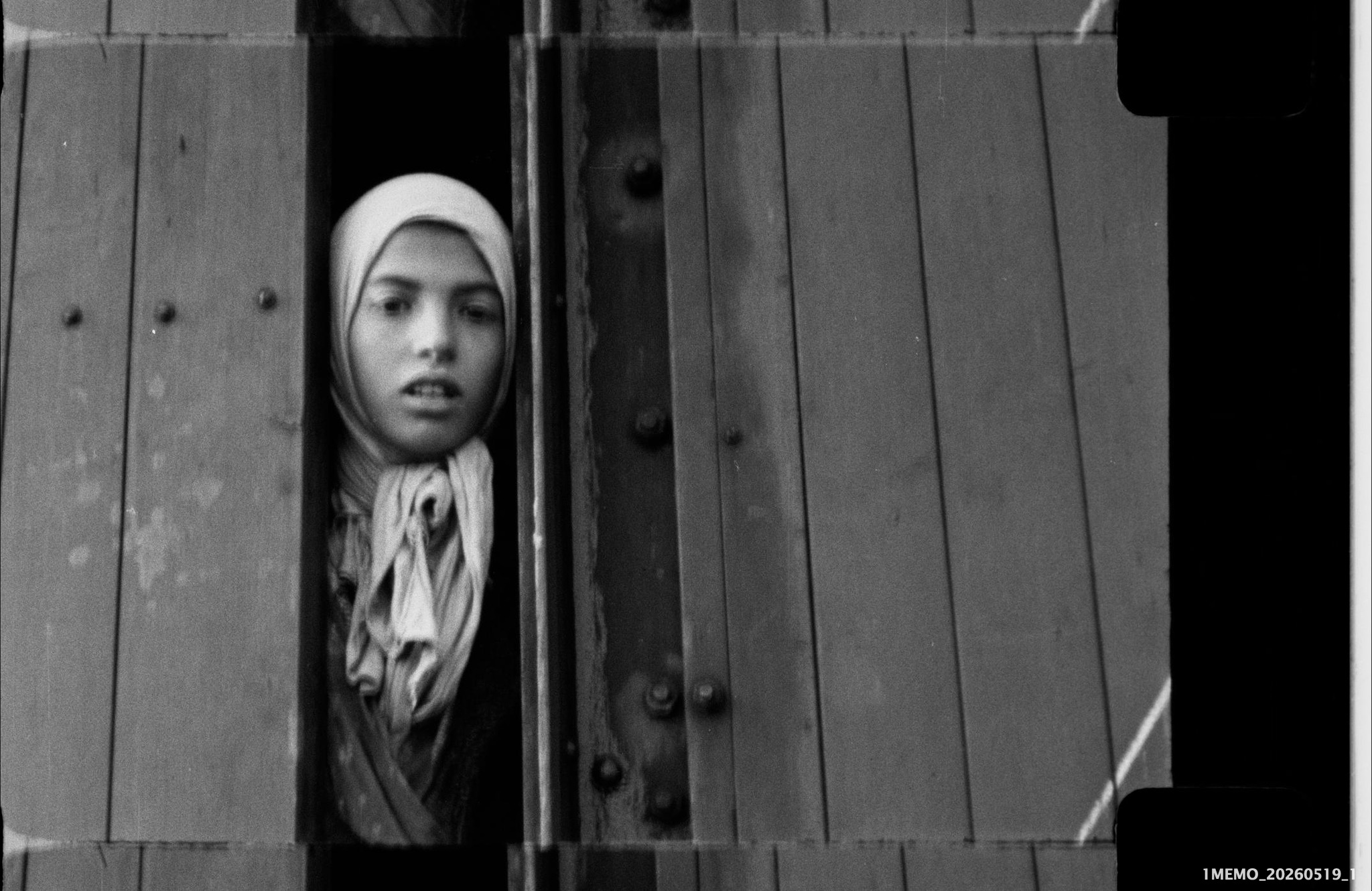
Settela Steinbach — The Girl with the Headscarf • 1MEMO_20260519_1 • Settela•Com • Frame from camera original film reel of the Westerborkfilm (1).
On May 19, 1944, at the Westerbork transit camp, a glimpse of Sinti girl Settela Steinbach wearing a headscarf appears between the sliding doors of a cattle car awaiting deportation to Auschwitz (1,2,3). In May 1945, her father, Moeselman Steinbach, wrote to “Repatriation” in the Netherlands: “…I very politely request you to inform me whether my wife and 10 children have arrived, or only children (Gypsy children) from the Auschwitz concentration camp in Poland.” (4).
The 9-year-old dutch Sinti-girl Anna Maria ‘Settela’ Steinbach peeks outside , at the last moment just before the sliding door is closed , standing inside a cattle car with 74 people on May 19 , 1944 in the Westerbork transit camp in Holland , when this deportation train leaves for Auschwitz-Birkenau – where Settela is murdered a few months later in one of the gas chambers (5).
While Settela peeks outside , her mother cries behind her in that cattle car : “Get out of there, or soon your head gets in between!”
She is wearing a headscarf made from a torn sheet because the Nazis shaved her head upon arrival at Westerbork transit camp on May 16, 1944, following the “Gypsy raid” carried out that same day at the Zwaaikom caravan site in Eindhoven, the Netherlands (6).
Settela Film • 20220630
Settela was filmed only a few seconds by the Jewish prisoner filmmaker Rudolf Breslauer as part of a documentary film being made in 1944 on the Westerbork camp .
Those seconds , also in slow-motion are shown in the 2022 Settela Film • 20220630 (7)
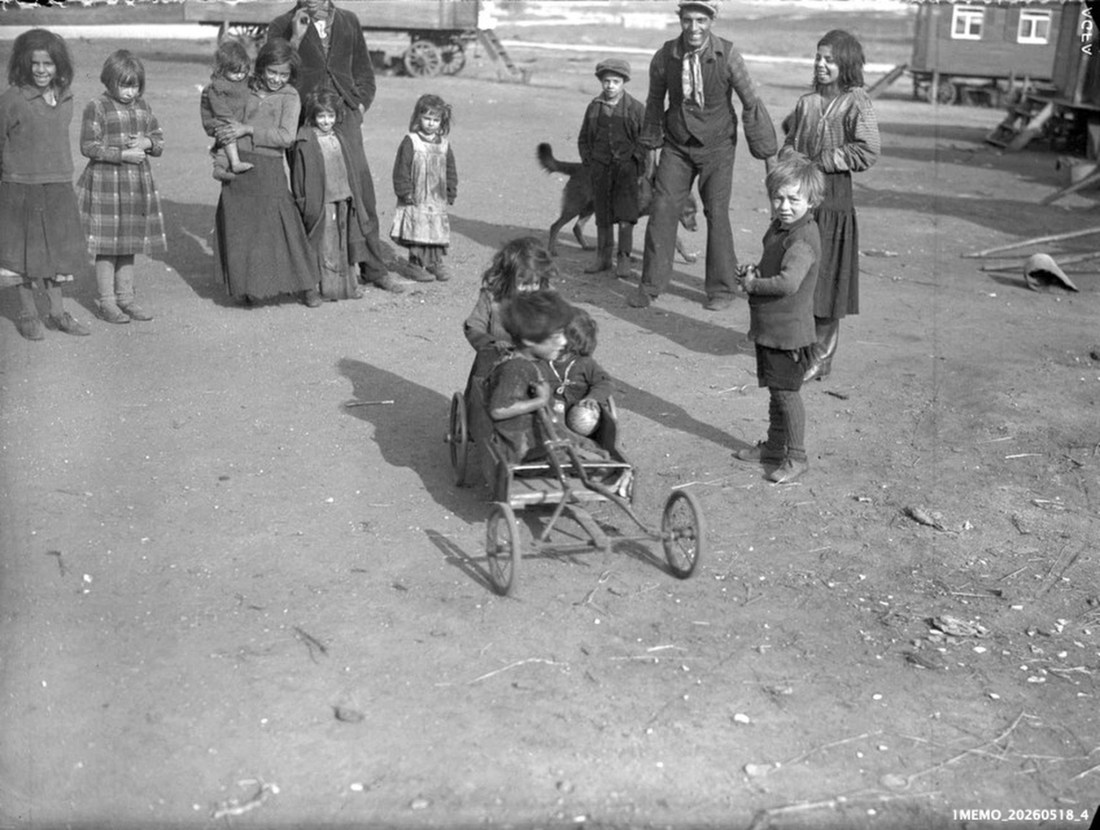
The toddler Settela in the arms of her older sister Elisabeth Steinbach at the Heksenberg Sinti caravan site in 1935 • Photo Jan de Jong • 1MEMO_20260518_4
Anna Maria (‘Settela’) Steinbach was born 23 December 1934 in Buchten, Netherlands, and photographed at age ~1 , in the arms of her older sister Elisabeth Steinbach, with others of the Steinbach family, and other families, at the nearby Sinti caravan site ‘Heksenberg’, October 1935, by photographer Jan de Jong (8) • 1MEMO_20260518_4
Settela was deported together with her brothers and sisters (Willy “Celestinus”, Willem, Elisabeth, Johanna, Philibert, Florentina, Willem, Anna), and mother Toetela (Emilia) Steinbach (born 23 March 1902 in Antwerp, Belgium), with other Steinbach and other nomad families – all together ca 245 Sinti and Roma and ca 450 Jews – on May 19th 1944 from the dutch Camp Westerbork to the Auschwitz and Bergen-Belsen camps (5,6).
Toetela’s eldest child Moekela (Magdalena; born 14 Sep 1922) had gone to Belgium and had been deported earlier – 15 Jan 1944 – with her 6 months old baby Jeanette – Toetela’s granddaughter – on the Z-Transport from transit camp Kazerne Dossin in Mechelen to Auschwitz, were they were murdered on arrival.
Settela’s father Heinrich (‘Moeselman’) Steinbach (born Nov 11, 1901 in Gründorf in Germany) died alone of grief June 6, 1946 in Maastricht in the Netherlands – his wife and 10 children had not survived the camps.
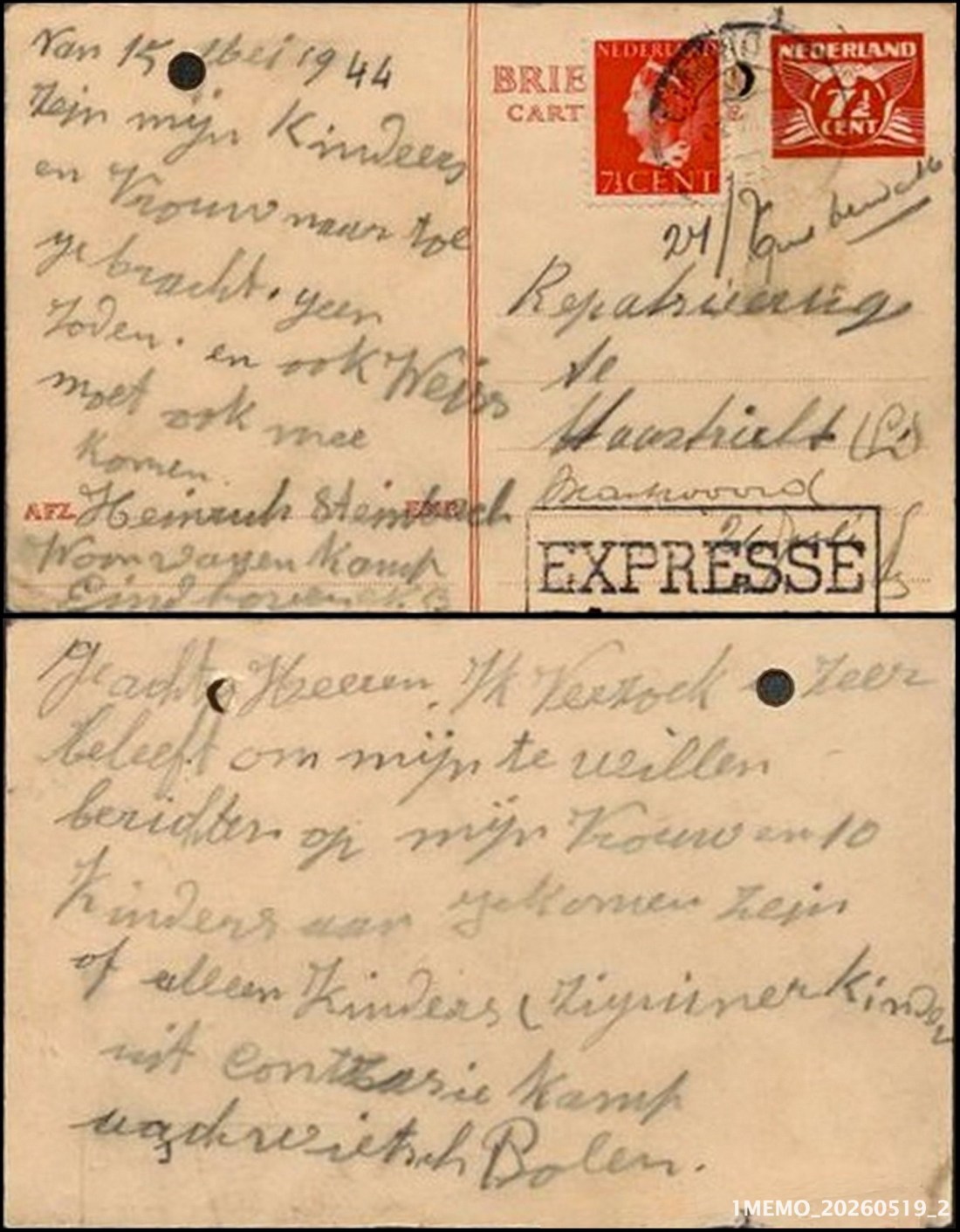
To : “Repatriation” in Maastricht (Netherlands) — “Dear Sirs, I very politely request you to inform me whether my wife and 10 children have arrived, or only children (Gypsy children) from the Auschwitz concentration camp in Poland. From May 15, 1944, my children and wife were taken there; no Jews. And Weiss had to come along too. — Heinrich Steinbach. Caravan site Eindhoven , North Brabant” • 1MEMO_20260519_2 • Settela•Com
One year earlier , May 22, 1945, two weeks after the liberation of Holland, Heinrich Steinbach — living at the caravan site in Eindhoven (North Brabant, Netherlands) — inquires about the fate of his wife and ten children on a postcard written to the “Repatriation” in Maastricht (Netherlands). The text on the postcard reads — translated from dutch (4) :
“Dear Sirs, I very politely request you to inform me whether my wife and 10 children have arrived, or only children (Gypsy children) from the Auschwitz concentration camp in Poland.
From May 15, 1944, my children and wife were taken there; no Jews. And Weiss had to come along too.
Heinrich Steinbach. Caravan site Eindhoven, North Brabant”
4 – May 1945 Postcard Heinrich Steinbach • 1MEMO_20260519_2 • Settela•Com | ISSN 2949-9313 | Source : Collectie HCL, archief Militair Gezag, Maastricht.
‘Moeselman’ Heinrich Steinbach — living at the caravan site in Eindhoven (North Brabant, Netherlands) — inquires about the fate of his wife and ten children on a postcard written to the “Repatriation” in Maastricht (Netherlands). The dutch text on the postcard reads :
“Geachte Heeren, Ik verzoek u zeer beleeft om mijn te willen berichten op mijn vrouw en 10 kinders aan gekomen zein of alleen kinders (zigeunerkinders) uit contrasie kamp uaschwietsch Polen.
Van 15 mei 1944 zein mijn kindeers en vrouw naar toe gebracht, geen joden. En ook Weiss moet ook mee komen. Heinrich Steinbach. Woonwagenkamp Eindhoven N.B.”
TRANSPORT XX — installation Brussels February 28th, 2009, Brussels. Day two, of my encounter with the TRANSPORT XX installation outside in the Royal park in Brussels, that presented 1200 photographic portraits of Jews deported from Malines (Belgium) to Auschwitz in 1943. One of the stills and establising video shots made that Saturday morning after finishing long take video recordings of the installation, during a walk from our hotel in the Leopold (European) Quarter via the Royal park direction the historic centre of Brussels. That weekend break in Brussels, today 15 years ago, turned out to be a turning point in my life. Two months later – April 19, 2009 – the film TRANSPORT XX — installation Brussels was published.
8. First Encounter TRANSPORT XX … | 20240227 | Michel van der Burg | Miracles•Media | URL https://michelvanderburg.com/2024/02/27 | TakeNode cf0dd64d-4512-4846-8bce-6b2d8cca24ef
9. Camera used for both photo and video (720p HD video) of the TRANSPORT XX installation in Brussels is the Sony DSC-T500 which has a CCD sensor – with global shutter – thus not affected by rolling shutter distortion while panning the installation.
Citation info : Encounter TRANSPORT XX … | 20240228 | Michel van der Burg | Miracles•Media | URL https://michelvanderburg.com/2024/02/28 | TakeNode a8317838-7470-4538-b788-40e6cc07b55a
February 28th, 2009, Brussels — my first encounter with the TRANSPORT XX installation in Brussels, that presented 1200 photographic portraits of Jews deported from Malines (Belgium) to Auschwitz in 1943. Turning point in my life. Two months later – April 19, 2009 – the film was published.
Citation info : First Encounter TRANSPORT XX … | 20240227 | Michel van der Burg | Miracles•Media | URL https://michelvanderburg.com/2024/02/27 | TakeNode cf0dd64d-4512-4846-8bce-6b2d8cca24ef
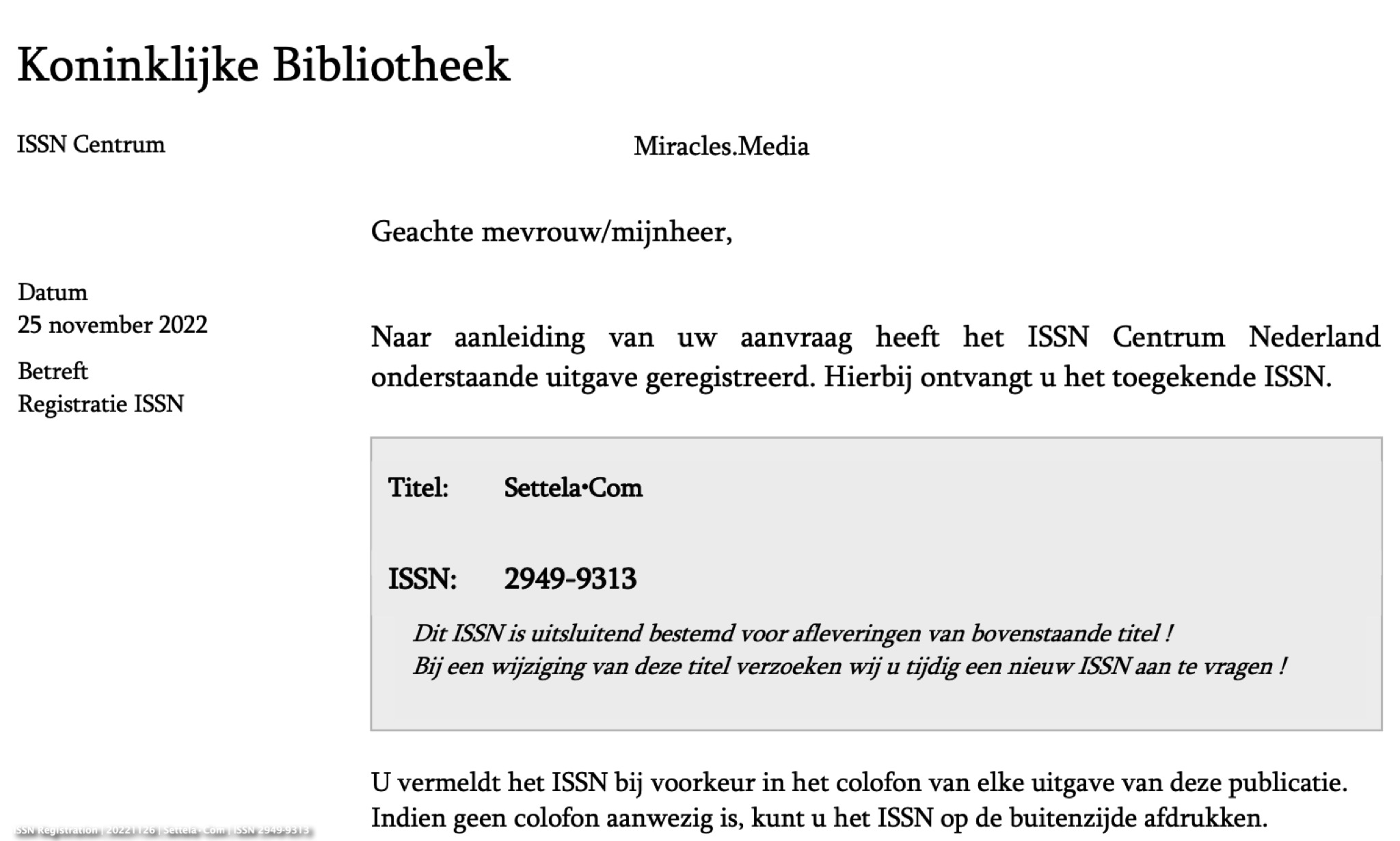
Settela•Com | ISSN 2949-9313 Registration – as ongoing integrating resource published by Miracles.Media (Netherlands) confirmed by the ISSN Centre of the Koninklijke Bibliotheek – the Netherlands National Library, Friday, 25th Nov 2022.
Settela•Com aims to online document and facilitate research of the Westerbork images, the use of the film in other works, the context of the camp and of the war in the Netherlands, and the destruction of diversity.
Settela•Com was made public with the first publication on May 19, 2019 — 75 years after the deportation of the Sinti girl Settela Steinbach from camp Westerbork was filmed — with the online premiere of the new one-minute film ‘Settela’.
From that first publication, contributions are published irregularly, with an average frequency of about once a month, mainly in English and Dutch, on the settela.com website.
Settela•Com welcomes contributions (English, Dutch, French) by submission of posts, papers, suggestions, or proposals within the scope of the platform.
ISSN Registration | 20221126 | Settela•Com | ISSN 2949-9313
TakeNode ID 44b0c33b-2be4-4fd7-816b-c38d35cdcbb5
Samudaripen Book Cover | 20221118 | Settela•Com
For Settela•Com , Michel worked with Elisabeth Obadia at the small publishing house L’Esprit Frappeur in Paris and the Tokyo based French visual artist Benoit Dupuis (eden-olympia.net), by preparing a high quality camera-original still image of Settela (Ref 1) from the Westerbork film (Ref 2, 3) for the cover of the 3rd edition of the book Samudaripen, le génocide des Tsiganes (Ref 4) — the genocide of the Gypsies – by author, historian, Claire Auzias. Proud with the result. Waiting for the book to arrive …