
Mechelen , Belgium. Friday 20th April 2007. Presentation Project TRANSPORT XX.

Project TRANSPORT XX | April 2007 – June 2007*
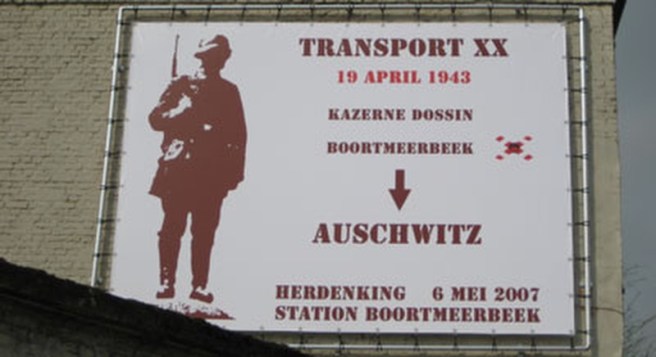
Transport XX is the only train convoy of Jewish deportees in Europe to be stopped by the Resistance in order to rescue prisoners. This unique armed attack took place on 19 April 1943 in Boortmeerbeek, Belgium.
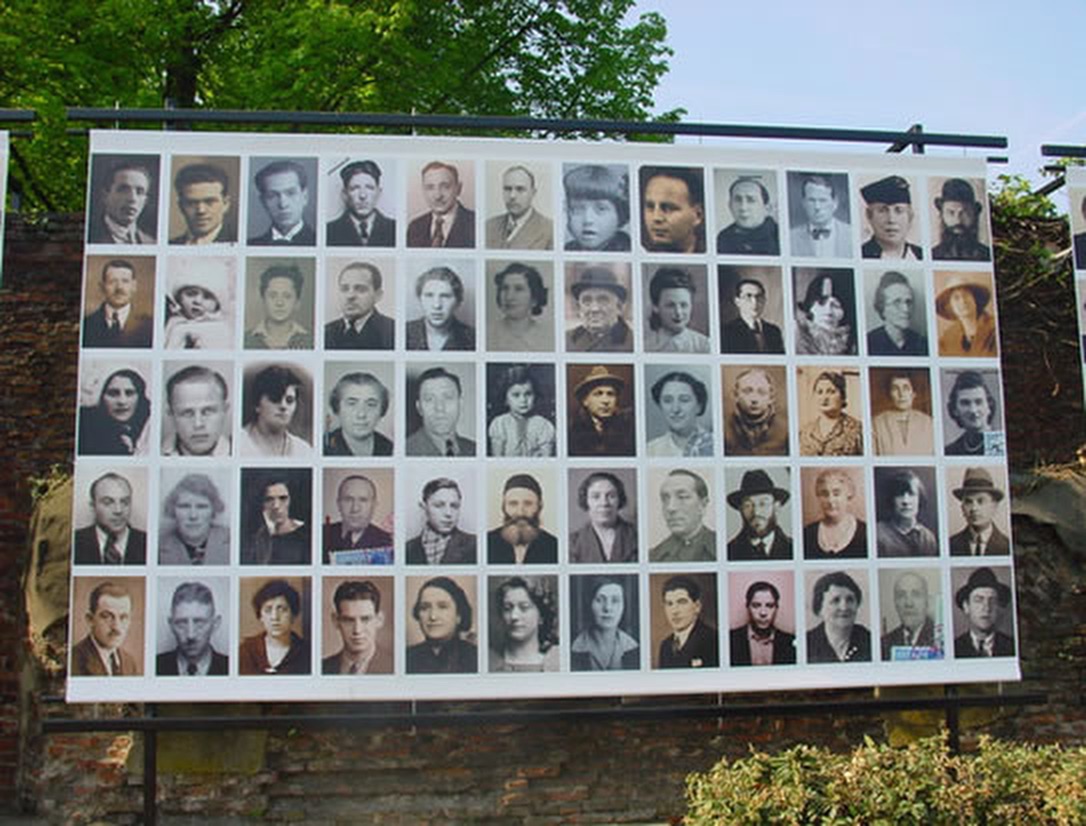
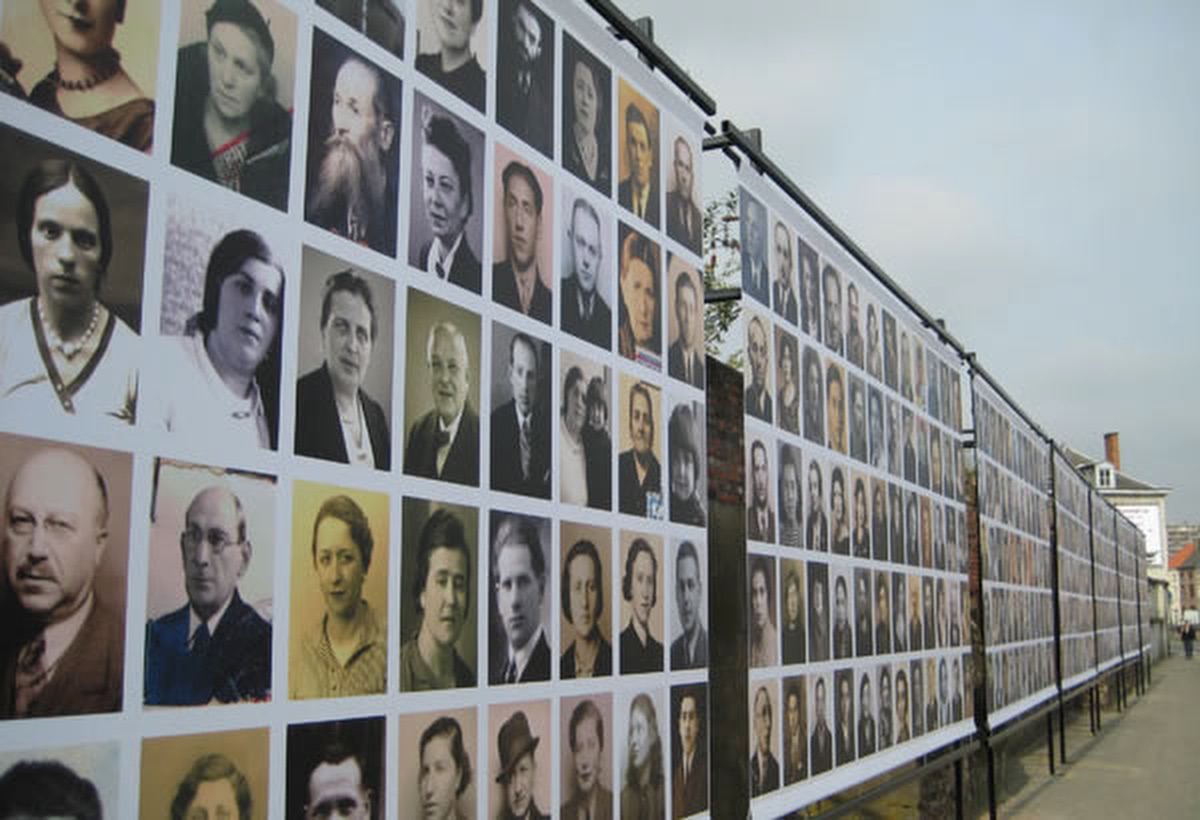
TRANSPORT XX is a construction depicting the portraits of 1,200 of the 1,631 prisoners deported on Convoy XX from the Kazerne Dossin (Dossin Barracks) direction Auschwitz-Birkenau. The photographs were displayed outside along a 100 yard stretch of the Edgard Tinellaan, where the old railway line used to run. In this way passers-by were confronted with 1,200 faces of the victims of racial genocide.
On Friday 20 April 2007, in the Jewish Museum of Deportation and Resistance (JMDR), the project TRANSPORT XX was presented to the international press.
The attack on Transport XX
In 1940 nearly 70,000 Jews were living in Belgium. During WW II ca 25,000 were deported from the Dossin Barracks in Mechelen (Belgium) and ca 5,000 via Drancy, close to Paris (France). In two years from the summer of 1942, 28 train convoys left Mechelen with their human cargo of Jews and ca 350 Gypsies. Their destination was, in the main, Auschwitz-Birkenau.
On 19 April 1943 Transport XX departed with 1,631 deportees. Transport XX was an exceptional convoy because it carried an unusually large number of victims (1,631) and it was the first time that the Nazis resorted to the use of a goods train. In previous convoys third class railway carriages had been used and deportees could, from time to time, escape through the carriage doors and windows. The goods wagons of Transport XX were locked from the outside and apertures were secured with barbed wire. Suzanne Kaminsky, the youngest Jewess to be deported from Mechelen, was transported to the East on Transport XX. She was born on 11 March 1943.
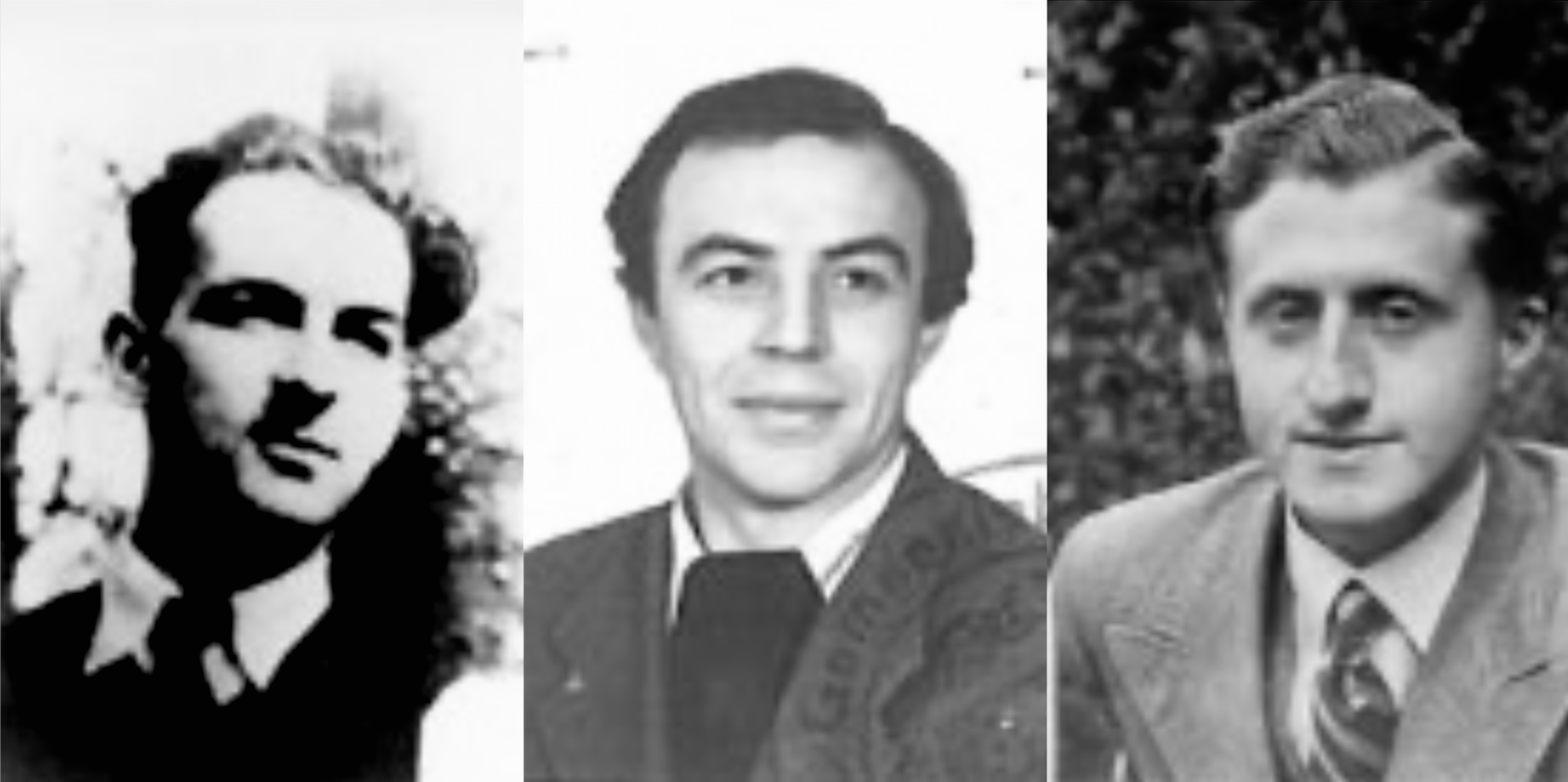
Youra (Georges) Livschitz, Robert Maistriau, and Jean Franklemon, pupils from the Athenaeum in Ukkel, Brussels, armed only with one revolver and a hurricane lamp covered with red paper, succeeded in stopping Transport XX between Mechelen and Louvain in the vicinity of Boortmeerbeek. This was the first and only such undertaking to rescue Jews being transported to the East during WW II.
Convoy XX was accompanied by a detachment of German Sicherheitspolizei comprising one officer and 40 men. Inspite of the guards Robert Maistriau succeeded in opening one of the goods wagons. 17 people escaped. As the train continued its journey dozens of other prisoners succeeded in escaping. Saws, files, pincers and other tools, which lay hidden in the straw, were used to open the wagons from within. A total of 238 deportees (update 20240518) managed to escape managed to escape from the train, however 90 were soon recaptured and put on the next convoy, 26 were shot dead and 122 succeeded in their escape. The 11 year old Simon Gronowski was long thought to be the youngest escapee. Actually the 6-year-old boy Aron Luksenberg was the youngest who jumped and went into hiding with a family in Wavre, where he survived the war but died of an illness at the age of fifteen (a recent finding by Jo Peeters). The youngest to escape was Viviane , who escaped in the womb of her three-months pregnant mother Isabella Weinreb-Castegnier, and was born 6 months later in Brussels (Miracles.Media).
Regine Krochmal an 18 year old nurse from the Resistance succeeded in escaping from the train by sawing through the wooden battens which were placed over an airhole in the goods wagon. She sprang from the moving train in the vicinity of Haacht. Both Simon Gronowski and Regine Krochmal survived the war.
On 22 April Convoy XX arrived at Auschwitz-Birkenau.
As a result of the attack on Convoy XX all future convoys would be more heavily guarded. A company of guards from Brussels would, henceforth, travel with the train to the German border.
The day of the attack on Convoy XX is symbolic, as the date coincides with that marking the beginning of the uprising in the Warsaw ghetto.
Speech by Bart Somers, Mayor of the city of Mechelen, Friday 20th April 2007.
Friends,
On behalf of the City of Mechelen I should like to welcome you to this presentation of TRANSPORT XX (CONVOY XX). I am delighted with the international interest shown in this project.
On account of its geographical situation, between Brussels and Antwerp, Mechelen was the ideal choice of the German occupying forces as an assembly point for Jews and Gypsies prior to their deportation to the notorious camp of Auschwitz-Birkenau. The citizens of Mechelen didn’t have a choice in this matter, however, we will always carry with us and guard the memory of this unseen crime against humanity – the genocide against Jews and Gypsies which took place in Belgium. This responsibility has, in fact, been placed upon us by the historical events in which our city played an integral part.
The city has continually offered its full support to the annual memorial events at the Kazerne Dossin (Dossin Barracks). The Joods Museum van Deportatie en Verzet – JMDV (Jewish Museum of Deportation and Resistance) has always been able to count on assistance from our public services. The police, the firebrigade, the ecological and the cleansing-department, the city archives, local museums, our high-school and last but not least, the staff at city hall, have all, when called upon, offered a helping hand. More than once the city hall, itself has been made available to house events organised by the JMDV.
Furthermore the City of Mechelen, together with the Government of Flanders and the JMDV will be playing a major role in the rebuilding and refurbishing of the present museum. This new project will enable the permanent exhibition over the genocide of the Jews and Gypsies to be extended and to incorporate associated themes and other violations of human rights.The new museum will be called Kazerne Dossin. Museum en Documentatiecentrum van Holocaust Mensenrechten.( Dossin Barracks. Museum and Documentation Centre of the Holocaust and of Human Rights). During the coming months we will keep you abreast of the progress in the development of this project both architecturally and also regarding the planning and organisation of the work. Anyway where we are now situated, the old gaol and the Predikherenklooster (Dominican Monastery) situated adjacent to us will definitely be incorporated into the master plan.
Finally I should like to congratulate the JMDV team for their success in presenting to the general public in such a spectacular and well documented manner one of the 28 train convoys which left Mechelen for the camps in Poland. I hope that the public will be deeply moved by the portraits of these murdered people.
Thank you.

Speech by Ward Adriaens, Curator of The JMDR, Friday 20th April 2007.
Friends,
The Joods Museum van Deportatie en Verzet – JMDV (Jewish Museum of Deportation and Resistance) presents, today, a portrait gallery of 1,200 Jewish deportees. They were prisoners who left here on 19 April 1943 in goods wagons bound for Auschwitz-Birkenau. It was a journey of no return. However more than 200 of them succeeded in escaping before the train reached the German border.
The pictures have been erected alongside the old railway line from the Kazerne Dossin (Dossin Barracks) which previously linked-up with the national railway network.
I believe that it is a unique event that a whole deportation train is once again given a face. It is a photographic reconstruction of one of the 28 convoys which was destined to make the same journey.
The installation of the reconstructed train takes account of the current typology ‘Perpetrators’,‘Victims’, and ‘Bystanders’ : 1 guard on the poster, 1,200 portraits of deportees and 12,000 people who daily ride past.
When we see these photographs we suddenly no longer have to speak solely over numbers or statstics – in this case 1,600 prisoners in a train. We are now able to show you the faces of 1,200 people with flesh and blood that only 60 years ago were registered, ostracised, tracked down, apprehended, robbed and finally murdered. Because they had a mother.
Let us clearly understand that this is the fundamental basis of racism: persecuted because we have a mother. We all have parents and many amongst us have children. In order to protect them it is essential that we do not give an inch to racism. Everyone of us will come under threat should the policy makers be influenced by racism.
That is why monuments and memorials exist ; in order to remind us and to give us the opportunity to reflect upon what went wrong in the past. Therefore there are historical museums such as Fort Breendonk and Flanders Fields. Therefore there are documentation centres and archives to substantiate the truth of the survivors. We have developed educational activities and projects for the general public such as TRANSPORT XX (Convoy XX), which we are presenting to you today.
TRANSPORT XX is a unique convoy in that it was the only train with Jewish deportees destined for the gas chambers that was attacked with the sole objective of rescuing prisoners. A group of the deportees had already taken steps to prepare for an escape attempt from the train. TRANSPORT XX also carried the youngest and oldest victims :
1. Susan Kaminski, 30 days old
2. Jacob Blom, 90 years of age
The story of TRANSPORT XX was originally brought into the public domain through the publication of the book written by our dearly departed friend, Marion Schreiber, Stille Rebellen (Silent Rebels). Johan Op de Beeck also made a documentary film over these events for the Belgian TV channel, Canvas. This year Rheingold Films and Skyline Films will commence the production of a feature film over this topic. An historical documentary about the attack on TRANSPORT XX will give the feature film scientific support.
During the preparation for the renovation of the Belgian exhibition in Auschwitz our research staff at the JMDV have re-examined all the available documentation. In June we plan to issue a photograph album of TRANSPORT XX with the latest updated information. Prof. Steinberg and archivist L. Schram are at present working to this end.
Finally the attack on the train in Boortmeerbeek took place on the same day that the uprising in the Warsaw ghetto was launched. As if by coincidence both of these separate events took on a highly symbolic meaning.
Thank you.
Speech by Claude Marinower, MP and member of the board of the JMDR, Friday 20th April 2007.
Today we have invited you to Mechelen in order to present to you our project
TRANSPORT XX. It is a project undertaken on the initiative of the curator of the JMDV, Ward Adriaens, a “spin-off”, in fact from the extensive research done in the archives of the museum.
The realisation of this project would not have been possible without the active intervention of the former Home Office Minister, Patrick Dewael. He responded favourably to my request to release certain archives to the JMDV that they were holding in safe custody. TRANSPORT XX can, therefore, be attributed to the revelations from these archives.
The archive department of the JMDV researches and preserves all relevant historical documents. The museum has, and will continue, to make these documents available to scientific researchers and to relatives, who, still, 60 years after the genocide, are still searching for traces of their loved ones. The archive department aims to assist the JMDV through its teaching programme to enable students and visitors to the museum to visualise the racist persecutions of the Nazi period. TRANSPORT XX is such a visual project.
The Home Office holds the largest data base on the history of Belgium. Amongst other data it retains files drawn up by the Alien Police from the local authorities and which were later centralised under the umbrella of the Home Office.
We were dealing with no less than 2.7 million files drawn up between 1861 and 1945 covering the registration and follow–up of migrants into the kingdom. Migrants were registered upon arrival and amendments to their domicile were noted everytime they moved. A passport photograph accompanied the file. Their social and marital status was continually monitored e.g. workman, self employed etc. This data is a unique source of historical, social, ethnic and genealogical information.
The JMDV has as objective the indentification of the 56,000 Jews who had been registered during WW II . More than 25,000 were actually deported from the Kazerne Dossin, in Mechelen and over 5,000 from Drancy in France.
More than 90% of those who have been identified did not hold the Belgian nationality : they were in fact immigrants. From this we can gather that, bearing in mind that juveniles were included in the files of their parents, the Home Office had almost 40,000 files of persons who were subjected to racial persecution of which approximately 20,000 were of deportees.
The JMDV has unlocked these files and during the digitilization many new facts about the persecuted and the deportees have come to light including pictures of the victims.
Today we have more than 12,500 portraits from more than 25,000 deportees. We hope that you will be moved and touched by these photographs.
You have probably already realised that the project will not be completed with just the digitilization of the photographs. Also the files, each of which contain on average 25 documents, will be digitilized. This is a major undertaking.
Fortunately we can count on the support of the authorities who are well aware of the historical and educational importance attached to these sources of information. I have already mentioned the former Minister of Home Affairs, Patrick Dewael who made this project possible however one should not forget the part played by Freddy Roosemont, Director of the Department for Alien Affairs who placed at our disposal sufficient office space for our work, in the World Trade Centre, in Brussels.
Thanks to the active co-operation of Mr. Louis Philippe Arnhem the scanning work is proceeding quickly and efficiently. A constant stream of identified files are being brought from the storage in the cellars under the WTC.
Miss Patricia Ramet took over the organisation and running of this project. She identified 17,000 files from deportees, took care of the “document flow” and the identification of the portraits. It should also be mentioned that we were now working with “public archives” and the JMDV only received subsidies when dealing with “private archives”. Private sponsering was, therefore, essential for us to continue our work.
Fortunately we have been able to count on the support of the National Lottery. Brun Tuybens, a Government Secretary assisted us in formulating the necessary information and documentation in order to successfully apply for project subsidies.
Our archive and documentation work was recently brought under the international spotlight with the opening of the new Belgian Exhibition in Auschwitz-Birkenau to mark the 60th anniversary of the liberation of the camp. This project was executed by the JMDV at the request of the Federal Government.
All available photographs of Jews and Gypsies who were deported from Mechelen will shortly be available on interactive screens in the Belgian Pavilion.
Those persecuted and deported people, the dead who have now been given a face, were unable to leave behind their physical remains and do not rest in a grave where relatives and friends can come to reflect. They were the old and the young, babies, intellectuals and workmen, orthodox rabbis and the laity, men, women and children who, in fact, had only one wish: to live. They were denied this wish as they were born from Jewish mothers and as such their fate was sealed in advance. They had to disappear. There was no future for Jews on this earth.
The project “Give Them a Face” is an attempt by the JMDV to keep alive the memory the events that took place here 65 years ago in what was called the last stop before death.
It is totally unacceptable , that those who despaired during WW II over a Maker who remained still and a, people who remained indifferent should, as it were, be forced to die again. Forgotten.
The memory of the dead, our memory, is the only place where the deportees can keep alive the memory of the dead.
At the front of the room you can consult with Mr. Zuckerman, who is able to call-up 10,000 portraits on the computer screen.
Furthermore our French colleagues from the Holocaust Museum in Paris have shown a great deal of interest in the pictures of Jews domiciled in Belgium who fled to France but were captured by the Nazis and sent to Auschwitz-Birkenau via Drancy.
Of course, it speaks for itself that we desire to make this treasure of information available to the Belgium public in the first place through the building of the new museum in Mechelen and, like today, in such projects as the reconstruction of Transport XX
In conclusion I sincerely hope that the educational and archive work of the JMDV in the future will continue to flourish and in the course of the next 10 years all information over the persecution of Jews and Gypsies in Belgium can be centralised in this place.
The Kazerne Dossin must become the centre of knowledge for this story.
Thank you.
Speech by Natan Ramet, Chairman of the JMDR, Friday 20th April 2007.
Friends,
As chairman of the Joods Museum van Deportatie en Verzet – JMDV (The Jewish Museum of Deportation and Resistance), but also as a survivor of Auschwitz and Dachau, I have, on more than one occasion spoken of the great fear of many of the the ex-deportees: the fear that our lost relatives, comrades and friends would be forgotten.
On behalf of the JMDV and my fellow camp inmates I should like to take this opportunity of expressing my gratitude to the curator of the museum, Ward Adriaens who, if I may say, has, still managed, after 10 years, to retain his enthusiasm for his work. The project Transport XX (Convoy XX) was undertaken on his initiative. It is his project. He found the sponsors:
• The insurance company P&V – Prevoyance & Voorzorg. Amongst us is the chairman of P&V, our friend Mr. Forest and his wife. • The National Lottery, today represented by Mrs. Luypaert.
• The City of Mechelen, represented by the mayor Bart Somers and our aldermen friends.
With projects such as Transport XX the memory of my lost relatives and fellow prisoners remains alive. The youngest deportee in Convoy XX, the 30 day old baby, Suzanne Kaminski and the oldest, Jacob Blom, 92 years of age may not have received a gravestone but they have been given a place in our memory.
The 12,000 portraits that we have so far examined did not just appear out of the blue on our desks . It is the result of years of research in the archives by the curator and his scientific staff, Laurence Schram and Ilse Marquenie under the auspices of Prof. Maxime Steinberg. It was Claude Marinower MP, who succeeded in persuading the former Home Office Minister, Patrick Dewael, to authorise the release of the archives held by the Alien Police, to the JMDV.
I would also like to give special thanks to our colleagues Patricia Ramet, project manager of Geef ze een Gezicht (Give them a Face) and Eric Hauterman who, in Brussels took on the task of examining 2.7 million files from the Alien Police and to sift through 25,000 files on deported Jews and Gypsies prior to digitalisation. They furnished us with most of 1,200 photographs for Transport XX and the 12,000 pictures that are now available to the public on ‘touch screen’.
I hope that members of the press will be duly impressed by the installations of the project, Transport XX , and that they will feel able to communicate this to their readers.
Thank you.
Notes
*Text (numbers) slightly edited by Michel van der Burg. Source : The Jewish Museum of Deportation and Resistance | cicb.be/en/news (retrieved March 28, 2011) | Archive Miracles.Media
Transport XX Exhibition Poster | Miracles•Media | 20240518_6 | Open Memory (Cologne, Germany), open-memory.info poster exhibition retrieved April 15, 2017) | Archive Miracles.Media
Citation info : TRANSPORT XX installation Mechelen | Miracles•Media | 20240518

