Camp Prisoner Badge W-46 Kazerne Dossin ~
A prisoner’s cardboard badge number W/46 from the SS administration of Kazerne Dossin. Jews earmarked for forced labour as prisoners in the SS Mechelen transit camp, the Dossin Barracks (Kazerne Dossin) carried a cardboard neck badge with “W” (Werk) followed by a number.
Interview with Janiv Stamberger (researcher Kazerne Dossin / University of Antwerp) filmed by Michel van der Burg (michelvanderburg.com) on August 18, 2016 at the Wiki Loves Art event in Kazerne Dossin , Mechelen , Belgium.
A still from this video (Image Ref.: mvdb20160818_182230) is available via Wikimedia .
Note : I corrected the number (from 64 to 46) in the Wiki description today , but I am not able to change the number in the file name (and the listed camera metadata) on Wikimedia.
Camp Prisoner Badge W-46 Kazerne Dossin | 20200819 | Michel van der Burg | michelvanderburg.com | miracles.media
Image The Other ~
Expo ‘The Image of the Other’ filmed March 18, 2014 in the Brussels Bequinage church.
Imaging the Other , Imagining Danger. How are “others” depicted? Are stereotypes necessary or dangerous? Does the comparison with contemporary cartoons hold up?
Quote :
“The Image of the Other wants to dwell on the image of the ‘Other’ : ‘the Black’, ‘the Jew’ , ‘the Turk’ , ‘the Heretic’. Examples from the Flemish and Dutch religious art from around 1450 – 1750 reflects this perception.
In art , the ‘Other’ is often stereotyped. Works of medieval or renaissance now give us the impression of being racist or discriminatory. But what about our newspapers and advertisements” Are they doing so much better?
The way in which the ‘Other’ is imagined should better not be underestimated as this could lead to serious consequences. For example, certain stereotypical views remain for decades and these biases can be part of our overall imaging. This process can even develop into structural racism. In that sense, there is a certain danger in the images of the other from the past. So we are quite critical of the thousands of images that we see every day.” — Quote from the installation ‘DE ANDERE VERBEELD / VERBEELD GEVAAR’ (The Image of the Other / Imaginary Danger) by ORBIT.
With this exhibition ORBIT wants to critically analyze our view of “the other”, past and present. ORBIT not only wants to dwell on the portrayal of ‘the other’ in Christian art, but also wants to dwell on today’s portrayal in the media. How are “others” depicted? Are stereotypes necessary or dangerous?
Thanks to Karen Wyckmans , Heritage Project Coordinator | Project “De Andere Verbeeld” (The Image of the Other) | ORBIT – http://www.orbitvzw.be . More info at site https://deandereverbeeld.wordpress.com .
Thanks also to priest Daniel Alliët – host of both the expo and the concurrent Afghan Refugee Camp (March 2014) in the Brussels Beguinage Church (Saint John the Baptist at the Béguinage – Église Saint-Jean-Baptiste au Grand Béguinage ) – now House of Compassion – http://www.houseofcompassion.brussels .
In the background sound of the Afghan Refugee Camp and the Béguinage church pipe organ played during music lessons by Félix Snyers and student.
From the Beguinage Project by Kristen Cattell (USA) and Michel van der Burg (Holland).
Film : Image The Other | 20200801 | Michel van der Burg | michelvanderburg.com | miracles.media
Samir Hamdard ~ Afghan Refugee Camp Brussels Beguinage Church ~ In March 2014 Kristen Cattell (USA) and Michel van der Burg (Holland) traveled to Brussels, Belgium to meet a group of Afghans living inside an old Catholic church – the church of Saint John the Baptist at the Béguinage (Beguinage Church). At the time, nearly one hundred Afghan refugees had set up camp within the walls of the seventeenth century compound. We made a reportage and interviewed several people including Samir Hamdard (Ahmad Samir Hamdard) .
Samir the tireless activist of peace, justice and solidarity, was the spokesperson for the afghan refugees in Belgium – he died following a terrible fire accident that happened today a year ago (July 2019).
We thank Samir Hamdard and the other Afghan refugee friends who welcomed us and gave the interviews (note : full report of the other interviews in a follow-up later). Special thanks to Isabelle Marchal and others whose works were on display in the church and are shown in this film. Félix Snyers on the Béguinage church pipe organ.
Special thanks also to priest Daniel Alliët – host of the camp – who when retiring in 2019 started a new life for the church as House of Compassion – officially March 21 , 2020 – @houseofcompassionbrussels – http://www.houseofcompassion.brussels .
Reportage by Kristen Cattell (USA) and Michel van der Burg (Holland) | Beguinage Project .
Film : Samir Hamdard ~ Afghan Refugee Camp Brussels Beguinage Church | 20200729 | Michel van der Burg | michelvanderburg.com | miracles.media
Window with a View ~ Pinhole Film .
Watching the sails spinning outside the Red windmill window – sitting inside the Red hollow post mill – in Holland known as “Rooie Wip” wipmolen , build 1639 for draining the polder water into the nearby Old Rhine river in Hazerswoude , Alphen , Holland.
Filmed summer 2013 with a pinhole camera : SLR Magic ‘Toy’ Pin Hole cap – f/128 aperture, 12mm focal length (24mm-equivalent), 84° angle view – mounted on a Olympus Micro Four Third camera (E-PM1). Synchronized sound from Olympus LS-10 Linear PCM Recorder.
First edition published as Windmill Window in lower resolution in 2016 (20160726).
Window with a View ~ Pinhole Film | 20160726 ~ 20200711 | Michel van der Burg | 1-memo•com | miracles•media
Spinning Sails ~ Pinhole Film .
Personal anecdote (to a grandchild, told at the end of this film , in dutch) : “a great-great grandmother of me was caught and killed by such spinning sails (blades) of her windmill” nearby in South-Holland.
Pinhole videography (camera without a lens – just a pinhole) of the sails of the hollow post corn windmill ‘New Life’ (dutch : wipstelling korenmolen “Nieuw Leven”) in the little town Hazerswoude , Alphen, South-Holland, Netherlands.
Previously as a shorter – one minute – edition published : Windmill Sails | 20160410 | Michel van der Burg | 1-memo.com .
Filmed summer 2013 with a Olympus Micro Four Third camera (E-PM1) capped with the SLR Magic ‘Toy’ Pin Hole cap – f/128 aperture, 12mm focal length (24mm-equivalent), 84° angle view. Synchronized sound from Olympus LS-10 Linear PCM Recorder.
Spinning Sails ~ Pinhole Film | 20200710 | Michel van der Burg | 1-memo•com | miracles•media
Red Polder Windmill ~ Pinhole Film .
In dutch known as “Rooie Wip” wipmolen – Red hollow post mill – build 1639 for draining polder water into the nearby Old Rhine river in Alphen (near Hazerswoude) , Holland.
Filmed summer 2013 with a pinhole camera : SLR Magic ‘Toy’ Pin Hole cap – f/128 aperture, 12mm focal length (24mm-equivalent), 84° angle view – mounted on a Olympus Micro Four Third camera (E-PM1). Sound recorded from both inside the mill (a little) and outside using a Olympus LS-10 Linear PCM Recorder. Red Polder Windmill ~ Pinhole Film | 20200709 | 1-memo.com
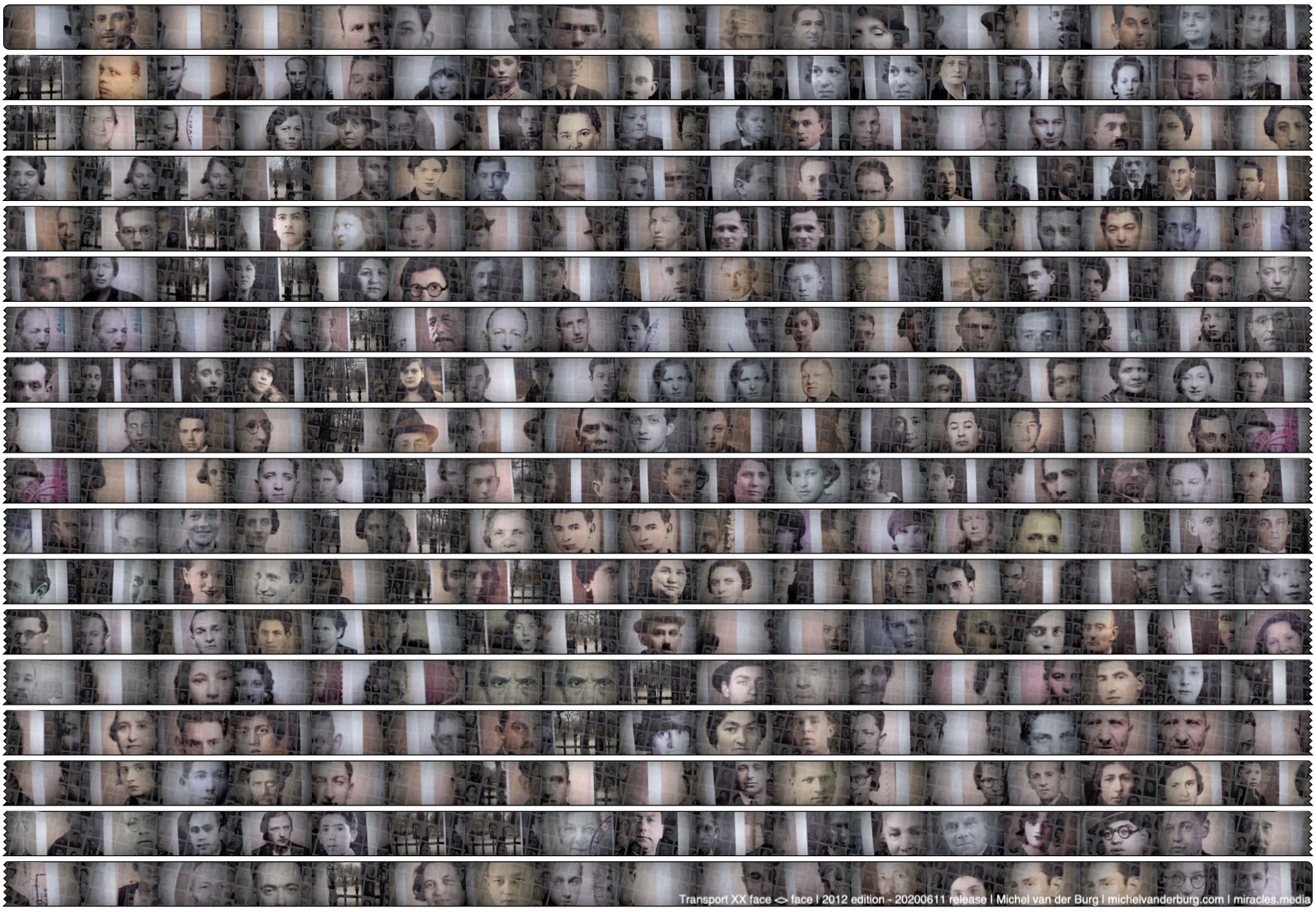
Transport XX face < > face | 2012 edition .
A video impression filmed February 2009 , of the confrontation of passers-by with the TRANSPORT XX installation in Brussels, that presented photographic portraits of 1,200 of the 1,631 Jewish prisoners deported with the 20th train convoy to Auschwitz in 1943.
The TRANSPORT XX installation in Brussels was organised from 27 January to 15 March 2009 by the BELvue Museum in collaboration with the JMDR / Kazerne Dossin. The photographic portraits were displayed outside in the Royal park in Brussels (opposite the Royal Palace).
On April 19, 1943 at 10 p.m. the 20th train convoy departed the Dossin barracks (Kazerne Dossin) in Mechelen (Belgium) with 40 cattle cars crammed with 1631 Jewish men, women and children for Auschwitz (Poland). The in Belgium captured Jews were over 90% ‘foreigners’ (with no Belgian nationality) who either when war broke out or (many) years earlier had fled from mainly Eastern Europe, Germany and Holland to Belgium. Half an hour after the departure of this transport XX three young Belgians from Brussels, Youra Livschitz, Jean Franklemon and Robert Maistriau stopped the train between Boortmeerbeek and Haacht, opened one of the cars and liberated 17 prisoners. Later before the train reaches the German border over 200 other prisoners decide to attempt to escape and also jump out of the cars. In total 236 people were able to escape, but 26 were shot and killed trying to escape.
This 20th transport arrived at Auschwitz on April 22 with 1395 deportees. Only approximately 151 of those on board survived this and later death camps. This was the only documented attack on a death train during the Shoah.
More on Transport XX – including the documentary film Transport XX to Auschwitz – at my web site here – https://michelvanderburg.com/2013/04/19/transport-xx-to-auschwitz/ .
TRANSPORT XX – installation Brussels | 2009 film .
First film edition “TRANSPORT XX – installation Brussels”.
A first edition of this film entitled “TRANSPORT XX – installation Brussels” was published on 19 april 2009 via my YouTube channel – and that version was also added in 2009 to the collection of the Dossin Barracks / Jewish Museum of Deportation and Resistance (Mechelen, Belgium).
Transport XX face to face | 2010 film .
The 2nd edition named “Transport XX face to face” has some editing corrections and a new title and credits.
This edition was first published October 2010 in the 7th round of the New Arrivals 2010 / 2011 of the dutch ‘NTR’ broadcaster: http://www.kortefilmonline.ntr.nl , and uploaded January 2011 at my Vimeo channel and at my now obsolete YouTube channel iClip. Remake 2010 film.
A remake at higher resolution , was published June 9, 2020.
Transport XX face to face | 1 minute film .
The 2010 second edition was used for the special 1 minute production “Transport XX face to face” selected in 2010 by The One Minutes and the dutch Museum of National History (innl) – see post 20200607.
Het XXste Transport naar Auschwitz | Marc Michiels & Mark Van den Wijngaert | ISBN 9789059089808
A DVD edition of that one minute film was screened at the book presentation April 2012 ‘Het XXste Transport naar Auschwitz’ by Marc Michiels & Mark Van den Wijngaert at the Boortmeerbeek townhall (note a new edition was published last year , ISBN 978 90 5908 980 8 ) , and next at the 2012 Transport XX commemoration and the war photography exhibition ‘Our World, at War’ from April 16 – May 31 , 2012 in the HaBoBIB public library in Boortmeerbeek, Belgium.
Storyboard film Transport XX face <> face | 2012 edition
Transport XX face < > face | 2012 edition .
This edition presented here is the 2012 film that was reworked – the opening and closing street scenes were deleted – and published April 2012 as Transport XX face <> face (2012 film) online via Vimeo , and distributed in a limited DVD edition of both that film version and also a ‘loop’ version of the film, to the Boortmeerbeek commemoration organization (together with the 1 minute film DVD edition – see above).
Transport XX face < > face | 2012 edition | 20200611 release
Today (20200611) this 2012 edition is published in higher resolution as part of my project to republish former Vimeo uploads at my YouTube channel (both to improve and secure screening and archiving).
Credits.
The Kazerne Dossin ( http://www.kazernedossin.eu/ ) digitalised the photo’s of the Dossin prisoners, that mostly are from the “National State Archives of Belgium. Ministry of Justice, Public Safety Office, Foreigner’s Police, individual files” ( http://www.arch.be/ ) .
Thank you: Marjan Verplancke and other co-workers of the Kazerne Dossin in Mechelen (Belgium) and project “Give them a Face” which aims to bring together as many portraits of deportees from the Dossin barracks in Mechelen as possible and give them back their face – and the memory alive.
Film : Transport XX face < > face | 2012 edition – 20200611 release | Michel van der Burg | michelvanderburg.com | miracles.media .