‘Entartete Art’ 1935 – Coleman Hawkins & Leo de la Fuente in Holland
American saxophonist Coleman Hawkins announces and plays – accompanied by Leo de la Fuente on piano – on his tenor saxophone ‘I wished that I were twins’.
In 1934, Coleman Hawkins left the Fletcher Henderson Orchestra and Amerika, moved to Europe, and joined the Jack Hylton Orchestra in England. Hylton and his band made regular ‘continental’ tours, and started another European tour January 1935 accompanied by Coleman Hawkins in Holland. At the end of January 1935 Hawkins joins the dutch band The Rambers … for 8 days … because Hawkins was denied entry to Germany because of his race, while Hylton and his band continued their tour without him and play for eight days at the Berlin Philharmonic Hall.
To end this special week with Hawkins well, the bandleader of The Ramblers – Theo Uden Masman – arranged with Decca for recordings 4 february 1935 in Pulchri Studio in The Hague, Holland, including this : I wish I were twins…that was also recorded on film by Polygoon (Polygoontoon) for the dutch cinema news for next week .
Coleman Hawkins is accomponied here on film by the dutch jazz pioneer Leo de la Fuente on piano , playing ‘I wished that I were twins’ . After the recordings, Hawkins moves further into Europe.
Leo – Leonard Henriques – de la Fuente, who was born Jewish in Amsterdam 28 March 1902, was deported by the nazi’s to Auschwitz on 2 November 1942, and died 30 April 1944 ‘somewhere in Mid Europe’.
entartete art jazz 1935 coleman hawkins leo de la fuente in holland 20231123 1
entartete art jazz 1935 coleman hawkins leo de la fuente in holland 20231123 2
entartete art jazz 1935 coleman hawkins leo de la fuente in holland 20231123 3
Citation : ‘Entartete Art’ 1935 – Coleman Hawkins & Leo de la Fuente in Holland | 20231123 | Settela•Com | ISSN 2949-9313 | TakeNode 4f388407-5ccc-4816-aef6-6064fcee35b2
Rhythmus was a jazz orchestra in the Buchenwald concentration camp in which a total of 23 musicians from 9 different countries played together from 1943 until the liberation. Czech prisoners around Jiří Žák took the initiative to found this orchestra in the summer of 1943.
Among the French prisoners that later joined, were Yves Darriet – the bandleader , who wrote most arrangements , and Robert Widerman – the band’s singer , who made a career as Robert Clary on Broadway after the war.
Two programs are known to have been performed in November 1944 and April 19, 1945, i.e. 8 days after the liberation of the camp (Ref 1) , including compositions by Duke Ellington, Lionel Hampton and pieces by Cole Porter, Fats Waller, Glenn Miller and Louis Armstrong. In The Mood was performed even though this music was banned in Nazi Germany.
Ref. 3 – Jazz im KZ Buchenwald – das gab es wirrklich! | weimarer-rendezvous | Sep 25, 2022 https://youtu.be/HX4X7TJ19nQ
„Rhythmus“ – Jazz im Konzentrationslager Buchenwald
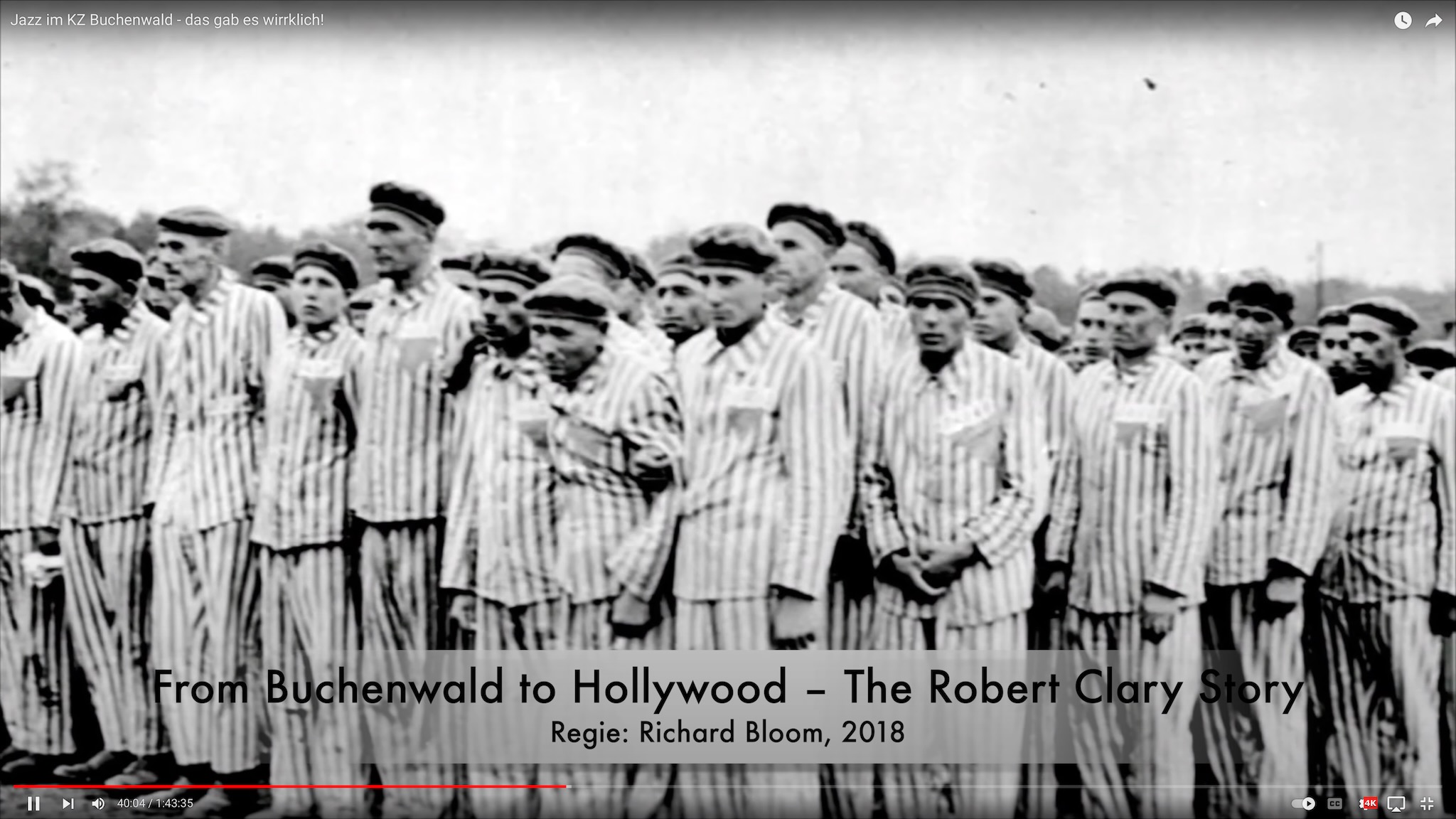
At the April 11, 2022 event ‘„Rhythmus“ – Jazz im Konzentrationslager Buchenwald’ — in the Notenbank in Weimar, Germany (Ref 2, 3) — the Big Band and a jazz ensemble of the Hochschule für Musik under the direction of Prof. Gero Schmidt-Oberländer performed 9 or 10 pieces from the programs. In addition biographies of the prisoners in the Buchenwald Jazz Orchestra were made visible using excerpts from their letters and reports.
The French singer Robert Widerman ( Robert Clary ) was shown in a clip (Ref 4) from the documentary film From Buchenwald to Hollywood, The Robert Clary Story (Ref 5). Robert Clary (March 1, 1926 – Nov 16, 2022) survived thanks to several prisoners, including Yves Darriet (pseudonym Jan Rolan, Jean Roland), Claude Francis-Boeuf, and Jiří Žák. (Ref 6)
5. From Buchenwald to Hollywood, The Robert Clary Story by Karen and Richard Bloom and Michel van der Burg | 2023 Edition | 20230202 | URL https://youtu.be/0tKc5T-Sw-E
Seven Sisters II | Falaise #156 | 20230816 | Michel van der Burg | 1-memo•com | The geological timeline is evident rising along the steep ca 60 meters high chalk cliffs of Ault, with horizontal dark bands of flint (hard rock) in the soft chalk rock of the cliffs. The Seven sisters flint band, which characterizes the transition between Middle and Upper Coniacian, is near the top of the cliffs. Aerial drone recording around 9 AM on April 2, 2022, on the Alabaster coast at the cliffs of Ault, Picardy, France…Follow-up of film Falaise #153 dd 20230813 | TakeNode
Seven Sisters | Falaise #153 | 20230813 | Michel van der Burg | 1-memo•com | The geological timeline is evident rising along the steep ca 60 meters high chalk cliffs of Ault, with horizontal dark bands of flint (hard rock) in the soft chalk rock of the cliffs. The Seven sisters flint band, which characterizes the transition between Middle and Upper Coniacian, is near the top of the cliffs. Aerial drone recording at 9 AM on April 2, 2022, on the Alabaster coast at the cliffs of Ault, France. | TakeNode 47411fe2-7cae-4853-8dee-ee6ebf695dbf
The Seven Sister were described April 2023 by Nelson Pain :
“The cliffs that surround Ault beach are made up of chalk from the Upper Cretaceous, more precisely from the terminal Turonian and Coniacian (about 83 Ma to 90 Ma). They are dotted with nodules of flint which underline the sub-horizontal stratification planes … The relative proportion between chalk and flint is approximately 90-95% chalk to 5-10% flint.
Flint horizons are stratigraphic markers. On the cliffs around Ault, the regular band of flint named Seven Sisters is recognizable and characterizes the boundary between the Middle Coniacian and the Upper Coniacian (about 87 Ma). The boundary between Lower and Middle Coniacian is marked by the marly Shoreham 2 level, which is more difficult to identify. These lithostratigraphic markers allow in particular the correlation of distant deposits, such as between the Normandy and Picardy coasts, or even between the French and English coasts.”
New updated edition (Jan 2023) of the film by Karen and Richard Bloom and Michel van der Burg , about the Hollywood legend, internationally known actor, Broadway star, singer, artist, author and Holocaust lecturer , Robert Clary.
“Don’t think negatively.
Think Positively.
Don’t Hate.
Hate is a waste of time and energy.”
In memoriam : Robert Clary (March 1, 1926 – Nov 16, 2022)
Rhythmus | 20221117 | 1-memo•com
Robert Clary had rhythm ! Born Robert Widerman, March 1, 1926 in Paris — he passed away yesterday Nov 16, 2022, at his home in Los Angeles. He was 96. Robert was deported from Paris at the age of 16 to the death camps. April 19, 1945 he was singing and dancing in Buchenwald with the Rhythmus Jazz Band entertaining the U.S. Army troops who had liberated the camp .
Photo (courtesy Richard Bloom Productions) copy of the Program of 19.4.1945 – Rhythmus – 1st Jazz Concert in the liberated Buchenwald – – Vocal : Widerman / France . With political prisoner , resistance fighter, Jiří Žák (bass; founder of the band) who saved Robert’s life and the life of others in the Buchenwald Concentration Camp. Band leader Yves Darriet came up with the nickname Clary for Robert (from the movie Les Adventures de Désirée Clary) — the artist name Robert Clary made name with on Broadway in Hollywood … the US .
TakeNode 41cea270-d525-45f2-81f6-8c95a15514dc