Spring 1944 a film is being made in the Westerbork camp, ordered and produced by camp commander SS-Obersturmführer Albert Gemmeker. Cameraman is the German Jewish prisoner Rudolf Breslauer – the camp photographer. In addition film scripts were made, but the film was never really finished or edited.
Westerbork Film Dossier
In 2017 the film dossier – with the film footage and production documents – enters the UNESCO Memory of the World Register (REF 1) . The final part of the UNESCO registry (Le film de Westerbork – édité le 8 mai 2017 – ID code 2016-118 ) lists all the documents on the Westerbork Film at the NIOD Institute for War, Holocaust and Genocide Studies (REF 2).
That NIOD archive file — called (translated) : Directing, texts and correspondence of the film “Westerbork” has been scanned and made available online. The file contains film scripts, title cards, and the correspondence on the film.
Westerbork Film
May 7, 2022 the latest edition of the Westerbork Film – a compilation of digitally restored footage – was posted with annotations as optional closed captions – CC (REF 3). In addition a short film ‘Westerborkfilm Introduction’ was posted (REF 4) that addresses briefly the history, context, and contents of the film dossier, camp and film crew, postwar route of the film footage, including a glimpse of the film plan, title cards and correspondence.
Production documents
Before , the title cards (REF 5) and the film scripts (REF 6) were posted.
All other production documents – a file with correspondence between the camp and the outside world on obtaining camera’s , film and film processing – are detailed chronologically here in this short silent film “Westerbork Film Correspondence | 20220509” .
CREDITS
Source : NIOD Institute for War, Holocaust and Genocide Studies | 250i Westerbork, Judendurchgangslager | 854 Stukken over de Westerbork-film, 7 maart – 20 april 1944 en z.d. | File retrieved May 23, 2019 from Nationaal Archief (REF 10).
Westerbork Film Correspondence | 20220509 | Michel van der Burg | Settela•Com – CC BY 4.0
9 – Settela, het meisje heeft haar naam terug (1995-2007) by Aad Wagenaar ISBN 9789089751898 / English translation by Janna Eliot ‘Settela’ (2005-2016) ISBN 978-0-9933898-2-5 .
Westerbork Film Plan
Spring 1944 a film is being made in the Westerbork camp, ordered and produced by camp commander SS-Obersturmführer Albert Gemmeker. A Film Plan propasal – 1.5 page – is written by his personal assistant the German prisoner Dienstleiter Heinz Todtmann – a journalist before WW2. Cameraman is the German Jewish prisoner Rudolf Breslauer – the camp photographer – who may have contributed to this filmplan too. In addition to the film plan , more detailed scripts were made with camera instructions and edit instructions. The film was never really finished or edited.
Westerbork Films Dossier
In 2017 the complete film dossier enters the UNESCO Memory of the World Register — including the film footage, the scripts, the drawn title cards, and the camp correspondence on the film (REF 1) . The final part of the UNESCO registry (Le film de Westerbork – édité le 8 mai 2017 – ID code 2016-118 ) lists all the documents on the Westerbork Film at the NIOD Institute for War, Holocaust and Genocide Studies.
That NIOD archive file — called (translated) : Directing, texts and correspondence of the film “Westerbork” consists of a file containing the original screenplay or script for the film, title cards, notes, correspondence and administration . That entire file has been scanned (total of 60 black and white scans) and is available online.
Westerbork Film
May 7, 2022 the complete remastered 2021 edition of the Westerbork Film – a compilation of digitally restored footage – was posted with annotations as optional closed captions – CC (REF 2) .
Westerborkfilm Introduction
May 7, 2022 also a short film ‘Westerborkfilm Introduction’ was posted (REF 3) that addresses briefly the history, context, and contents of the film dossier, camp and film crew, postwar route of the film footage, including a glimpse of the film plan, title cards and correspondence.
Title Cards
The title cards were posted in detail May 2021 (REF 4).
Film Scripts
Likewise now the film scripts (REF 5) are detailed in this short silent film Westerbork Film Scripts | 20220508 .
9 – Settela, het meisje heeft haar naam terug (1995-2007) by Aad Wagenaar ISBN 9789089751898 / English translation by Janna Eliot ‘Settela’ (2005-2016) ISBN 978-0-9933898-2-5 .
Westerborkfilm Introduction | 20220507 | Michel van der Burg | Settela•Com | Introduction by Michel van der Burg on the Westerborkfilm first showing May 7, 2022 in cinema METRO Kinokulturhaus , Vienna , Austria at the DOCUMENTS OF DESTRUCTION | DOKUMENTE DER VERNICHTUNG Symposium 6-7 May, 2022 curated by Florian Widegger. Presented by Filmarchiv Austria in cooperation with the Vienna Jewish Film Festival and the Mauthausen Memorial.
This introduction is now screening via YouTube , and embedded above.
Westerborkfilm with introduction – DOKUMENTE DER VERNICHTUNG Symposium 6-7 May, 2022 curated by Florian Widegger. Presented by Filmarchiv Austria in cooperation with the Vienna Jewish Film Festival and the Mauthausen Memorial URL https://www.filmarchiv.at/en/program/special/dokumente-der-vernichtung/
CREDITS & REFERENCES
Special thanks to Valentine Kuypers , curator at Sound and Vision, image researcher Gerard Nijssen, and the Westerbork Memorial Center researchers Bas Kortholt , Koert Broersma and Gerard Rossing. Aad Wagenaar, research journalist and author of book Settela.
Work on the 2021 Westerbork film edition has been a joint effort of four dutch organizations : the Dutch media archive Sound & Vision, Camp Westerbork Memorial Centre , the NIOD Institute for War, Holocaust and Genocide Studies, and the Jewish Cultural Quarter in Amsterdam.
The Westerbork film, May 7, 2022 at the symposium DOKUMENTE DER VERNICHTUNG of the Jüdischen Filmfestival Wien , the Mauthausen Memorial , and Filmarchiv Austria.
Settela, het meisje heeft haar naam terug (1995-2007) by Aad Wagenaar ISBN 9789089751898 / English translation by Janna Eliot ‘Settela’ (2005-2016) ISBN 978-0-9933898-2-5 .
Documentary film Settela, gezicht van het verleden by Cherry Duyns (VPRO, 1994).
De Westerborkfilm 📽️🎞️ | Nederlands Instituut voor Beeld & Geluid | YouTube Apr 8, 2021 URL https://youtu.be/8Y-A4BkWY18
Gerestaureerde filmbeelden Westerbork (1944) (May 18, 2021) Nederlands Instituut voor Beeld en Geluid | Youtube (accessed 2021 Jul 19) URL: https://youtu.be/-zCmr6PSNcI
Kamp Westerbork gefilmd (May 2021) Koert Broersma, Gerard Rossing (editor Gorcum B.V., Koninklijke van) ISBN 9789023257622.
‘Kamp Westerbork gefilmd’ by Koert Broersma and Gerard Rossing (editors Dirk Mulder and Ben Prinsen) ISBN 9023232658
Dawn Skorczewski & Bettine Siertsema (2018): ‘The kind of spirit that people still kept’: VHA testimonies of Amsterdam’s Diamond Jews, Holocaust Studies URL: https://doi.org/10.1080/17504902.2018.1516361
Diamantkinderen: Amsterdamse Diamantjoden en de Holocaust . Translated title of the contribution: Diamond Children: Amsterdam’s Diamond Jews and the Holocaust. Siertsema, Bettine (2020) Uitgeverij Verbum ISBN 9789493028340
Fabian Schmidt (2020): The Westerbork Film Revisited: Provenance, the Re-Use of Archive Material and Holocaust Remembrances, Historical Journal of Film, Radio and Television, URL : https://doi.org/10.1080/01439685.2020.1730033
Westerbork Film Scripts | 20220508 | Michel van der Burg | Settela•Com
Westerbork Film Correspondence | 20220509 | Michel van der Burg | Settela•Com
ANONYM | Girl with the headscarf … | 20210416 | Michel van der Burg | Settela•Com
Westerbork Film in ‘Proces Rauter’ 1948 | 20190520 | Michel van der Burg | Settela•Com
Westerbork Film 🎦 2021 | 20220302 | Michel van der Burg | Settela•Com | Display edition annotated online in CC.
Westerborkfilm Introduction | 20220507 | Michel van der Burg | Settela•Com | Introduction by Michel van der Burg on the Westerborkfilm screening in METRO Kinokulturhaus , Vienna , Austria at the DOCUMENTS OF DESTRUCTION | DOKUMENTE DER VERNICHTUNG Symposium 6-7 May, 2022 curated by Florian Widegger. Presented by Filmarchiv Austria in cooperation with the Vienna Jewish Film Festival and the Mauthausen Memorial.
Dag uit het leven van Simon Gronowski — de jongen die uit de trein sprong die naar Auschwitz reed
Dinsdag 19 april 2022
Rutger | Groep 8, School Ter Cleeff, Haarlem, Holland
Wie Is Simon Gronowski?
Het is nu 1943. Ik heet Simon Gronowski. Ik ben geboren op 12 oktober 1931 in Brussel, waar ik ook nog steeds woon. Als klein jongetje ging ik graag naar de bioscoop of naar het Terkamerenbos (park in België) om met mijn hond Bobby te spelen. Mijn moeder heet Ania en mijn vader heet Léon. Mijn vader heeft een eigen winkel en hij maakt ook een eigen krant. Ik heb ook nog een zus: Ita. Ze is 18 jaar en zeven jaar ouder dan ik. Ze kan heel goed piano spelen en is altijd aardig. Ze heeft ook al een vriend, hij heet Jacques. Op school ben ik een echte vechtersbaas en ook thuis haal ik af en toe kattenkwaad uit! Vanaf mijn negende zit ik op scouting. Ik vind het daar heel cool. En ik heb er veel nieuwe vrienden leren kennen. Zoals elke scout heb ik een teamnaam; de mijne is “Bambi”.
De Bezetting
In 1940 hoorden wij de motoren van Duitse vliegtuigen boven Brussel. Mijn vader legde uit dat Hitler eerst Oostenrijk en Polen heeft veroverd met zijn leger en ook België wil overnemen. De Duitse soldaten zijn langzamerhand een vertrouwd beeld op straat. Ze zijn een klant in de winkel van mijn ouders. Ik vond ze in het begin eigenlijk wel aardig. Het is de tijd van de bezetting en in het begin gaat het leven nog gewoon helemaal hetzelfde. Want weet je de vervelende dingen van de oorlog die komen beetje bij beetje. Je hebt het niet gelijk door. Eerst willen de nazi’s lijsten opmaken met namen van alle joden. Met iedereen, die tenminste drie joodse grootouders hebt. De nazi’s vertellen ons dat ze dit doen om ons te helpen. En dus heeft mijn vader me ingeschreven. We hadden ze minder moeten vertrouwen… Wanneer we beseften dat we gevaar liepen, was het al te laat: ze hadden ons verplicht een gele ster op onze kleren laten naaien. Ze hebben beslist om aparte scholen te openen voor de Joodse kinderen. Persoonlijk maakt dat me niet zoveel uit en ben ik ook niet echt bang. Wat belangrijk is als je jong bent is dat je vrienden hebt en plezier maakt. Je maakt jezelf wijs dat het allemaal normaal is, dat het hoort bij een oorlog. Soms hoor je verhalen, maar wil je gewoon niet geloven wat er wordt verteld. Later nemen de Duitsers de radio’s in beslag. We kunnen en mogen niet langer naar nieuwsberichten luisteren. Ze sluiten ook de winkel.
Onze winkel heet “bij Sally”! De s van Simon (dat ben ik!). De a van Ania (mijn moeder), de l van Léon (mijn vader met een dubbele l, omdat hij het allersterkst is). En tot slot de y van Ita (mijn zus). We hebben bewust niet een i genomen anders had er Salli gestaan wat “vuil gemaakt” betekent in het Frans. Ze beginnen wijken af te sluiten en razzia’s uit te voeren, waarbij ze massaal mensen arresteren, alleen omdat ze Joods zijn. Vrienden van scouting verstoppen ons. We moeten ons huis, en onze tuin verlaten en leven vanaf nu met zijn vieren opgesloten in een appartement. Met amper 3 kamers in Woluwe (een dorp vlakbij Brussel). In het midden van de winter wordt mijn vader ziek en moet hij naar het ziekenhuis.
17 Maart 1943
Het is negen uur ’s ochtends. We zitten aan tafel te ontbijten: mijn moeder, mijn zus en ik. Er wordt aangebeld. De deur gaat open. Plotseling stormen twee Duitsers de kamer binnen. Mijn moeder toont haar papieren. Ze vragen waar mijn vader is. Zij zegt dat hij dood is. We moeten onze koffers laten zien. Ze binden mijn hond vast aan een trapleuning. En toen zijn we met ze meegegaan. De politie stopt ons dan in een kelder. Op de muren staan allemaal namen en datums die daar door andere mensen zijn gekrast die hier ook gevangen hebben gezeten. We moeten daar de hele nacht blijven.
De Ontvoering
Tot de volgende dag krijgen we niets te eten of te drinken. Het is dan al bijna avond. Wanneer we van hen wegmoeten uit de kelder, zijn we met zo ongeveer 50 mensen, allemaal opgepakt tijdens de razzia’s, in amper twee dagen tijd. Ze laten ons op een kleine vrachtwagen klimmen, waar we ons meteen onder een zeil moeten verstoppen, zodat de mensen op straat ons niet konden zien. Toen zijn ze met ons naar een kazerne in Mechelen gereden. Daar aangekomen, stellen ze ons op een hele grote binnenplaats in rijen op. Iedereen heeft in zijn koffers de meest waardevolle spullen meegenomen: juwelen, rantsoenbonnetjes, sleutels, familiefoto’s, brieven… We moeten één voor één aan een tafel langsgaan en alles geven wat we nog hebben kunnen meenemen. Ze kijken ook alle hoeden grondig na en halen er zelfs de voering uit. Ze snauwen ons toe en je kan ook het gehuil horen van de mensen die zich toch proberen te verzetten.
Mij vragen ze alleen mijn naam. Dan geven ze een stuk karton met daarop het nummer voor mijn transport, nummer 1234. Ik moet het karton om mijn hals hangen. Mijn moeder krijgt nummer 1233. Ze brengen ons naar zaal 18, op de 2de verdieping. Ita krijgt nummer B274, omdat zij op haar 16de voor de Belgische nationaliteit heeft mogen kiezen. Zij wordt naar een andere zaal weggevoerd. Iedereen weet dat deze kazerne een verzamelplaats is, maar niemand weet wat er binnen de muren gebeurt. Twee tot drie keer per week komen hier vrachtwagens naar toe.
In onze zaal staan honderd stapelbedden. Geen wc, enkel een paar gaten. Een pan met warm water moet soep en koffie voorstellen. Ze geven ons een beetje brood. Wie geluk heeft, krijgt een pakje van zijn vrienden toegestuurd. We moeten ons twee keer per dag melden op de binnenplaats, zowel ’s nachts als overdag, onder het waakzaam oog van de Duitsers, met een zweep in de hand en een pistool aan de riem. Ikzelf ben blij dat ik niet van mijn moeder en zus gescheiden word.
Met een paar vrienden oefenen we om later kunnen ontsnappen. We blijven daar een maand. Plots gaat er een gerucht rond dat er binnenkort weer een groep mensen moet vertrekken. En op zondag is het dan zover. Er wordt ons gezegd dat we naar een werkkamp vertrekken, ergens in Oost-Europa. Ik moet heel lang in de file aanschuiven, samen met mijn moeder. Vanachter haar raam houdt mijn zus ons in het oog. Op dat moment worden de mensen met een Belgisch paspoort nog niet gedeporteerd. Wanneer onze nummers worden geroepen, moeten we in een treinwagon stappen. De vloer is bedekt met stro. De deur wordt dichtgeschoven. We zitten met vijftig anderen mensen gevangen in het donker. En dan valt de grendel in het slot. We moeten nog uren wachten tot de trein gaat rijden.
19 April 1943
Het is 19 april. Mijn vader is jarig, hij wordt 45. Ik ben tijdens de reis in slaap gevallen. Tijdens mijn slaap hebben een paar gevangenen de deur van de wagon opengemaakt. En wanneer mijn moeder me wakker maakt, staat de deur wagenwijd open. Mijn moeder zegt dat ik moet springen. Ze laat me los. Ik spring. Ik wacht op mijn moeder en hoor dat de trein tot stilstand komt. Dan wordt er in het Duits geroepen en gevloekt en vallen er geweerschoten. Als ik had geweten dat mijn moeder niet uit de trein zou gaan springen, was ik ook nooit gegaan. Ik zie dat de trein weer gaat rijden. Ik loop weg van het spoor, maar weet niet precies in welke richting ik moet lopen. Ik heb de hele nacht doorgelopen.
Na De Gebeurtenis
De volgende ochtend, helemaal onder het vuil, kom ik aan in een dorp. Ik ga ergens aanbellen. De vrouw die de deur opent, gaat met mij naar de politie die mij naar Jean Aerts, een politieagent brengt. Hij begint mij vragen te stellen. Ik vertel dat ik in de buurt met kinderen aan het spelen was, maar verkeerd ben gelopen. Ik moet naar Brussel, naar mijn vader. De politieagent zegt: ik weet alles. Jij bent dat Joodse jongetje dat van de trein is afgesprongen. Je hoeft niet bang te zijn. Ik zal je niet verraden. Jean Aerts en zijn vrouw stellen voor om me veilig bij hen te verstoppen. Maar ik wilde koste wat het kost terug bij mijn vader zijn. Wat later brengt hij me op zijn fiets naar het station. Sinds lange tijd zie ik opnieuw hoe er buiten uit ziet: de lucht, de velden, de bomen, de vrijheid… Er zijn nog andere mensen van dezelfde wagon gesprongen, maar die hebben minder geluk gehad.
Ik heb mijn leven te danken aan de personen die de deur van de wagon open hebben gekregen, aan een mevrouw die haar deur niet voor mijn neus heeft dichtgegooid en aan een politieagent. Iedereen heeft moed gevonden om iets voor mij te doen en het zijn precies deze kleine dingen die mij uiteindelijk gered hebben!
Nawoord
Mijn YouTube-opa (Michel van der Burg) heeft me op dit verhaal gewezen. Hij heeft Simon Gronowski meerdere keren gesproken en geïnterviewd. Hij heeft samen met anderen van dit verhaal een film (Transport XX to Auschwitz – current version – YouTube https://youtu.be/CgE7x4qwQZs ) gemaakt, die je op zijn YouTube- kanaal kunt bekijken.
Rutger , 19 april 2022
Dank
Dag uit het leven van Simon Gronowski, de jongen die uit de trein sprong die naar Auschwitz reed | Rutger | Stelopdracht dinsdag 19 april 2022, Groep 8, School Ter Cleeff, Haarlem, Holland.
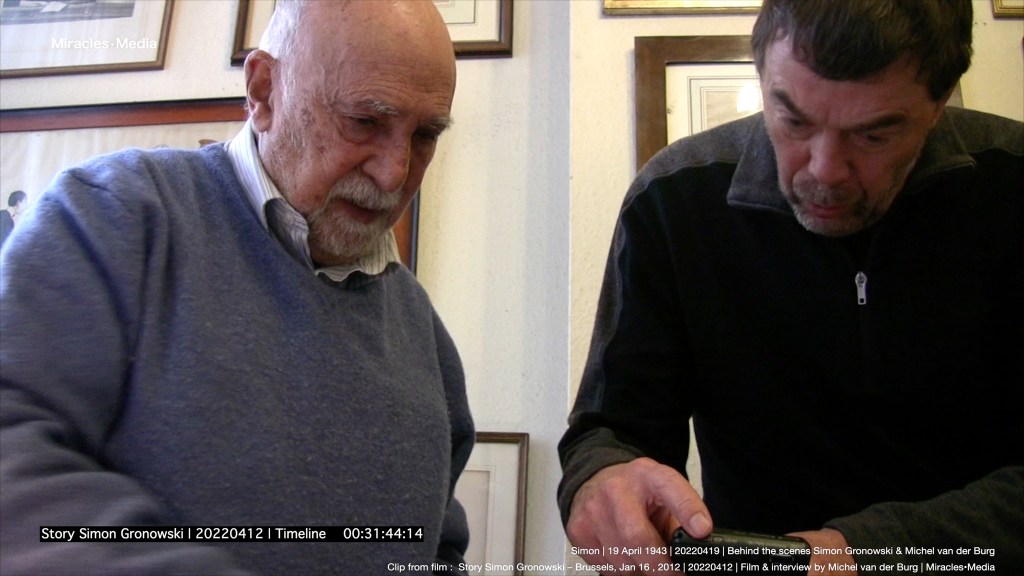
Simon | 19 April 1943 | 20220419 | Behind the scenes Simon Gronowski & Michel van der Burg | Clip from film : Story Simon Gronowski – Brussels, Jan 16 , 2012 | 20220412 | Film & interview by Michel van der Burg | Miracles•Media
Film : Story Simon Gronowski – Brussels, Jan 16 , 2012 | 20220412 | Film & interview by Michel van der Burg | Miracles•Media | Raw footage film Miracles (currently not for general public distribution).
Transport XX to Auschwitz – a film by Karen Lynne & Richard Bloom and Michel van der Burg – YouTube https://youtu.be/CgE7x4qwQZs
Westerbork Film 🎦 2021 | The complete remastered edition of the Westerbork Film , here annotated online in CC – by Michel van der Burg as an ongoing integrating resource.
The original display edition of the restored Westerbork film was edited only for black bar removal conform 4:3 format and insertion of a title card intro and outro. Annotations are added as CC – closed captions.
Source : digital display edition of the restored Westerbork film compilation made available in Public Domain by Sound and Vision from May 18, 2021. Courtesy of Collection NIOD held at the Netherlands Institute for Sound and Vision. Source File : Westerbork (gerestaureerd) | Display edition. Retrieved (20210518) PID: URN:NBN:NL:IN:20-ZCRLTUSICOSDILNR .
Credit line :
Westerbork Film 🎦 2021 | 20220302 | Michel van der Burg | Settela•Com – CC BY 4.0
Description & Introduction film
The Westerbork Film – a silent film – is unique…the only authentic documentary footage filmed in a Nazi camp – a waiting room for death in the Netherlands for more than 100,000 Jews, and Roma, Sinti, and resistance workers. A documentary filmed spring 1944, in the Westerbork camp, by the German-Jewish camp prisoner Rudolf Werner Breslauer – the camp photographer, and commissioned by camp commander, SS-Obersturmbannführer, Albert Konrad Gemmeker.
The Westerbork camp was set up in 1939 before the war in Holland, by the Dutch government, as a central refugees camp for Jewish refugees from Nazi-Germany.
July 1942 , when the Nazi’s decided to start ‘Entjüdung’ of the Netherlands, they took over the camp for use as transit camp for deportation of mainly Jews, and Roma, Sinti, and resistance people to eastern Europe.
March 2, 1944 , SS leader Rauter in the Netherlands reports to Germany’s SS Reichsführer Himmler : the Netherlands are ‘Judenfrei’. March 5, 1944 the camp is ‘Arbeitslager’ – a work camp – when
Rudolf Breslauer starts filming the daily life of the Westerbork prisoners. After Breslauer films the deportation of Jews, Roma and Sinti to Bergen-Belsen and Auschwitz on May 19, 1944 the filming stops. The film is also not edited. In 1986 the dutch RVD Information Center makes a first montage in 4 acts of the footage into what is known now as the Westerborkfilm. In 2017 the film dossier – film and production documents – enter the UNESCO Memory of the World Register. Spring 2019 the Westerbork Film – full version (RVD) was published online and annotated – https://settela.com/2019/06/05/westerbork-film-full-version-rvd/ .
Spring 2019 the dutch Sound & Vision , EYE Filmmuseum and NIOD (former RIOD) started a major restauration project and search for all footage of the Westerbork film in all archives.
Two reels with original negative film were discovered by image researcher Gerard Nijssen.
All restored unique shots using both the camera original film and film copies (prints – when no original is known) were used for the new restored Westerbork film compilation made available as ‘display edition’ – with no title actually – by Sound and Vision | NIOD on May 18, 2021.
This newly restored 2021 version of the Westerbork film , 145 min long – was prepared for presentation here in 4:3 format (black bars removed) with a 6 seconds title card superimposed both at the start and the end of the film (superimposed on the originally 30 sec intro text and 17 sec outro text sections by Sound & Vision), in order not to change the length of the film – to allow exact reference to the original file’s timeline.
Westerbork Film 🎦 2021 | 20220302 was first uploaded March 2, 2022, and is now after annotation of the online film made public May 7, 2022 together with a short introductory film : Westerborkfilm Introduction | 20220507 | Michel van der Burg | Settela•Com | An introduction film by Michel van der Burg on the Westerbork film with a first showing May 7, 2022 in METRO Kinokulturhaus , Vienna , Austria at the DOCUMENTS OF DESTRUCTION | DOKUMENTE DER VERNICHTUNG Symposium 6-7 May, 2022 curated by Florian Widegger. Presented by Filmarchiv Austria in cooperation with the Vienna Jewish Film Festival and the Mauthausen Memorial.
Annotations
On YouTube called Chapters – there limited number due to limit number of characters in description
NOTE : for this shot right after the Degen toddlers, Breslauer had to move all the way back to last cars of the transport to Auschwitz – May 19, 1944 – E198 Roll 2/4
00:17:03 Outbound transport to Bergen-Belsen and Auschwitz – May 19, 1944 – Original Reel E198 Roll 2/4
00:17:49 Gemmeker group passing camera in the middle
00:17:55 Outbound transport to Bergen-Belsen and Auschwitz – May 19, 1944 – Original Reel E198 Roll 2/4
Original Reel E198 Roll 3/4
00:18:13 Outbound transport to Bergen-Belsen and Auschwitz – May 19, 1944 – Original Reel E198 Roll 3/4
00:18:51 On the right : SS-Obersturmführer Albert Gemmeker , Commander of Westerbork transit camp
00:18:56 Outbound transport to Bergen-Belsen and Auschwitz – May 19, 1944 – Original Reel E198 Roll 3/4
Special thanks to Valentine Kuypers , curator at Sound and Vision, image researcher Gerard Nijssen, and the Westerbork Memorial Center researchers Bas Kortholt , Koert Broersma and Gerard Rossing. Aad Wagenaar, research journalist and author of book Settela.
Work on the 2021 Westerbork film edition has been a joint effort of four dutch organizations : the Dutch media archive Sound & Vision, Camp Westerbork Memorial Centre , the NIOD Institute for War, Holocaust and Genocide Studies, and the Jewish Cultural Quarter in Amsterdam.
The Westerbork film, May 7, 2022 at the symposium DOKUMENTE DER VERNICHTUNG of the Jüdischen Filmfestival Wien , the Mauthausen Memorial , and Filmarchiv Austria.
Settela, het meisje heeft haar naam terug (1995-2007) by Aad Wagenaar ISBN 9789089751898 / English translation by Janna Eliot ‘Settela’ (2005-2016) ISBN 978-0-9933898-2-5 .
Documentary film Settela, gezicht van het verleden by Cherry Duyns (VPRO, 1994).
De Westerborkfilm 📽️🎞️ | Nederlands Instituut voor Beeld & Geluid | YouTube Apr 8, 2021 URL https://youtu.be/8Y-A4BkWY18
Gerestaureerde filmbeelden Westerbork (1944) (May 18, 2021) Nederlands Instituut voor Beeld en Geluid | Youtube (accessed 2021 Jul 19) URL: https://youtu.be/-zCmr6PSNcI
Kamp Westerbork gefilmd (May 2021) Koert Broersma, Gerard Rossing (editor Gorcum B.V., Koninklijke van) ISBN 9789023257622.
‘Kamp Westerbork gefilmd’ by Koert Broersma and Gerard Rossing (editors Dirk Mulder and Ben Prinsen) ISBN 9023232658
Dawn Skorczewski & Bettine Siertsema (2018): ‘The kind of spirit that people still kept’: VHA testimonies of Amsterdam’s Diamond Jews, Holocaust Studies URL: https://doi.org/10.1080/17504902.2018.1516361
Diamantkinderen: Amsterdamse Diamantjoden en de Holocaust . Translated title of the contribution: Diamond Children: Amsterdam’s Diamond Jews and the Holocaust. Siertsema, Bettine (2020) Uitgeverij Verbum ISBN 9789493028340
Fabian Schmidt (2020): The Westerbork Film Revisited: Provenance, the Re-Use of Archive Material and Holocaust Remembrances, Historical Journal of Film, Radio and Television, URL : https://doi.org/10.1080/01439685.2020.1730033
Westerbork Film Scripts | 20220508 | Michel van der Burg | Settela•Com
Westerbork Film Correspondence | 20220509 | Michel van der Burg | Settela•Com
ANONYM | Girl with the headscarf … | 20210416 | Michel van der Burg | Settela•Com
Westerbork Film in ‘Proces Rauter’ 1948 (20190520) Michel van der Burg | Settela•Com
Westerbork Film 🎦 2021 | 20220302 | Michel van der Burg | Settela•Com | Display edition film annotated online in CC
Westerborkfilm Introduction | 20220507 | Michel van der Burg | Settela•Com | Introduction by Michel van der Burg on the Westerborkfilm screening in METRO Kinokulturhaus , Vienna , Austria at the DOCUMENTS OF DESTRUCTION | DOKUMENTE DER VERNICHTUNG Symposium 6-7 May, 2022 curated by Florian Widegger. Presented by Filmarchiv Austria in cooperation with the Vienna Jewish Film Festival and the Mauthausen Memorial.
20220511 Info on order of shots added in post Westerbork Film Shots Order | 20220511 . Based on that info , here the Annotations list now has sub-headings like ‘Original Reel E325’ etc.
20220604 – Format changes credit line , references
“From Buchenwald to Hollywood, The Robert Clary Story” – A film by Karen and Richard Bloom and Michel van der Burg .
March 1, 2022 – Celebrating Robert Clary’s 96th birthday today announcing this special gift :
Watch online free now our full feature documentary “From Buchenwald to Hollywood, The Robert Clary Story” – A film by Karen and Richard Bloom and Michel van der Burg.
Synopsis
The truly inspiring story of Holocaust Survivor, Robert Clary (born Robert Max Widerman, March 1, 1926 in the heart of Paris, France) who was liberated from Buchenwald on April 11, 1945 by the U.S.Army. Discovered singing in a Paris cabaret and brought to the United States where he became internationally known for his portrayal of Corporal Louie LeBeau on the long running hit TV show Hogan’s Heroes as well as for his Broadway, soap opera and movie roles, his record albums, paintings, autobiography and as an impassioned Holocaust spokesperson.
After the world premiere at the FLIFF (2018) in Hollywood (Florida, USA), and screening at the Paris (2021) Sydney & Melbourne (2021) and Berlin (2022) Lift-Off Film Festivals, the “The Robert Clary Story” film is now made public worldwide available for free watching via their YouTube channel by Richard Bloom Productions (richardbloomproductions•com).
Special thanks to Robert Clary, and Christopher Ray Allison (interview – cinematography) and Nathaniel Link (interview – sound) and many many others…
Watch Free Online – The Robert Clary Story | 20220301
“From Buchenwald to Hollywood, The Robert Clary Story” – A film by Karen and Richard Bloom and Michel van der Burg .
Watch now online at the Berlin Lift-Off Film Festival 2022 … a truly inspiring film about a Hollywood legend ….
Click ⓘ right corner YouTube screen – for link to the site of the Berlin Lift-Off Film Festival 2022 Monday 7th February – Monday 7th March.
Features films
The Berlin Lift-Off Film Festival 2022 is screening 52 feature films The Robert Clary Story is Episode 40 .
Festival Tickets
Get a ‘Features’ ticket with access to all the 52 Features from the Lift-Off Film site, which also allows voting (2 votes) for the films — for direct link Click Checkout ⓘ right corner YouTube screen.
Robert Clary
The producers of Transport XX to Auschwitz and Defending Holocaust History are proudly bringing to the screen, the inspirational film, From Buchenwald to Hollywood, The Robert Clary Story, about a Hollywood legend, an internationally known actor, Broadway star, singer, artist, author and Holocaust lecturer.
Mr. Clary is widely known for his role as Corporal Lebeau on the long running TV series Hogan’s Heroes. What is little known by the public is that Robert’s real last name is Widerman, and in 1942 at the age of 16, he and thirteen members of his family were rounded up in Paris, France and deported by the Nazis to concentration camps. He was the only one to survive, having endured 31 months in four Nazi camps and a death march until his liberation from Buchenwald by the U.S. Army on April 11, 1945. He was discovered singing in a Paris nightclub in 1947, signed to a recording contract and brought to the United States in 1949 where he met Merv Griffin, who introduced him to Eddie and Ida Cantor and their daughter, Natalie, who he would later marry.
The World Premiere was at the Fort Lauderdale International Film Festival in Cinema Paradiso, Hollywood, Fl (USA) in 2018.
Last year the film was screening at the Paris Lift–Off Film Festival 2021, and the Sydney & Melbourne Lift-Off Film Festival 2021.
The film is also available at the holocaust centers USHMM and Yad Vashem.
Promo film (20220224) by Michel van der Burg | Miracles•Media