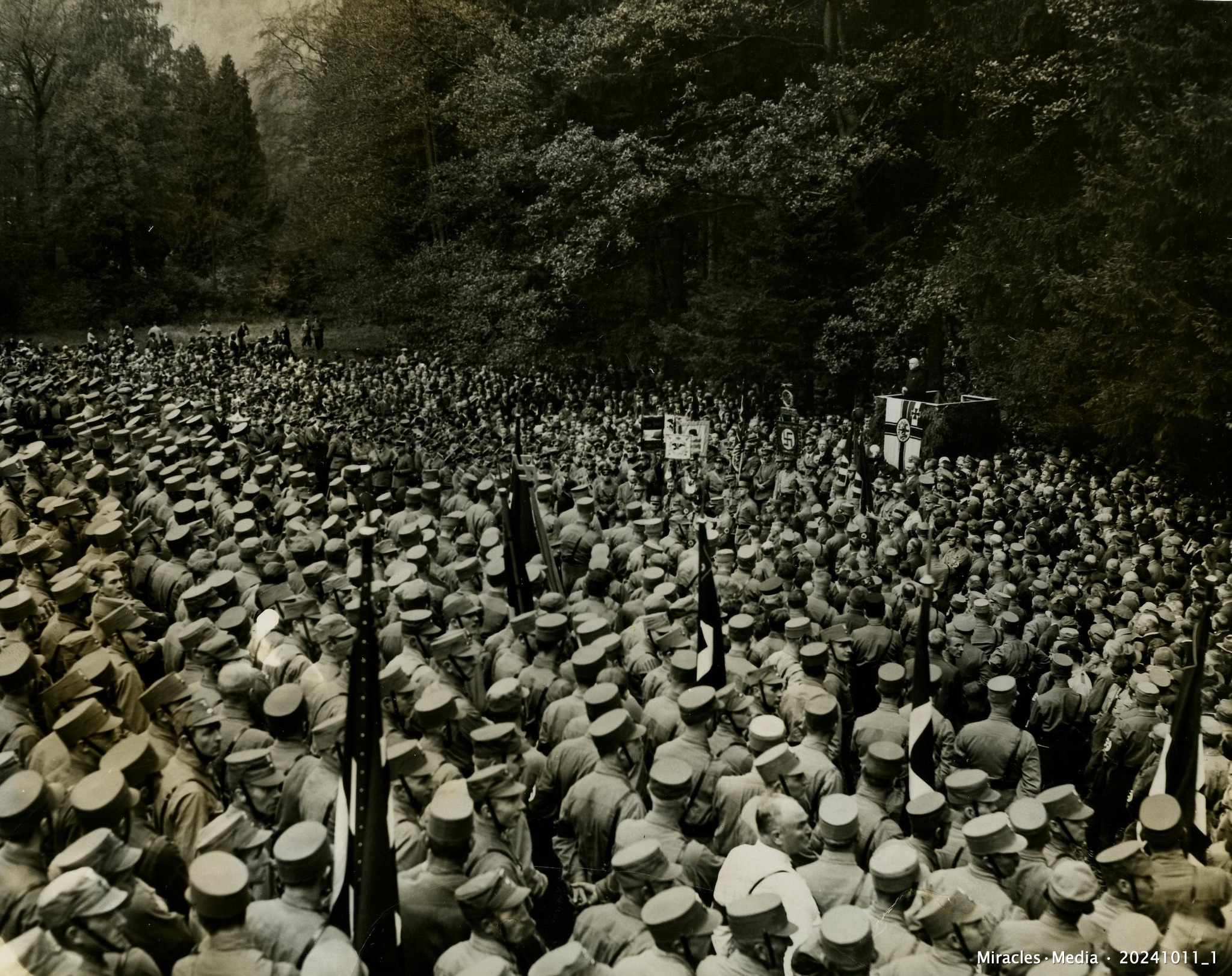
Miracles•Media • 20241011_1 • Harzburger Front founding field service with preacher Bruno Doehring on the Kaltental-Wiese (meadow) in Bad Harzburg, October 11, 1931.
Founding of the ‘Harzburger Front’ in Bad Harzburg, October 11, 1931 – an alliance between right-wing, nationalist, conservative elements and Hitler, to attempt to topple the Weimar government of chancellor Heinrich Brüning. The field service on the Kaltental-Wiese (meadow) in Bad Harzburg, with the Berlin Protestant preacher Bruno Doehring, on the platform (pulpit).
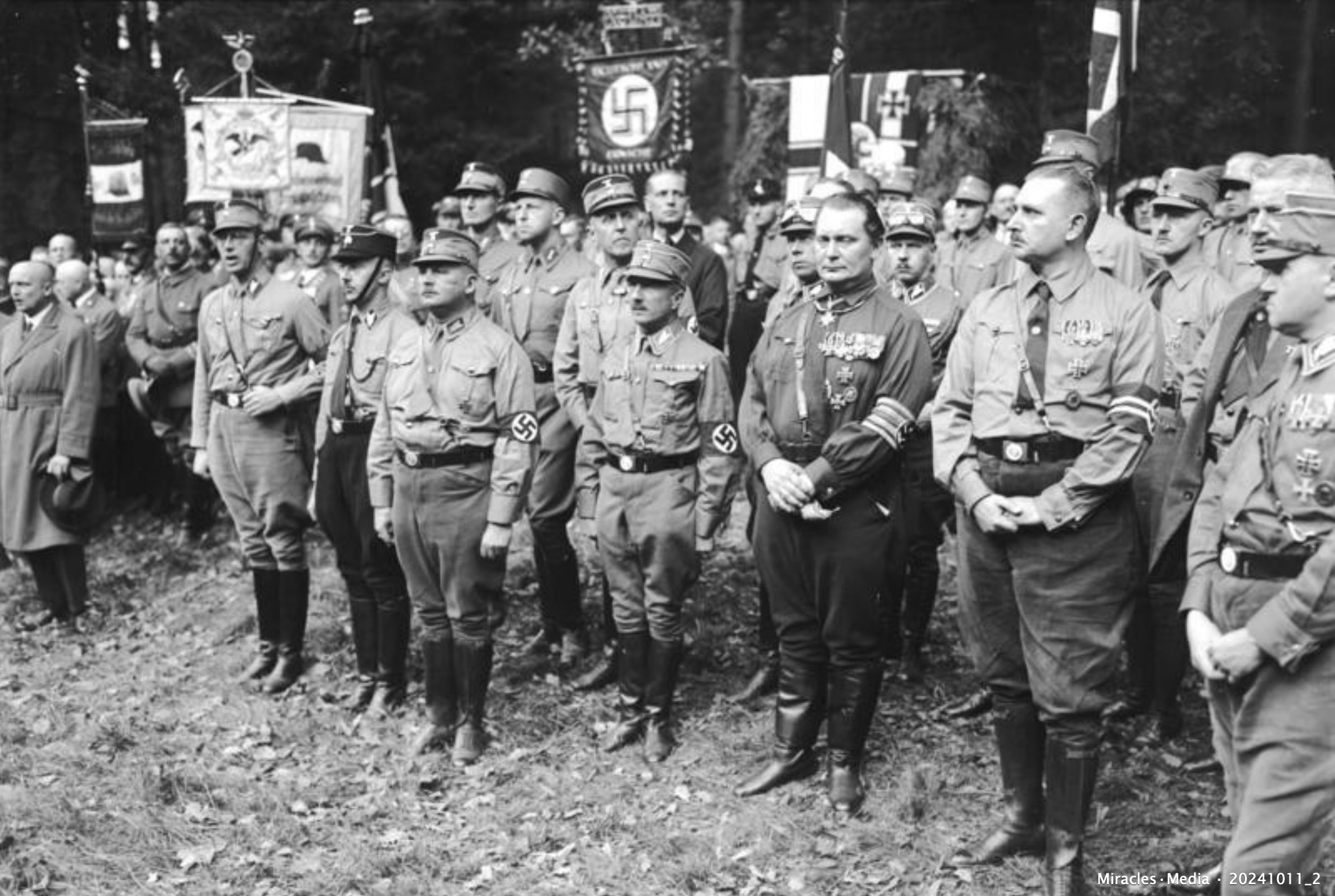
Miracles•Media • 20241011 2 • Nazi Party at the founding of the ‘Harzburger Front’ in Bad Harzburg, October 11, 1931. Bundesarchiv image 102 02134 • CC BY SA 3.0
The Nazi Party delegation during the field service on the Kaltental-Wiese (meadow) in Bad Harzburg. First row , left to right: Gerret Korsemann (SA-leader), Heinrich Himmler (SS Chief), Ernst Röhm (SA Chief), Franz Ritter von Hörauf, Hermann Göring (Reichsmarschall, Commander-in-Chief of the Luftwaffe, Prime Minister of Prussia), Bernhard Rust (Prussian Minister of Culture).
Citation info : Radical Right Front • Miracles•Media • 20241011 • URL michelvanderburg.com/2024/10/11/
Greek Poster • Michel van der Burg • Miracles•Media • 20241009
Funny. LibreOffice Vanilla Issue.
Greek characters appeared in this poster originally designed with english text and produced on a Macintosh computer and Imagewriter dotmatrix printer, September 3, 1990, using the MacDraw II application, with graphs from Cricket Graph. That 1990 Mac file was remastered today in LibreOffice Vanilla (other minor issues in graphs not corrected). Generally LibreOffice does a great job with these ancient files. I recently posted several of such posters at site michelvanderburg.com. However, some of the posters retrieved from my archive show up with Greek characters when opened in LibreOffice, like this poster produced in English (with roman characters). Those problematic posters have in common that the Apple Chicago font was used – the interface font in Apple’s early versions of Mac OS from 1984 to 1997. Clearly LibreOffice cannot handle this Chicago font correctly. I have not found a solution for this. Text in other posters, produced with Helvetica, had only minor issues in LibreOffice, Helvetica italics text appeared as regular Times.
The original poster and abstract (below) were presented at the 8th International Symposium on Gastrointestinal Hormones, in Timmendorfer Strand Baltic Sea (FRG) September 4–8, 1990.
Abstract
Contribution of gut factors to canine isolated islet function M.P.M. van der Burg, O.R. Guicherit, J.B.M.J. Jansen, C.B.H.W. Lamers, J.P. Scherft, M. Frölich, H.G. Gooszen. Departments of Surgery, Gastroenterology. Endocrinology and Cel Biology. University Hospital, Leiden, The Netherlands. Techniques for isolating islets of Langerhans from the large mammalian pancreas have improved to the point where islet transplantation as a therapeutical approach to human diabetes has become more realistic. The quality of metabolic control is however largely unknown. We studied canine isolated-islet function both in vivo after autotransplantation, as well as in vitro by perifusion. Five normal dogs underwent total pancreatectomy. Islets were isolated from the excised pancreas by collagenase digestion, dispersion and purification with filtration and density gradients. Isolated islets were autotransplanted into the spleen of the dog by retrograde venous infusion. Graft function was assessed up to 3 mo by determining the glucose and insulin response to an intravenous glucose injection (IVGTT), i.v. arginine injection during 35 mM glucose clamp (AT), and a meal. In addition (n = 4) the in vitro insulin response of overnight cultured canine islets was studied by perifusion with cholecystokinin (CCK-33) and glucose-dependent insulinotropic polypeptide (GIP). The islet dose at transplantation ranged from 3500 – 13000 islets/kg b.w. One animal became overtly hyperglycemic (fasting glucose 18 mM) within 7 days after receiving 3500 islets/kg b.w. The other grafts (> 6000 islets/kg b.w.) were successful (fasting glucose <7mM) but demonstrated, compared to pre-operative values, a 50% reduced glucose clearance and insulin response at IVGTT, and a 90% reduced insulin secreting capacity at AT. Postprandially hyperglycemia (~ 10 mM) and in contrast to i.v. glucose and arginine, a normal insulin response was observed. The in vitro insulin response at 7.5 mM glucose to equimolar (0.1-1- 10 nM) concentrations of either CCK, GIP or both, demonstrated a sustained dose-response to GIP (up to 5x basal values) and a significant albeit small and transient effect of CCK as of 1 nM. No synergistic effect was observed. In dogs ‘one-to-one’ transplantation was successful in 4/5 recipients of isolated islets. The difference in the effect of islet transplantation on the insulin response to intravenous glucose or – arginine and a meal, may be related to the postprandial, hyperglycemia enhanced, activation of the entero-insular axis, especially GIP.
Van der Burg MPM, Guicherit OR, Jansen JBMJ, Lamers CBHW, Scherft JP, Frölich M, Gooszen HG. Contribution of gut factors to canine isolated islet function (Abstract). Digestion 1990; 46 (Suppl 1): 14–15. https://doi.org/10.1159/000200356
PDF abstract shown below – file 20241009_1_Digestion.pdf
Citation info : Greek Poster • Michel van der Burg • Miracles•Media • 20241009 • URL michelvanderburg.com/2024/10/09 | TakeNode 10afaddd-08b7-4dcd-ad7a-43228420ad59
Daniel Brandhorst at work in the Giessen islet transplant lab. Photo taken during my working visit June 20, 1996, at the laboratory of Experimental and Clinical Islet Transplantation, Third Medical Department of Internal Medicine (head: Prof. dr. R.G. Bretzel), Justus-Liebig-University Giessen, in Giessen, Germany.
Citation info : Giessen Islet Transplant Lab • 20240905 • Michel van der Burg • michelvanderburg•com • TakeNode a9a118ee-6413-4d4f-aa17-d207d7a90025
The Jackson Girls dancing , Summer 1925, on the Scheveningen beach (The Hague) in Holland. Touring troupe of the German-based company of high-kicking precision dancers managed by impresario Alfred Jackson.
Silent film edited from August 1925 film by Willy Mullens | Haghefilm | Sound & Vision (Open Images).
Citation info : Jackson Girls Kickline | 20240108 | Miracles•Media | @michelvanderburg | TakeNode 76a42294-b3b0-45b5-a162-bc81e8a41b13
‘Entartete Art’ 1935 – Coleman Hawkins & Leo de la Fuente in Holland
American saxophonist Coleman Hawkins announces and plays – accompanied by Leo de la Fuente on piano – on his tenor saxophone ‘I wished that I were twins’.
In 1934, Coleman Hawkins left the Fletcher Henderson Orchestra and Amerika, moved to Europe, and joined the Jack Hylton Orchestra in England. Hylton and his band made regular ‘continental’ tours, and started another European tour January 1935 accompanied by Coleman Hawkins in Holland. At the end of January 1935 Hawkins joins the dutch band The Rambers … for 8 days … because Hawkins was denied entry to Germany because of his race, while Hylton and his band continued their tour without him and play for eight days at the Berlin Philharmonic Hall.
To end this special week with Hawkins well, the bandleader of The Ramblers – Theo Uden Masman – arranged with Decca for recordings 4 february 1935 in Pulchri Studio in The Hague, Holland, including this : I wish I were twins…that was also recorded on film by Polygoon (Polygoontoon) for the dutch cinema news for next week .
Coleman Hawkins is accomponied here on film by the dutch jazz pioneer Leo de la Fuente on piano , playing ‘I wished that I were twins’ . After the recordings, Hawkins moves further into Europe.
Leo – Leonard Henriques – de la Fuente, who was born Jewish in Amsterdam 28 March 1902, was deported by the nazi’s to Auschwitz on 2 November 1942, and died 30 April 1944 ‘somewhere in Mid Europe’.
entartete art jazz 1935 coleman hawkins leo de la fuente in holland 20231123 1
entartete art jazz 1935 coleman hawkins leo de la fuente in holland 20231123 2
entartete art jazz 1935 coleman hawkins leo de la fuente in holland 20231123 3
Citation : ‘Entartete Art’ 1935 – Coleman Hawkins & Leo de la Fuente in Holland | 20231123 | Settela•Com | ISSN 2949-9313 | TakeNode 4f388407-5ccc-4816-aef6-6064fcee35b2
Silent film — Towards the end of World War I – in the summer 1918 , after the Allies defeated the Germans in the Second Battle of the Marne – large groups of Belgians and French refugees flee in front of the retreating enemy force to the neutral Netherlands.
The Dutch army and Red Cross prepared to receive a possible 100,000 evacuees in the border towns in the south of the Netherlands.
After wandering weeks in the north of France , and next crossing Belgium on foot, the first group of French refugees arrived at the Dutch border October 20, completely exhausted.
At the gate in the electric wire fence at the border to the Netherlands – the so-called ‘Death Wire’ (dutch : Dodendraad ) Dutch soldiers took them over from German escorts.
Some refugees had travelled by tram part of the route crossing Belgium to the belgian border town Molenbeersel.
At the dutch border the refugees were welcomed and ladies from relief committees provide the refugees with food and drinks on the road to Stramproy in the Netherlands.
Within days , thousands of French refugees arrive in the village of Stramproy and are transferred to the city of Weert .
On arrival in the city center of Weert the dutch army registered people and handed out soup and bread.
The weak, the sick, and maternity women were cared for by the Red Cross and taken to an aid post for further care.
The refugees were sheltered the night in buildings like convents and schools in Weert, before being housed elsewhere in the country the following days.
References
Source (video footage) : Belgische vluchtelingen 1e Wereldoorlog. Open Images | Beeld & Geluid (Sound &Vision).
Weert en het einde van W.O.-I. | Jan Henkens | Stichting Historisch Onderzoek Weert | URL http://www.showeert.nl