Citation info : Youtube Top 50 • Hessel & Tess • Michel van der Burg • Miracles•Media • @1MEMO 20251024 • TakeNode d8fa14f3-c24a-4a6d-be9b-89436045bb64 / f407ea33-2b69-43ae-93af-f8d34516bdfa
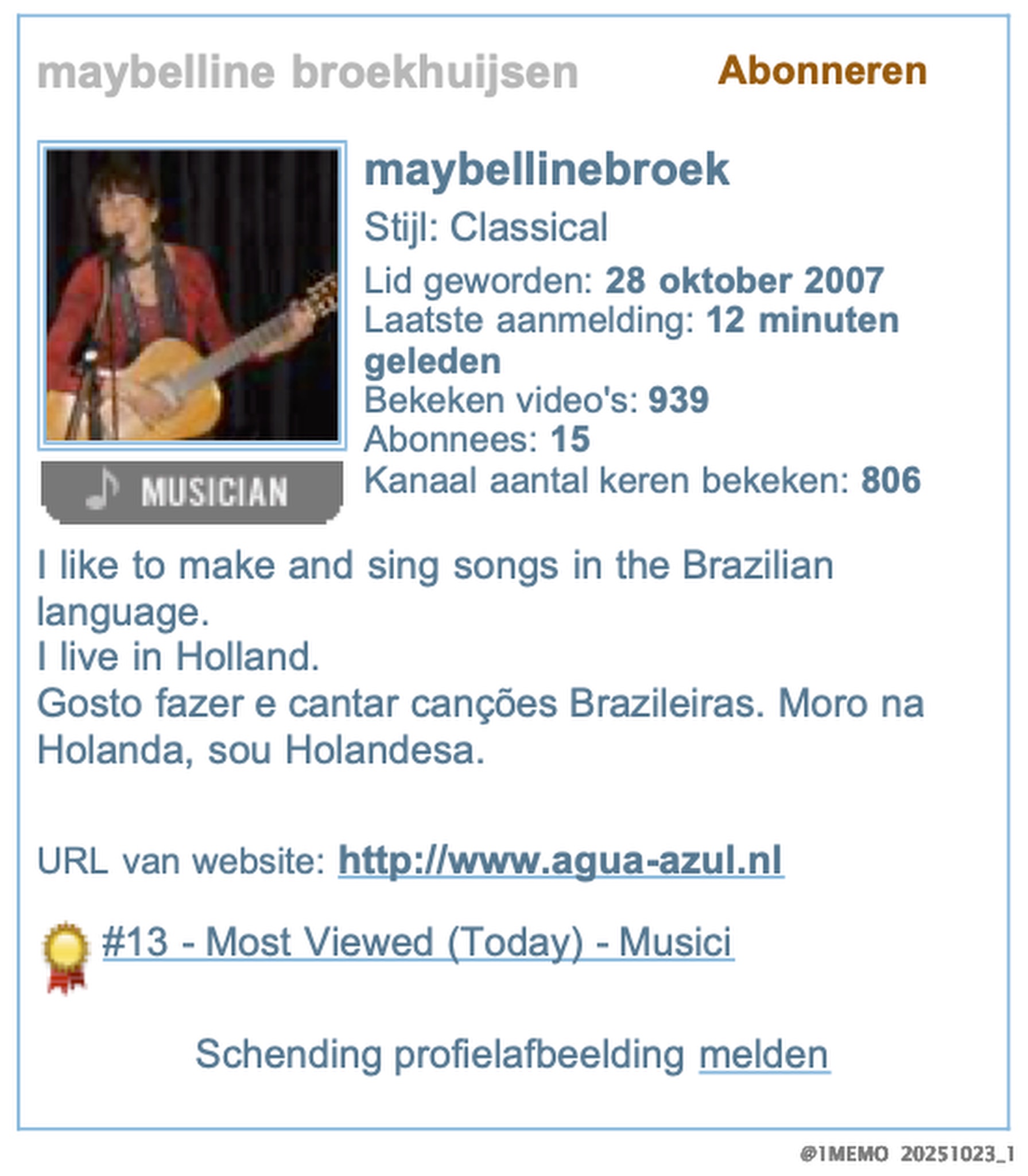
#13 Most Viewed Today Musicians on YouTube featuring Duo Agua Azul
I joined YouTube with Channel012 on June 20, 2007 , soon after YouTube was purchased by Google late 2006 . My first public video was uploaded Dec 30, 2007 : ‘Fire Breather’.
The 2nd video was a high quality video : “Tiroler Fasnacht 2008 in Igls”. Traditional carnival in the streets in Austria. This was uploaded May 7, 2008.
Some days later I was contacted by Maybelline — a friend from the early 1970s when we both studied biology at Leiden University in Holland, with whom I had not had any contact since — who was wondering whether it was me ‘the Michel of the biology study, after I had left a comment signed ‘Michel’ at her YouTube channel (@maybellinebroek) with music videos.
I learned she had just started the duo Agua Azul together with pianist Thijmen Vonk, with already about 16 performances lined up, one just completed , and an upcoming talent show in theater Agnietenhof in Tiel, Holland, next Friday 16 May, 2008. Just in time, the afternoon before that talent show, we agreed I’d film the show, and a few hours before the performance, I received the stage setup. Unfortunately, I was late for the opening number… and then filming… and same night editing. Next day rushes were checked, and the evening of May 19 the uploads of 4 of the songs at Maybelline’s channel succeeded — just in time for a screening the next morning for an important venue, to determine if they want to book Agua Azul in Cultuurhuis Doorn…which they did.
Maybelline’s YouTube channel ranked #13 Most Viewed Today Musicians in the Netherlands within the first two days after uploading our Agua Azul videos. Channel ranking was #58 in Most Viewed (This Week) Musicians in the Netherlands – a week after uploading (20080526).
Notes
More recently, I uploaded remastered editions of those videos , and added a new video too, a video of the interview with Agua Azul on that “Open Podium” in the Agnietenhof Theatre in Tiel , Holland on Friday 16 May, 2008.
Start Agua Azul ~ Holland • @1MEMO 20180523 • Interview 10 years ago at the flying start of Maybelline’s Agua Azul with pianist Thijmen Vonk – May 2008 – by Stefka at the “Open Podium” in the “Agnietenhof Theatre” in Tiel , Holland • URL https://youtu.be/Dlqk02QvXu8
Um Dia Novo • Agua Azul • @1MEMO 20211109 • Concert by Agua Azul on May 16, 2008 in Agnietenhof Theatre, Tiel, Netherlands ~ Percussion: Thijmen Vonk ~ Words and Music: Maybelline Broekhuijsen | agua-azul.nl | Text inspired by the story “De Rivier” by Bert Bijl ~ Film : Michel van der Burg | Miracles•Media | Remastered 2nd edition of film first published May 19, 2008 • URL https://youtu.be/W_fpcewYFZY
Reunião • Agua Azul • @1MEMO 20211108 • Concert by Agua Azul on May 16, 2008 in Agnietenhof Theatre, Tiel, Netherlands ~ Piano: Thijmen Vonk ~ Words and Music: Maybelline Broekhuijsen | agua-azul.nl ~ Film : Michel van der Burg | Miracles•Media | Remastered 2nd edition of film first published May 19, 2008 • URL https://youtu.be/_XU0OgDN4Nw
Journey • Thijmen Vonk • @1MEMO 20211107 • Thijmen Vonk – the Dutch Piano Wizard – plays (and improvises on) his own composition ‘Journey’ at the Agua Azul concert May 16, 2008 in Agnietenhof Theatre, Tiel, Netherlands | agua-azul.nl ~ Film : Michel van der Burg | Miracles•Media | Remastered 2nd edition of film first published May 19, 2008 • https://youtu.be/j5Gb6fzKePs
Agua Azul is screening via channel @AguaAzulHolland
Citation info : Youtube Top 15 • Agua Azul • Michel van der Burg • Miracles•Media • @1MEMO 20251023 • TakeNode 3e68356b-e1ae-4a79-a8e4-abf513d61d0a / 29d4ed88-5551-42ff-8bd6-4c8269fe89b5
Big surprise today , to encounter this nice news article by journalist Rob van Dijk reporting on our pancreatic islet transplantation breakthrough in the Leiden University Hospital (now LUMC) in the Amsterdam based Dutch national newspaper Parool , Saturday 6 January 1990 (1).
I was searching actually for a better copy of a different news article I have archived on my clinical islet transplantation work (Newspaper Volkskrant 10 April 1999) in the Delpher archive of the National Library of the Netherlands , scrolling the search results, and noticed this Parool article – I didn’t know it existed ;)
Journalist Rob van Dijk did not interview me for the Parool, so I assume his source was the interview I gave for publication in Cicero, the biweekly LUMC publication, and the Dutch newspaper ‘Leidsch Dagblad’, and posted a year ago (2).
The articles reports (my translation from dutch*) :
Transplantation
Islet transplantation has been possible for a few years now, but it doesn’t (yet?) work in humans. The technique itself isn’t that complicated: as many islets of Langerhans as possible are extracted from a pancreas, injected into the diabetic patient’s liver or spleen, and thus, start producing insulin. However, that “thus” is still a bit tricky… …
The major problems lie in the fact that the yield of properly functioning islets is too small (at least 30 percent of the islets must be obtained undamaged to achieve sufficient insulin production after a transplant) and that the suspensions are too impure. Nevertheless, progress is being made.
The best news comes from Leiden University Hospital. There, biologist M. van der Burg, MSc has developed a method to isolate a very high and pure yield of islets from a dog’s pancreas. Van der Burg succeeded in isolating 40 percent of the vital islets from a dog’s pancreas. Through special processing, he was able to completely purify these cell clumps of 90 percent of excess and complicating pancreatic tissue. These islets were injected into the spleen of the same dog, where they produced sufficient insulin. This initial experiment has since been repeated in Leiden with several dogs with the same success. However, major challenges remain, not the least of which is the rejection problem. The Leiden experiments used the dog’s own tissue. The big question remains how the human immune system reacts when islets from a donor are injected.
*NL (dutch) quote :
Transplantatie
Sinds een paar jaar is eilandjestransplantatie wel mogelijk, alleen, bij de mens werkt het (nog?) niet. De techniek is op zichzelf niet zo ingewikkeld: men haalt zoveel mogelijk eilandjes van Langerhans uit een pancreas, spuit die bij de suikerzieke in lever of milt in en dan gaan ze dus insuline maken. Met dat ‘dus’ ligt het echter nog moeilijk… …
De grote problemen schuilen hem erin dat de oogst aan goed werkende eilandjes te gering is (men moet ten minste 30 procent van de eilandjes onbeschadigd te pakken krijgen om na een transplantatie voldoende insulineproduktie te verkrijgen) en dat de suspensies te onzuiver zijn. Toch zit er schot in.
Het beste nieuws komt uit het academisch ziekenhuis te Leiden. Daar heeft de bioloog drs. M. van der Burg een methode ontwikkeld om uit een hondepancreas een zeer hoge en zuivere oogst aan eilandjes te isoleren. Van der Burg slaagde erin uit de alvleesklier van een hond 40 procent van de vitale eilandjes te isoleren, door een speciale bewerking kon hij deze celklompjes voor 90 procent absoluut zuiveren van overbodig en complicerend pancreasweefsel. Deze eilandjes werden ingespoten in de milt van dezelfde hond en produceren daar voldoende insuline. Dit eerste experiment is in Leiden intussen met meerdere honden met hetzelfde succes herhaald. Maar er zijn nog grote problemen op te lossen en bepaald niet het geringste daarvan is dat van de afstoting. Bij de Leidse experimenten werd gebruik gemaakt van eigen weefsel van de hond. De grote vraag blijft hoe het immuunsysteem van de mens reageert als er eilandjes van een donor worden ingespoten.
Citation info : Islet Transplantation LUMC News Surprise • Michel van der Burg • Miracles.Media • @1MEMO 20251020 • URL michelvanderburg.com/2025/10/20/
Big surprise today , to encounter this nice news article by journalist Rob van Dijk reporting on our pancreatic islet transplantation breakthrough in the Leiden University Hospital (now LUMC) in the Amsterdam based Dutch national newspaper Parool , Saturday 6 January 1990 (1).
I was searching actually for a better copy of a different news article I have archived on my clinical islet transplantation work (Newspaper Volkskrant 10 April 1999) in the Delpher archive of the National Library of the Netherlands , scrolling the search results, and noticed this Parool article – I didn’t know it existed ;)
Journalist Rob van Dijk did not interview me for the Parool, so I assume his source was the interview I gave for publication in Cicero, the biweekly LUMC publication, and the Dutch newspaper ‘Leidsch Dagblad’, and posted a year ago (2).
The articles reports (my translation from dutch*) :
Transplantation
Islet transplantation has been possible for a few years now, but it doesn’t (yet?) work in humans. The technique itself isn’t that complicated: as many islets of Langerhans as possible are extracted from a pancreas, injected into the diabetic patient’s liver or spleen, and thus, start producing insulin. However, that “thus” is still a bit tricky… …
The major problems lie in the fact that the yield of properly functioning islets is too small (at least 30 percent of the islets must be obtained undamaged to achieve sufficient insulin production after a transplant) and that the suspensions are too impure. Nevertheless, progress is being made.
The best news comes from Leiden University Hospital. There, biologist M. van der Burg, MSc has developed a method to isolate a very high and pure yield of islets from a dog’s pancreas. Van der Burg succeeded in isolating 40 percent of the vital islets from a dog’s pancreas. Through special processing, he was able to completely purify these cell clumps of 90 percent of excess and complicating pancreatic tissue. These islets were injected into the spleen of the same dog, where they produced sufficient insulin. This initial experiment has since been repeated in Leiden with several dogs with the same success. However, major challenges remain, not the least of which is the rejection problem. The Leiden experiments used the dog’s own tissue. The big question remains how the human immune system reacts when islets from a donor are injected.
*NL (dutch) quote :
Transplantatie
Sinds een paar jaar is eilandjestransplantatie wel mogelijk, alleen, bij de mens werkt het (nog?) niet. De techniek is op zichzelf niet zo ingewikkeld: men haalt zoveel mogelijk eilandjes van Langerhans uit een pancreas, spuit die bij de suikerzieke in lever of milt in en dan gaan ze dus insuline maken. Met dat ‘dus’ ligt het echter nog moeilijk… …
De grote problemen schuilen hem erin dat de oogst aan goed werkende eilandjes te gering is (men moet ten minste 30 procent van de eilandjes onbeschadigd te pakken krijgen om na een transplantatie voldoende insulineproduktie te verkrijgen) en dat de suspensies te onzuiver zijn. Toch zit er schot in.
Het beste nieuws komt uit het academisch ziekenhuis te Leiden. Daar heeft de bioloog drs. M. van der Burg een methode ontwikkeld om uit een hondepancreas een zeer hoge en zuivere oogst aan eilandjes te isoleren. Van der Burg slaagde erin uit de alvleesklier van een hond 40 procent van de vitale eilandjes te isoleren, door een speciale bewerking kon hij deze celklompjes voor 90 procent absoluut zuiveren van overbodig en complicerend pancreasweefsel. Deze eilandjes werden ingespoten in de milt van dezelfde hond en produceren daar voldoende insuline. Dit eerste experiment is in Leiden intussen met meerdere honden met hetzelfde succes herhaald. Maar er zijn nog grote problemen op te lossen en bepaald niet het geringste daarvan is dat van de afstoting. Bij de Leidse experimenten werd gebruik gemaakt van eigen weefsel van de hond. De grote vraag blijft hoe het immuunsysteem van de mens reageert als er eilandjes van een donor worden ingespoten.
Citation info : Islet Transplantation LUMC News Surprise • Michel van der Burg • Miracles.Media • @1MEMO 20251020 • URL michelvanderburg.com/2025/10/20/
B-roll en route the 13th internationales literaturfestival berlin (13.ilb) working on a Miracles•Media reportage of the 7 Sep 2013 presentation by Simon Gronowski and Koenraad Tinel (Belgium) ‘Finally Free after 70 years’.
Citation info : Amersfoort Transport • @1MEMO 20250918 • Michel van der Burg • Miracles•Media • TakeNode 91700ee1-9546-43fb-be6c-570d0f99b5b6
B-roll en route the 13th internationales literaturfestival berlin (13.ilb) working on a Miracles•Media reportage of the 7 Sep 2013 presentation by Simon Gronowski and Koenraad Tinel (Belgium) ‘Finally Free after 70 years’.
Citation info : Amersfoort Transport • @1MEMO 20250917 • Michel van der Burg • Miracles•Media • TakeNode 60cbd409-08aa-4edf-b9b6-1a3cf39e9ff6