Slow Foxtrot dancing after arrival May 1934 at the Amsterdam Schiphol airport of dance couples participating in the International Dance Competition that is being organized in Amsterdam to coincide with the release of the MGM film ‘Dancing Lady’. The winning dance couple will be delegated to Hollywood by MGM .
Film edited from dutch Polygoon cinema news reel week 21 , 1934 | Polygoontoon | Sound & Vision (Open Images).
Music in this Polygoon footage is the hit song of MGM’s “Dancing Lady” : Everything I Have Is Yours by George Olsen & his Music.
Citation info : Slowfox Dance | 20240104 | Miracles•Media | @michelvanderburg | TakeNode bf0e1108-1a03-4b60-8474-a8b7cea18672
‘Wild’ jazz was used in the August 1937 dutch cinema news reel showing people all over Holland in a rush going on summer holiday. So jazz in those prewar years wasn’t considered ‘entartete’ art and clearly socially acceptable …. ‘salonfähig’… in Holland.
Film edited from dutch Polygoon cinema news reel week 34 , 1937 | Polygoon Hollands Nieuws | Sound & Vision (Open Images).
Citation info : Jazzy 1937 Summer Holiday | 20240103 | Miracles•Media | @michelvanderburg | TakeNode 84b219fc-41b1-498b-b099-8ce166d2aee6
Some Shimmiers – Wild shimmy jazz and tango dancing with black musicians in an apaches cellar, images from a silent 1919 movie on a slumming party : well-off whites exploring communities of ‘the other’, such as poor working-class neighborhoods (1).
Film edited with selected clips from the comic one-act play ‘Some Shimmiers’ by Eddie Lyons and Lee Moran with Mildred Moore and John George, published 31 March 1919 in the dutch edition ‘Boevenliefde’ by H.A.P Film | Universal | source: EYE Sound & Vision (Open Images).
Cancan dance performance (silent film) by the Miss Walker Girls & De Groot’s Select Jazz Orchestra, Summer 1926, in Cinema Royal, Amsterdam, Holland. Bandleader Hugo de Groot started the first cinema jazz orchestra in Holland in 1925 with his ‘De Groot’s Royal Band’. In 1926 he started with the help of other musicians in town the larger De Groot’s Select Jazz Orchestra (1).
‘Entartete Art’ 1935 – Coleman Hawkins & Leo de la Fuente in Holland
American saxophonist Coleman Hawkins announces and plays – accompanied by Leo de la Fuente on piano – on his tenor saxophone ‘I wished that I were twins’.
In 1934, Coleman Hawkins left the Fletcher Henderson Orchestra and Amerika, moved to Europe, and joined the Jack Hylton Orchestra in England. Hylton and his band made regular ‘continental’ tours, and started another European tour January 1935 accompanied by Coleman Hawkins in Holland. At the end of January 1935 Hawkins joins the dutch band The Rambers … for 8 days … because Hawkins was denied entry to Germany because of his race, while Hylton and his band continued their tour without him and play for eight days at the Berlin Philharmonic Hall.
To end this special week with Hawkins well, the bandleader of The Ramblers – Theo Uden Masman – arranged with Decca for recordings 4 february 1935 in Pulchri Studio in The Hague, Holland, including this : I wish I were twins…that was also recorded on film by Polygoon (Polygoontoon) for the dutch cinema news for next week .
Coleman Hawkins is accomponied here on film by the dutch jazz pioneer Leo de la Fuente on piano , playing ‘I wished that I were twins’ . After the recordings, Hawkins moves further into Europe.
Leo – Leonard Henriques – de la Fuente, who was born Jewish in Amsterdam 28 March 1902, was deported by the nazi’s to Auschwitz on 2 November 1942, and died 30 April 1944 ‘somewhere in Mid Europe’.
entartete art jazz 1935 coleman hawkins leo de la fuente in holland 20231123 1
entartete art jazz 1935 coleman hawkins leo de la fuente in holland 20231123 2
entartete art jazz 1935 coleman hawkins leo de la fuente in holland 20231123 3
Citation : ‘Entartete Art’ 1935 – Coleman Hawkins & Leo de la Fuente in Holland | 20231123 | Settela•Com | ISSN 2949-9313 | TakeNode 4f388407-5ccc-4816-aef6-6064fcee35b2
Rhythmus was a jazz orchestra in the Buchenwald concentration camp in which a total of 23 musicians from 9 different countries played together from 1943 until the liberation. Czech prisoners around Jiří Žák took the initiative to found this orchestra in the summer of 1943.
Among the French prisoners that later joined, were Yves Darriet – the bandleader , who wrote most arrangements , and Robert Widerman – the band’s singer , who made a career as Robert Clary on Broadway after the war.
Two programs are known to have been performed in November 1944 and April 19, 1945, i.e. 8 days after the liberation of the camp (Ref 1) , including compositions by Duke Ellington, Lionel Hampton and pieces by Cole Porter, Fats Waller, Glenn Miller and Louis Armstrong. In The Mood was performed even though this music was banned in Nazi Germany.
Ref. 3 – Jazz im KZ Buchenwald – das gab es wirrklich! | weimarer-rendezvous | Sep 25, 2022 https://youtu.be/HX4X7TJ19nQ
„Rhythmus“ – Jazz im Konzentrationslager Buchenwald
At the April 11, 2022 event ‘„Rhythmus“ – Jazz im Konzentrationslager Buchenwald’ — in the Notenbank in Weimar, Germany (Ref 2, 3) — the Big Band and a jazz ensemble of the Hochschule für Musik under the direction of Prof. Gero Schmidt-Oberländer performed 9 or 10 pieces from the programs. In addition biographies of the prisoners in the Buchenwald Jazz Orchestra were made visible using excerpts from their letters and reports.
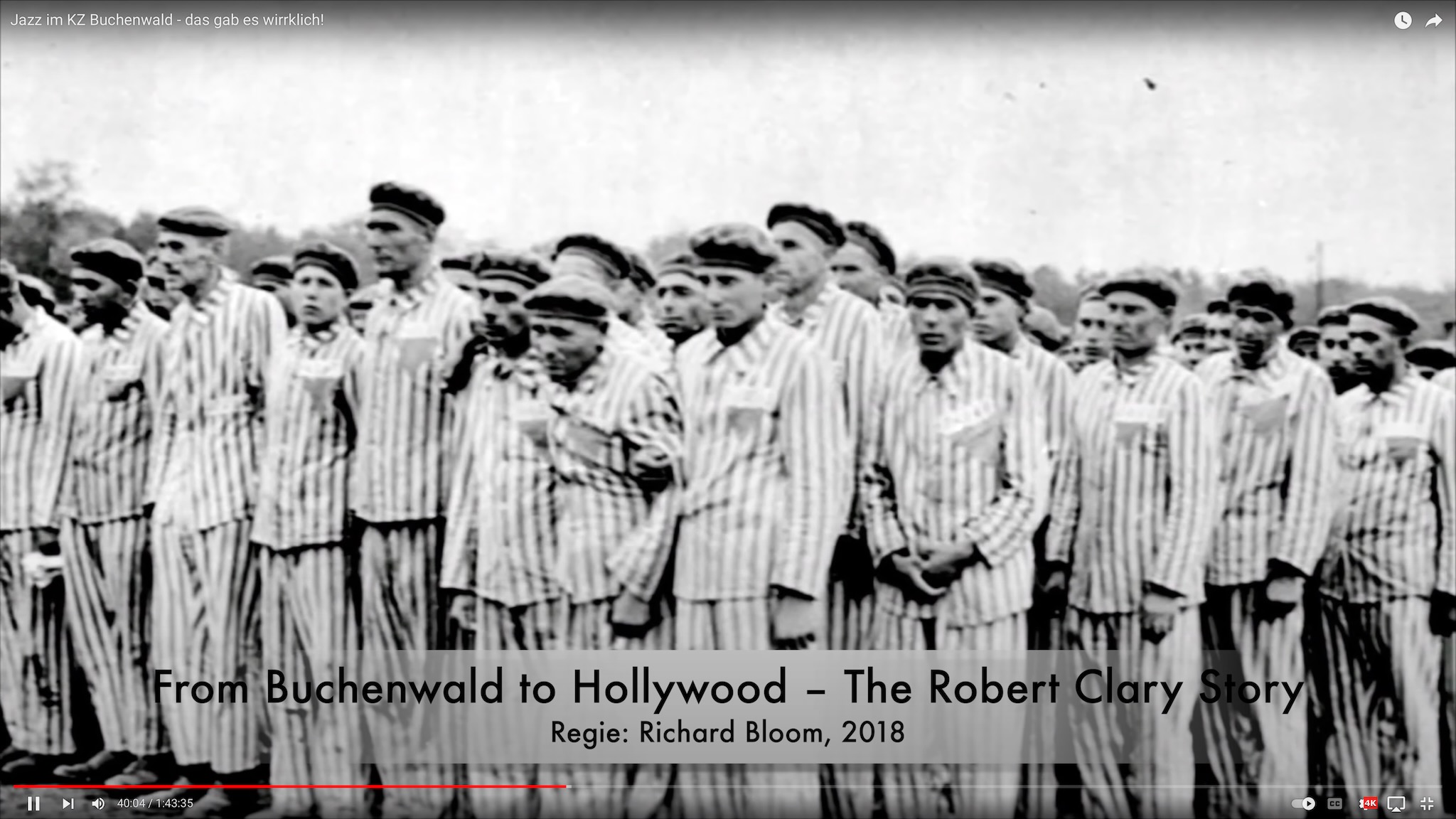
The French singer Robert Widerman ( Robert Clary ) was shown in a clip (Ref 4) from the documentary film From Buchenwald to Hollywood, The Robert Clary Story (Ref 5). Robert Clary (March 1, 1926 – Nov 16, 2022) survived thanks to several prisoners, including Yves Darriet (pseudonym Jan Rolan, Jean Roland), Claude Francis-Boeuf, and Jiří Žák. (Ref 6)
5. From Buchenwald to Hollywood, The Robert Clary Story by Karen and Richard Bloom and Michel van der Burg | 2023 Edition | 20230202 | URL https://youtu.be/0tKc5T-Sw-E