Islet Transplantation LUMC News Surprise • @1MEMO 20251020

Diabetic (dutch ‘Suikerzieke) … Parool, 6 Jan 1990 • @1MEMO 20251020

Big surprise today , to encounter this nice news article by journalist Rob van Dijk reporting on our pancreatic islet transplantation breakthrough in the Leiden University Hospital (now LUMC) in the Amsterdam based Dutch national newspaper Parool , Saturday 6 January 1990 (1).

I was searching actually for a better copy of a different news article I have archived on my clinical islet transplantation work (Newspaper Volkskrant 10 April 1999) in the Delpher archive of the National Library of the Netherlands , scrolling the search results, and noticed this Parool article – I didn’t know it existed ;)

Journalist Rob van Dijk did not interview me for the Parool, so I assume his source was the interview I gave for publication in Cicero, the biweekly LUMC publication, and the Dutch newspaper ‘Leidsch Dagblad’, and posted a year ago (2).

The articles reports (my translation from dutch*) :

Transplantation

Islet transplantation has been possible for a few years now, but it doesn’t (yet?) work in humans. The technique itself isn’t that complicated: as many islets of Langerhans as possible are extracted from a pancreas, injected into the diabetic patient’s liver or spleen, and thus, start producing insulin. However, that “thus” is still a bit tricky… …
The major problems lie in the fact that the yield of properly functioning islets is too small (at least 30 percent of the islets must be obtained undamaged to achieve sufficient insulin production after a transplant) and that the suspensions are too impure. Nevertheless, progress is being made.
The best news comes from Leiden University Hospital. There, biologist M. van der Burg, MSc has developed a method to isolate a very high and pure yield of islets from a dog’s pancreas. Van der Burg succeeded in isolating 40 percent of the vital islets from a dog’s pancreas. Through special processing, he was able to completely purify these cell clumps of 90 percent of excess and complicating pancreatic tissue. These islets were injected into the spleen of the same dog, where they produced sufficient insulin. This initial experiment has since been repeated in Leiden with several dogs with the same success. However, major challenges remain, not the least of which is the rejection problem. The Leiden experiments used the dog’s own tissue. The big question remains how the human immune system reacts when islets from a donor are injected.

*NL (dutch) quote :

Transplantatie

Sinds een paar jaar is eilandjestransplantatie wel mogelijk, alleen, bij de mens werkt het (nog?) niet. De techniek is op zichzelf niet zo ingewikkeld: men haalt zoveel mogelijk eilandjes van Langerhans uit een pancreas, spuit die bij de suikerzieke in lever of milt in en dan gaan ze dus insuline maken. Met dat ‘dus’ ligt het echter nog moeilijk… …
De grote problemen schuilen hem erin dat de oogst aan goed werkende eilandjes te gering is (men moet ten minste 30 procent van de eilandjes onbeschadigd te pakken krijgen om na een transplantatie voldoende insulineproduktie te verkrijgen) en dat de suspensies te onzuiver zijn. Toch zit er schot in.
Het beste nieuws komt uit het academisch ziekenhuis te Leiden. Daar heeft de bioloog drs. M. van der Burg een methode ontwikkeld om uit een hondepancreas een zeer hoge en zuivere oogst aan eilandjes te isoleren. Van der Burg slaagde erin uit de alvleesklier van een hond 40 procent van de vitale eilandjes te isoleren, door een speciale bewerking kon hij deze celklompjes voor 90 procent absoluut zuiveren van overbodig en complicerend pancreasweefsel. Deze eilandjes werden ingespoten in de milt van dezelfde hond en produceren daar voldoende insuline. Dit eerste experiment is in Leiden intussen met meerdere honden met hetzelfde succes herhaald. Maar er zijn nog grote problemen op te lossen en bepaald niet het geringste daarvan is dat van de afstoting. Bij de Leidse experimenten werd gebruik gemaakt van eigen weefsel van de hond. De grote vraag blijft hoe het immuunsysteem van de mens reageert als er eilandjes van een donor worden ingespoten.

Notes

1) Transplantatie. “Het Parool”. Amsterdam, 06-01-1990. Retrieved in Delpher on 20-10-2025, https://resolver.kb.nl/resolve?urn=ABCDDD:010834140:mpeg21:p017

2) Islet Transplantation Breakthrough in Leiden University Hospital • 20240830 • Michel van der Burg • michelvanderburg•com • URL https://michelvanderburg.com/2024/08/30/islet-transplantation-breakthrough-in-leiden-university-hospital-20240830/

Citation info : Islet Transplantation LUMC News Surprise • Michel van der Burg • Miracles.Media • @1MEMO 20251020 • URL michelvanderburg.com/2025/10/20/

Islet Transplantation LUMC News Surprise • @1MEMO 20251020

Diabetic (dutch ‘Suikerzieke) … Parool, 6 Jan 1990 • @1MEMO 20251020

Big surprise today , to encounter this nice news article by journalist Rob van Dijk reporting on our pancreatic islet transplantation breakthrough in the Leiden University Hospital (now LUMC) in the Amsterdam based Dutch national newspaper Parool , Saturday 6 January 1990 (1).

I was searching actually for a better copy of a different news article I have archived on my clinical islet transplantation work (Newspaper Volkskrant 10 April 1999) in the Delpher archive of the National Library of the Netherlands , scrolling the search results, and noticed this Parool article – I didn’t know it existed ;)

Journalist Rob van Dijk did not interview me for the Parool, so I assume his source was the interview I gave for publication in Cicero, the biweekly LUMC publication, and the Dutch newspaper ‘Leidsch Dagblad’, and posted a year ago (2).

The articles reports (my translation from dutch*) :

Transplantation

Islet transplantation has been possible for a few years now, but it doesn’t (yet?) work in humans. The technique itself isn’t that complicated: as many islets of Langerhans as possible are extracted from a pancreas, injected into the diabetic patient’s liver or spleen, and thus, start producing insulin. However, that “thus” is still a bit tricky… …
The major problems lie in the fact that the yield of properly functioning islets is too small (at least 30 percent of the islets must be obtained undamaged to achieve sufficient insulin production after a transplant) and that the suspensions are too impure. Nevertheless, progress is being made.
The best news comes from Leiden University Hospital. There, biologist M. van der Burg, MSc has developed a method to isolate a very high and pure yield of islets from a dog’s pancreas. Van der Burg succeeded in isolating 40 percent of the vital islets from a dog’s pancreas. Through special processing, he was able to completely purify these cell clumps of 90 percent of excess and complicating pancreatic tissue. These islets were injected into the spleen of the same dog, where they produced sufficient insulin. This initial experiment has since been repeated in Leiden with several dogs with the same success. However, major challenges remain, not the least of which is the rejection problem. The Leiden experiments used the dog’s own tissue. The big question remains how the human immune system reacts when islets from a donor are injected.

*NL (dutch) quote :

Transplantatie

Sinds een paar jaar is eilandjestransplantatie wel mogelijk, alleen, bij de mens werkt het (nog?) niet. De techniek is op zichzelf niet zo ingewikkeld: men haalt zoveel mogelijk eilandjes van Langerhans uit een pancreas, spuit die bij de suikerzieke in lever of milt in en dan gaan ze dus insuline maken. Met dat ‘dus’ ligt het echter nog moeilijk… …
De grote problemen schuilen hem erin dat de oogst aan goed werkende eilandjes te gering is (men moet ten minste 30 procent van de eilandjes onbeschadigd te pakken krijgen om na een transplantatie voldoende insulineproduktie te verkrijgen) en dat de suspensies te onzuiver zijn. Toch zit er schot in.
Het beste nieuws komt uit het academisch ziekenhuis te Leiden. Daar heeft de bioloog drs. M. van der Burg een methode ontwikkeld om uit een hondepancreas een zeer hoge en zuivere oogst aan eilandjes te isoleren. Van der Burg slaagde erin uit de alvleesklier van een hond 40 procent van de vitale eilandjes te isoleren, door een speciale bewerking kon hij deze celklompjes voor 90 procent absoluut zuiveren van overbodig en complicerend pancreasweefsel. Deze eilandjes werden ingespoten in de milt van dezelfde hond en produceren daar voldoende insuline. Dit eerste experiment is in Leiden intussen met meerdere honden met hetzelfde succes herhaald. Maar er zijn nog grote problemen op te lossen en bepaald niet het geringste daarvan is dat van de afstoting. Bij de Leidse experimenten werd gebruik gemaakt van eigen weefsel van de hond. De grote vraag blijft hoe het immuunsysteem van de mens reageert als er eilandjes van een donor worden ingespoten.

Notes

1) Transplantatie. “Het Parool”. Amsterdam, 06-01-1990. Retrieved in Delpher on 20-10-2025, https://resolver.kb.nl/resolve?urn=ABCDDD:010834140:mpeg21:p017

2) Islet Transplantation Breakthrough in Leiden University Hospital • 20240830 • Michel van der Burg • michelvanderburg•com • URL https://michelvanderburg.com/2024/08/30/islet-transplantation-breakthrough-in-leiden-university-hospital-20240830/

Citation info : Islet Transplantation LUMC News Surprise • Michel van der Burg • Miracles.Media • @1MEMO 20251020 • URL michelvanderburg.com/2025/10/20/

Coding 1995 Internet Access Macintosh • @1MEMO 20250515

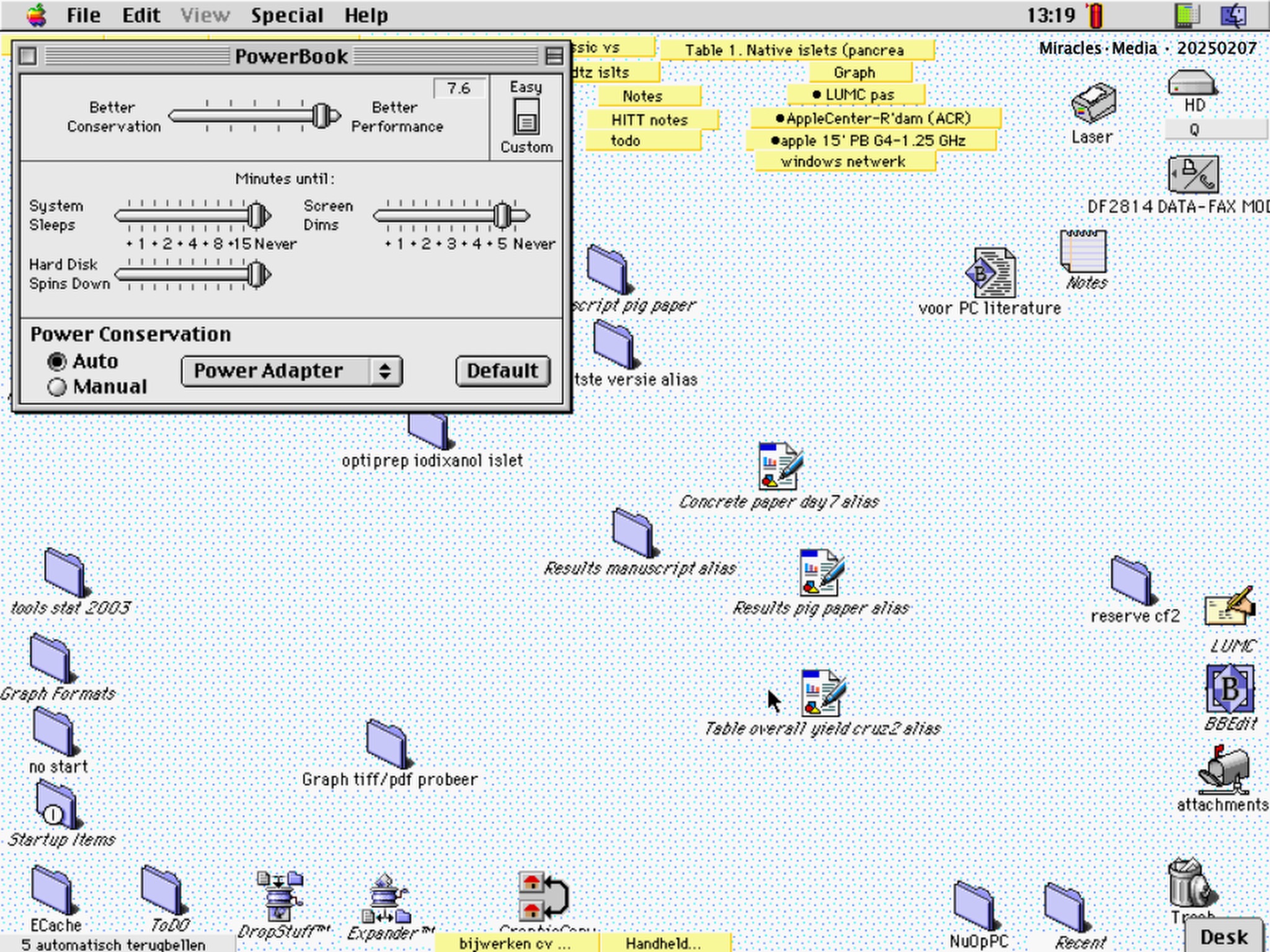
Screenshot April 11, 1995 at 21:48 of the desktop with a Filemaker window (•Brieffile, correspondence) on my Apple Macintosh PowerBook 160. A PICT file image that I recently gained access to.
Desktop shows icon (renamed) SLIP of the InterSLIP application I used to get modem access (phone line) to the Leiden University gateway to internet, email, news, gopher, ftp etc .
I wrote the protocol (two scripts) required by this SLIP application to get access to the Leiden University gateway to the internet.
From May 1995 Leiden University distributed my scripts to the other Macintosh users of our University.

Below the two scripts published May 18, 1995 ….

Below the ‘Minimal dialing script’ :

! Original script by Fred Morris
! Modifications and comments by Adam C. Engst
! 21-Feb-94 = Added redial feature (ACE)

@originate
! Initialize mode from string in InterSLIP configuration
note “Initializing modem”
write “^4\13”
pause 20
! Dial modem from number in InterSLIP configuration
note “Dialing ^1”
write “atdt^1\13”
! Check only for BUSY or CONNECT, then redial or connect
matchstr 1 10 “BUSY”
matchstr 2 20 “CONNECT”
matchread 500

@label 10
! The line is busy, so let’s redial the modem indefinitely
! This will also redial after the (matchread 500) timeout if you get
endless rings
note “Line busy, redialing ^1”
! First hang up and reinitialize modem from string in InterSLIP configuration
write “+++”
pause 60
write “ath\13”
write “^4\13”
! Then go back and dial again using phone number in InterSLIP configuration
jump originate

@label 20
! Everything worked fine, you’re connected now
note “Dialed successfully”
exit 0

@answer
@hangup
! Hang up the modem and reinitialize from string in InterSLIP configuration
! The only way to get here is to manually click the Disconnect button
note “Hanging up modem”
write “+++”
pause 60
write “ath\13”
write “^4\13”
exit 0

Below the “FullCRIgateScript” for access via 278282 with password and
username check:

! InterSLIP gateway script for CRIgate with password access
! original script by Adam C. Engst
! modified by MvdBurg@RULLF2.MedFac.LeidenUniv.NL (MPM van der Burg)
!
@originate
!write “\13”
note “Waiting for prompt”
matchclr
matchstr 1 1 “Annex username: “
matchread 900
note “Gateway not responding!”
exit -1
!
@label 1
note “Sending user name”
write “^5\13”
matchclr
matchstr 1 2 “Annex password:”
matchread 900
note “Gateway not responding!”
exit -1
!
!
@label 2
note “Sending password”
write “^6\13”
matchclr
matchstr 1 4 “Permission granted”
matchstr 2 3 “Username/Password Incorrect”
matchread 900
jump 99
!
@label 3
note “Username/Password Incorrect”
jump 99
!
@label 4
note “Requesting SLIP”
matchclr
matchstr 1 5 “drive-in: “
matchread 900
jump 99
!
@label 5
write “slip\13”
matchclr
matchstr 1 10 “Switching to SLIP.”
matchstr 2 6 “CLI: Command not found.”
matchread 900
note “Cannot invoke SLIP mode”
jump 99
!
@label 6
note “Command not found”
jump 99
!
@label 10
note “Searching IP address”
matchclr
matchstr 1 25 “Your address is “
matchread 900
note “No AddressLine found”
jump 99
!
@label 25
note “SLIP address found”
matchclr
matchexp 1 30 “[0-9][0-9]\.[0-9][0-9]\.[0-9][0-9]\.[0-9][0-9]\.”
matchread 500
note “No IP address found”
jump 99
!
@label 99
pause 1
pause 60
exit -1
!
! We’ve found an IP address, so inform MacTCP of it.
!
@label 30
note “Setting IP address”
setip “^0”
note “^0”
Pause 30
write “set port internet slip enable”
write “\13”
!
note “Slip enabled”
pause 20
!
matchclr
exit 0

!
! Answer and Hangup modes are currently unused in gateway
! scripts, but just for future compatibility, exit successfully.
!
@answer
@hangup
! Hang up the modem and reinitialize from string in InterSLIP configuration
! The only way to get here is to manually click the Disconnect button
note “Hanging up modem”
write “+++”
pause 60
write “ath\13”
write “^4\13”
exit 0

TAGs :
#coding #script #modem #dial #Leiden #University #SLIP #Apple #Powerbook #Mosaic #internet #history #desktop #intransition

Citation info : Coding 1995 Internet Access Macintosh • Michel van der Burg • Miracles•Media • @1MEMO 20250515 • TakeNode • URL 1-memo.com/2025/05/15 •

Daily Cookbook • @1MEMO 20250209

‘Spruitjessoep’ , dutch Brussels sprout soup, in the Daily Cookbook (Dagkookboek by Marianne Stuit) I bought new — two copies for both me and my friend — in 1971-2. I was living in Oegstgeest, Holland, near Leiden, as a student Biology (Biochemistry) at the Leiden University. I vividly remember, sliding across the floor (with a sprained ankle) between my tiny kitchen and student room – in the attic of my landlady’s house – with a large enamel pot of Brussels sprout soup.

Citation info : Daily Cookbook • Michel van der Burg • Miracles.Media • @1MEMO 20250209 • TakeNode 092c41bb-18f0-4430-adb4-74b66b1c6933

Milan Papers • @1MEMO 20250205

Manuscripts (Preprints) and Abstracts copies of the presentations at the IPITA 1997 meeting in Milan (Italy).

1) Van der Burg MPM, Basir I, Zwaan RP, Bouwman E. Porcine islet preservation during isolation in University of Wisconsin solution. Transplant Proc. 1998 Mar;30(2):360-1. doi: 10.1016/s0041-1345(97)01307-9. PMID: 9532079.

PMID_9532079_20250205_1 • Michel van der Burg • Miracles.Media • @1MEMO 20250205_1 • CC BY-NC-ND • TakeNode 406dbe1e-66e3-4edc-acb8-83fdc8ddc5c8

2) Van der Burg MPM, Basir I, Bouwman E. No porcine islet loss during density gradient purification in a novel iodixanol in University of Wisconsin solution. Transplant Proc. 1998 Mar;30(2):362-3. doi: 10.1016/s0041-1345(97)01308-0. PMID: 9532080.

PMID_9532080_20250205_2 • Michel van der Burg • Miracles.Media • @1MEMO 20250205_2 • CC BY-NC-ND • TakeNode c60e0743-946a-4950-b156-7e671593e482

3) Abstracts

Van der Burg MPM, Basir I, Bouwman E. No porcine islet loss during density gradient purification in a novel iodixanol in University of Wisconsin solution (Abstract). Acta Diabetol 1997; 34: 101.

Van der Burg MPM, Basir I, Zwaan RP, Bouwman E. Porcine islet preservation during isolation in University of Wisconsin solution (Abstract). Acta Diabetol 1997; 34: 136.

1MEMO_ 20250205_3 • Michel van der Burg • Miracles.Media • @1MEMO 20250205_3 • CC BY-NC-ND • TakeNode e5b1c598-fc48-4f2a-93ae-526cd4be082e

Citation info : Milan Papers • Michel van der Burg • Miracles.Media • @1MEMO 20250205 • URL michelvanderburg.com/2025/02/05/