Dutch cinema news reel from November 1945 reporting on Palestine soldiers of the Jewish Brigade, stationed in the Dutch port city of IJmuiden, and taking a course at the municipal fishing school there, where they learned to navigate and fish, practicing at the Dutch IJsselmeer lake, in order to settle in Palestine as fishermen after completing their service.
Notes
After the German surrender in 1945, soldiers of the Jewish Brigade, the “Jewish Fighting Unit”, a unit of around 5,000 Jewish volunteers from Mandatory Palestine serving in the British Army, were stationed in northwestern Europe, including the Netherlands.
Members of the Jewish Brigade in the Dutch port town IJmuiden (port to Amsterdam) and its surroundings were involved in: guarding German POWs , displaced persons support, and facilitating Jewish refugees’ clandestine departure to Palestine. Seafaring skills were directly relevant to both commercial livelihoods and the clandestine immigration (Aliyah Bet) efforts by sea. The British disbanded the brigade in July 1946.
Credits
Source: Dutch cinema news Polygoon-Profilti (Producer | Nov 1945) courtesy of Netherlands Institute for Sound and Vision (Open Images).
Citation info : Jewish Brigade 1945 • Dutch Seamanship Training | 20250615 | Michel van der Burg | Miracles•Media | Settela•Com | ISSN 2949-9313 | TakeNode a24a6599-dd79-47e3-a106-51289a480995 | URL https://settela.com/2025/06/15/
TikTok @miraclesmedia 20250503 • TikTok – Says the seagull attacking – pecking at the shiny camera lens of my drone flying along the Normandy chalk cliffs in France. #tik_tok#blooper#drone#attack#bird#crash
From Buchenwald to Hollywood, The Robert Clary Story : The Documentary (Extended Version) • 20250419 • A film by Karen and Richard Bloom and Michel van der Burg
Today 80 years ago , April 19, 1945 – the Buchenwald band ‘Rhythmus’ – with Jiří Žák & Robert Clary – gave a jazz concert in the Nazi concentration camp Buchenwald for their comrades and US soldiers that liberated the camp .
We , today, present the extended version of our Robert Clary documentary, now featuring also Robert Clary’s desire that Jiří Žák be nominated as a Righteous Among the Nations at Yad Vashem…
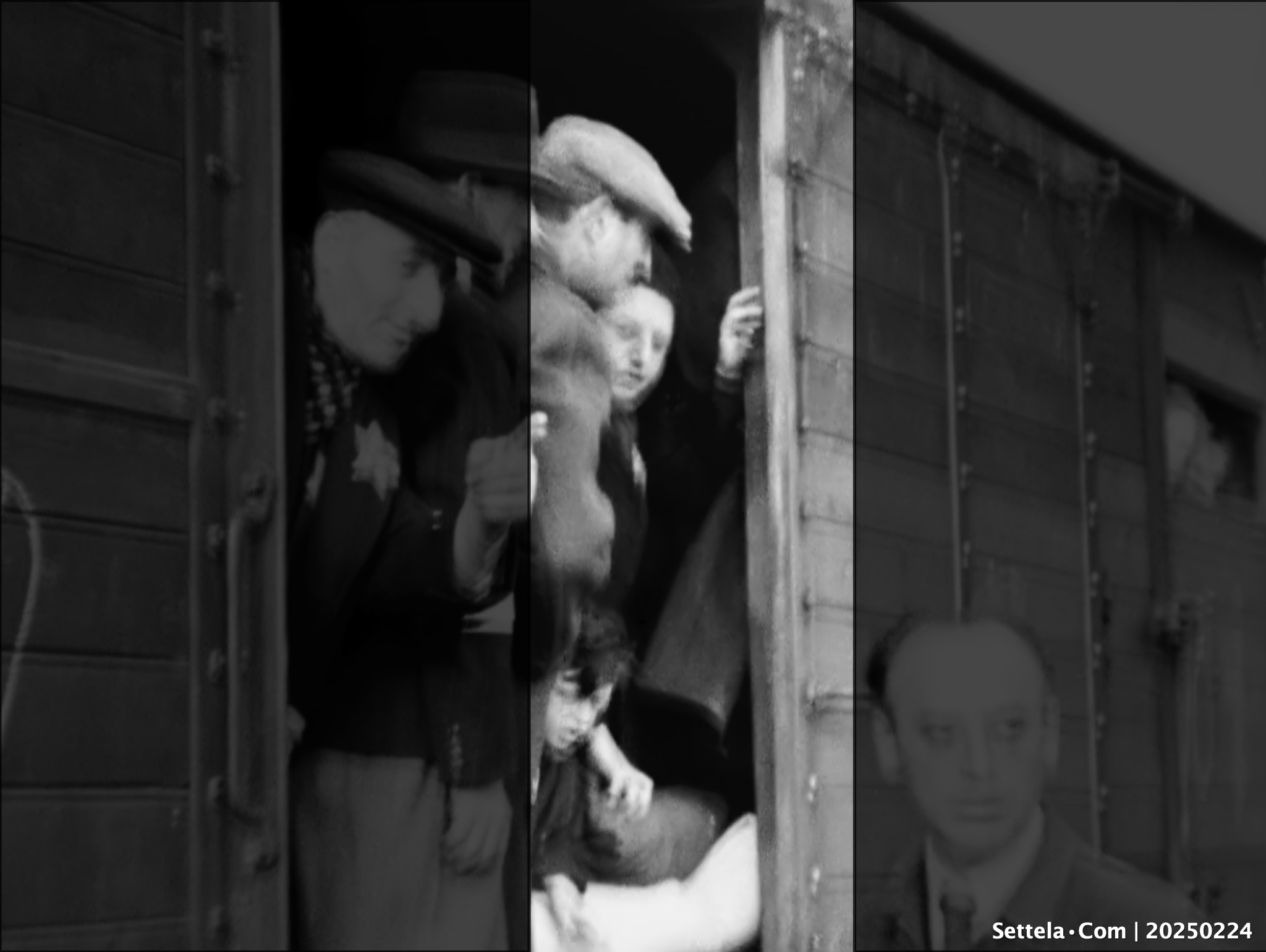
Almost certainly, three Jewish people have been recognized in the unique Westerbork film from 1944 (1). This time it concerns the 9-year-old boy Israël Wijnschenk, his father Max Wijnschenk, and his grandmother Betje Kokernoot-van Furth, who all lived in Utrecht (Holland).
Last week, the Dutch public broadcaster NOS (2) reported the news from the Utrecht (Dutch) news site Nieuws030 (3) that it is very likely that three people were recognized again in this film made by the Jewish prisoner and filmmaker Rudolf Breslauer showing the deportation of Jews, Roma and Sinti by train in Camp Westerbork on May 19, 1944.
Image researcher Koen Hulsbos — who previously identified an Amsterdam couple in this deportation train (4) — thought he recognized the young Israël Wijnschenk, a pupil at the time of the Joodse (Jewish) School Utrecht, and presented this to Victor Frederik, researcher of the Joodse School (5,6). The boy, the man, and the woman seem to belong together, and were recognized from family photos, also by family members.
It is certain that Max and his wife Chel (not in the images) returned to Utrecht after the war, their children Israël and his sister Kitty were murdered. Grandma Betje was also gassed in Auschwitz.
A portrait of Israël Wijnschenk is shown at the site of Joods Monument (7).
According to the transport list, there were two other children in that wagon, Joseph Beugeltas (11 years old) and Manfred Studzinsky (7 years old). Joseph Beugeltas appeared to have blond hair, and could not have been it (6). To be completely sure, the researchers are still looking for a photo of Manfred Studzinsky, for comparison…
The Dutch national broadcaster NOS (1) and the local RTV Drenthe (2) reported this morning (23 Dec 2024) that 2 more people have been recognized in the Westerbork film.
It is the Amsterdam couple Marcus Pels and Hendrika Brandon. They were identified by the image researcher Koen Hulsbos – volunteer working at the Behind the Star project of the NIOD Institute for War, Holocaust and Genocide Studies .
The Jewish photographer and filmmaker Rudolf Breslauer, while a prisoner in the Westerbork transit camp in the Netherlands, was commissioned by camp commander Albert Gemmeker to make film recordings for the Westerbork film in the spring of 1944, featuring images of a deportation train.
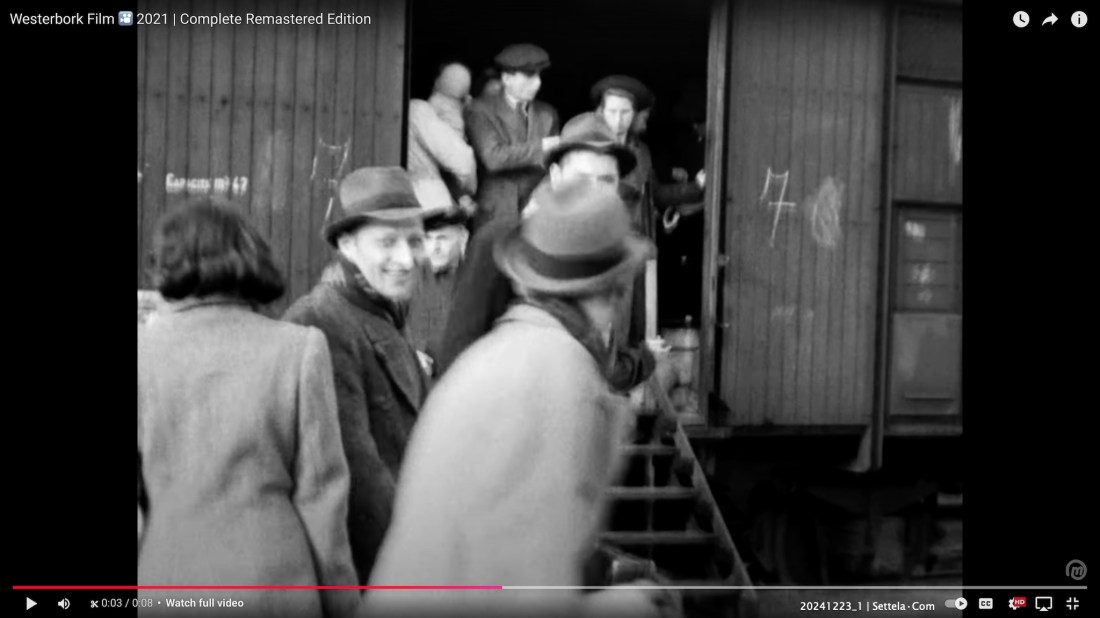
The NOS broadcast referred to images in the first published Westerbork film (3)The film can be viewed in its entirety on YouTube. After just under 5 minutes 🔗 a man with a hat can be seen looking into the camera with a smile, and next to him a woman with black, slightly wavy hair can be seen from behind. The same couple appears again at 6 minutes 🔗 . It turned out to be the Amsterdam couple Marcus Pels and Hendrika Brandon.
Pels & Brandon Clip 1 & 2
Also available on YouTube is the more recent second Westerborkfilm (4). This 2021 edition has the recently found original camera rolls of the deportation transport (Reel E198), with higher quality images of the couple.
Hulsbos had already had photos of Marcus Pels and Hendrika Brandon in his collection of images of prisoners who were transported on that day – May 19, 1944 – when Breslauer films the deportation of Jews, Roma and Sinti to Bergen-Belsen and Auschwitz.
“I’ve seen the film many times, but at one point I thought, ‘Hey, this couple is on screen twice.’ I had never really noticed that before,” says Hulsbos.
Hulsbos then compared the film footage with his photos. “And then I thought: that’s it,” says the amateur film historian.
Marcus Pels was murdered immediately after arriving in Auschwitz. Hendrika Brandon survived the war, as did their daughter and son, who were in hiding with a foster family. Katy (Keetje, 86 years old) and Philip (83) are still alive and live in Canada. They were shown the film footage and confirmed that they were their parents.
“They don’t remember their father. So to actually see images of him, to see him just walking around alive, there are no words to describe it,” granddaughter Lisa Kaufman said as a family spokesperson. “It was very special to see my grandmother, who I grew up with.”
Anonym | Girl with the headscarf …
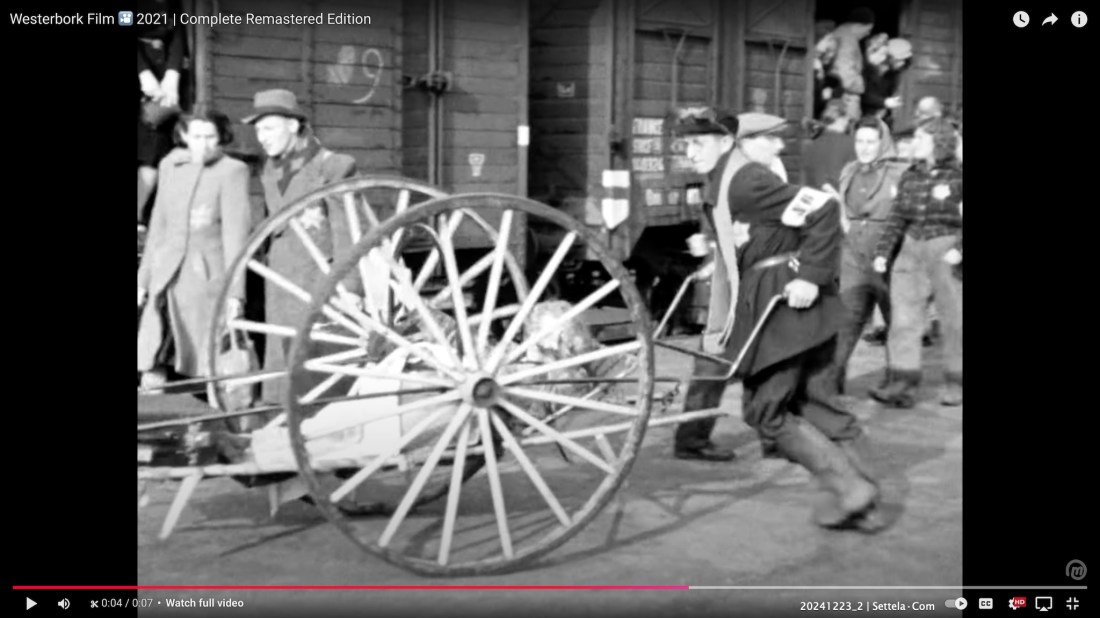
In the Westerbork film, Hendrika looks at the woman on the stretcher, who was recognized in the 1990s through her suitcase as Frouwke Kroon, and thus was the key to identifying this transport and thus also to the name of the anonymous girl with the headscarf between the wagon doors – Settela (5,6).
Deportation Breslauer family
Earlier this year it was reported that filmmaker Rudolf Breslauer had also filmed two of his children , Stefan , and Ursula Breslauer in the Westerborkfilm at the farm (7).
Werner Rudolf Breslauer , his wife Bella Weihsmann, sons Stefan and Max Michael (Mischa), and daughter Ursula were deported later in 1944 from Westerbork to Theresienstadt and Auschwitz. Only Ursula survived.
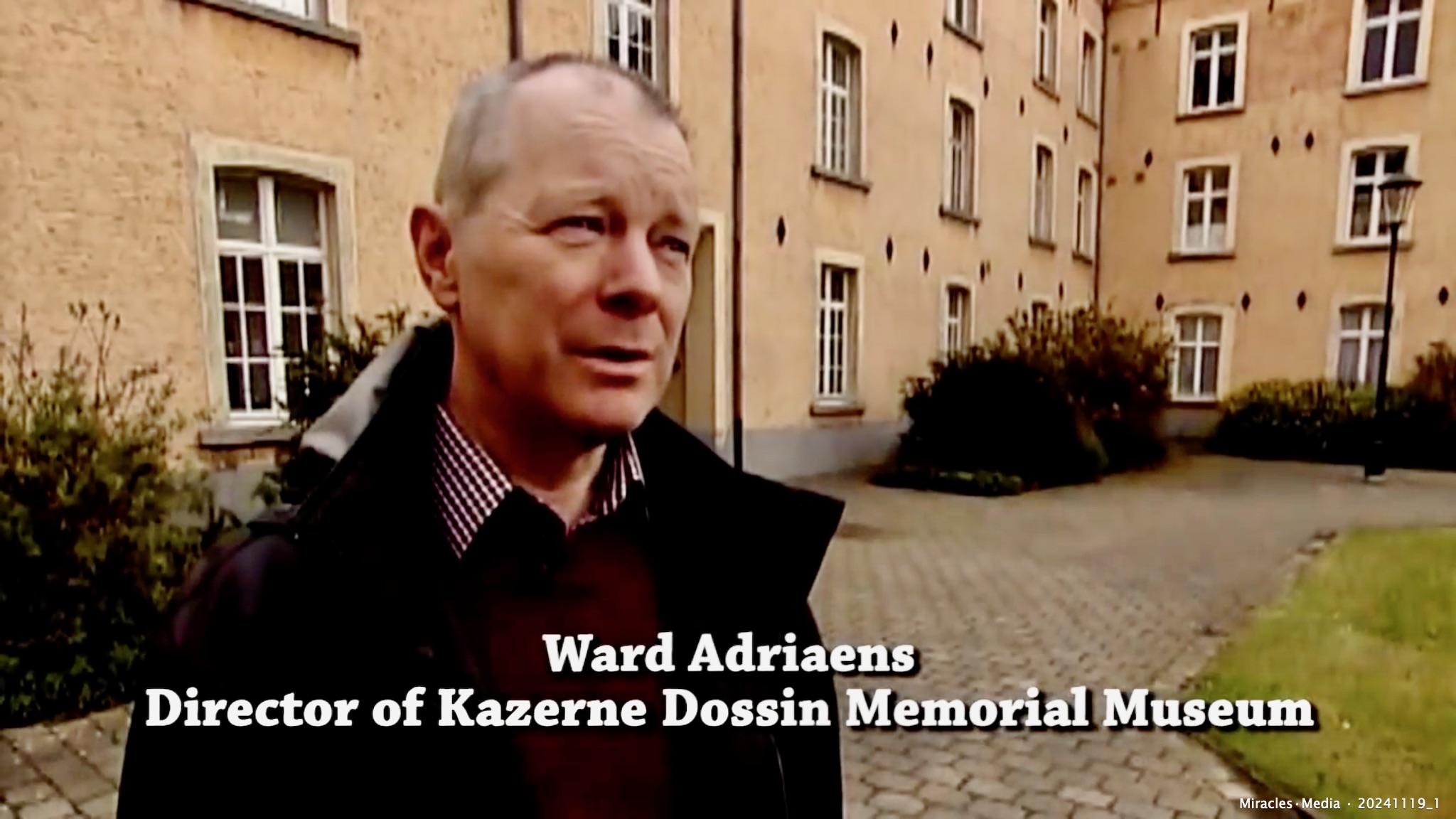
Ward Adriaens (Mechelen, Belgium) passed away suddenly on the evening of November 15th, 2024. A wonderful man, a freethinker, author, with a passion for living history, especially the resistance, partisans, in World War II, and the founding director in 1995 of the Jewish Museum of Deportation and Resistance (JMDR) that opened its doors in 1996. In 2012 the JMDR became the Kazerne Dossin museum, with Ward Adriaens as honorary curator. In 2005 Ward Adriaens launched the Give Them a Face archival project. The portraits of all Jewish, Roma and Sinti deportees which passed through the SS-Sammellager Mecheln (Dossin barracks, transit camp, Mechelen) in 1942-1944, were scanned to create the “Give Them a Face” portrait collection. All around 20,000 photos in the Give Them a Face portrait collection are now part of the commemoration wall – a permanent exhibition – at the Kazerne Dossin museum.
In 2009 , I first encountered the Transport XX installation in Brussels, and met Ward Adriaens’ team of the Give Them a Face project in the Jewish Museum of Deportation and Resistance in Mechelen, Belgium (1,2).
Next , Ward Adriaens participated in our 2012 documentary Transport XX to Auschwitz (3).
Recently, May 2024, Ward Adriaens’ opening speech at the TRANSPORT XX installation in Mechelen in 2007, was posted in the ‘Miracles’ project at Miracles•Media (4).
Quote
“…Let us clearly understand that this is the fundamental basis of racism: persecuted because we have a mother. We all have parents and many amongst us have children. In order to protect them it is essential that we do not give an inch to racism. Everyone of us will come under threat should the policy makers be influenced by racism…”
3. Ward Adriaens’ interview by the dutch reporters Piet de Blaauw & Aart Zeeman (Dutch NCRV-Netwerk broadcast, 13 April 2005, NL1) from the documentary ‘Transport XX to Auschwitz’ – a film by Karen Lynne & Richard Bloom and Michel van der Burg • In : Documentary film “Transport XX to Auschwitz” • Miracles•Media • 20130419 • URL (retrieved 20241119) https://michelvanderburg.com/2013/04/19/transport-xx-to-auschwitz/