‘Entartete Art’ 1935 – Coleman Hawkins & Leo de la Fuente in Holland
American saxophonist Coleman Hawkins announces and plays – accompanied by Leo de la Fuente on piano – on his tenor saxophone ‘I wished that I were twins’.
In 1934, Coleman Hawkins left the Fletcher Henderson Orchestra and Amerika, moved to Europe, and joined the Jack Hylton Orchestra in England. Hylton and his band made regular ‘continental’ tours, and started another European tour January 1935 accompanied by Coleman Hawkins in Holland. At the end of January 1935 Hawkins joins the dutch band The Rambers … for 8 days … because Hawkins was denied entry to Germany because of his race, while Hylton and his band continued their tour without him and play for eight days at the Berlin Philharmonic Hall.
To end this special week with Hawkins well, the bandleader of The Ramblers – Theo Uden Masman – arranged with Decca for recordings 4 february 1935 in Pulchri Studio in The Hague, Holland, including this : I wish I were twins…that was also recorded on film by Polygoon (Polygoontoon) for the dutch cinema news for next week .
Coleman Hawkins is accomponied here on film by the dutch jazz pioneer Leo de la Fuente on piano , playing ‘I wished that I were twins’ . After the recordings, Hawkins moves further into Europe.
Leo – Leonard Henriques – de la Fuente, who was born Jewish in Amsterdam 28 March 1902, was deported by the nazi’s to Auschwitz on 2 November 1942, and died 30 April 1944 ‘somewhere in Mid Europe’.
entartete art jazz 1935 coleman hawkins leo de la fuente in holland 20231123 1
entartete art jazz 1935 coleman hawkins leo de la fuente in holland 20231123 2
entartete art jazz 1935 coleman hawkins leo de la fuente in holland 20231123 3
Citation : ‘Entartete Art’ 1935 – Coleman Hawkins & Leo de la Fuente in Holland | 20231123 | Settela•Com | ISSN 2949-9313 | TakeNode 4f388407-5ccc-4816-aef6-6064fcee35b2
Silent film — Towards the end of World War I – in the summer 1918 , after the Allies defeated the Germans in the Second Battle of the Marne – large groups of Belgians and French refugees flee in front of the retreating enemy force to the neutral Netherlands.
The Dutch army and Red Cross prepared to receive a possible 100,000 evacuees in the border towns in the south of the Netherlands.
After wandering weeks in the north of France , and next crossing Belgium on foot, the first group of French refugees arrived at the Dutch border October 20, completely exhausted.
At the gate in the electric wire fence at the border to the Netherlands – the so-called ‘Death Wire’ (dutch : Dodendraad ) Dutch soldiers took them over from German escorts.
Some refugees had travelled by tram part of the route crossing Belgium to the belgian border town Molenbeersel.
At the dutch border the refugees were welcomed and ladies from relief committees provide the refugees with food and drinks on the road to Stramproy in the Netherlands.
Within days , thousands of French refugees arrive in the village of Stramproy and are transferred to the city of Weert .
On arrival in the city center of Weert the dutch army registered people and handed out soup and bread.
The weak, the sick, and maternity women were cared for by the Red Cross and taken to an aid post for further care.
The refugees were sheltered the night in buildings like convents and schools in Weert, before being housed elsewhere in the country the following days.
References
Source (video footage) : Belgische vluchtelingen 1e Wereldoorlog. Open Images | Beeld & Geluid (Sound &Vision).
Weert en het einde van W.O.-I. | Jan Henkens | Stichting Historisch Onderzoek Weert | URL http://www.showeert.nl
Short film that I made June 8, 2016 as ‘Selfie For The Sea’ for World Oceans Day. My encounter with Sara the southern Sea lion diving in the open Caribbean Sea along the coast of Curaçao (Netherlands) was filmed by Gordy Cox in 2004.
Remastered 20230907 edition of vimeo•com/169906000 posted 20160608 . @CelebrateOceans @WorldOceansDay
Citation : Sara & Me • Selfie For The Sea | 20160608 • 20230907 | Michel van der Burg | 1-memo•com | TakeNode 7eb3c7e0-f4fb-48aa-8dbe-3363eef0e6bc
Starfighter Photography Prohibited ! Bio 1965 | 20230729 | Michel van der Burg | Miracles•Media | Photography not allowed here in 1965 where I – at the age of 13 – took this low-flying fighter jet picture hiding in the heath on a trip around our summer camp – first year highschool Aloysius College – at the Tranchée in forest and heathland between Weert and Budel in the south of the Netherlands near the border with Belgium. The camera – a Voigtländer Vito camera (no light meter / no rangefinder / fixed lens / viewfinder) – was a 13 birthday gift earlier that year – that I used here for my short first ‘reportage’. @michelvanderburg | TakeNode 9245cb78-da77-4069-879e-74a01b52fdb5
Images from the Westerborkfilm have been used countless times in documentaries and films about the Second World War. Here images screening in the virtual opera PUSH – based on the story of Simon Gronowski – an 11 year old Jewish boy who was pushed from the train – Transport XX – by his mother on the way to Auschwitz — Video clip https://youtube.com/clip/UgkxsM6Rj_HB0xEh4TksbjhIm4EzY81dc4H0
A virtual performance, during the April 2020 Corona virus lockdown, of the epilogue of the community opera PUSH , entitled : Ma Vie N’est Que Miracles | My life is only miracles – hosted by composer Howard Moody. It premiered on the night of the 19th April 2020, exactly 77 years after three Brussels resistance heroes stopped the Nazi train Transport XX, transporting 1600 Jewish deportees to Auschwitz, and more than 200 prisoners escaped from the train before the German border. Info : michelvanderburg.com/2020/04/19 .
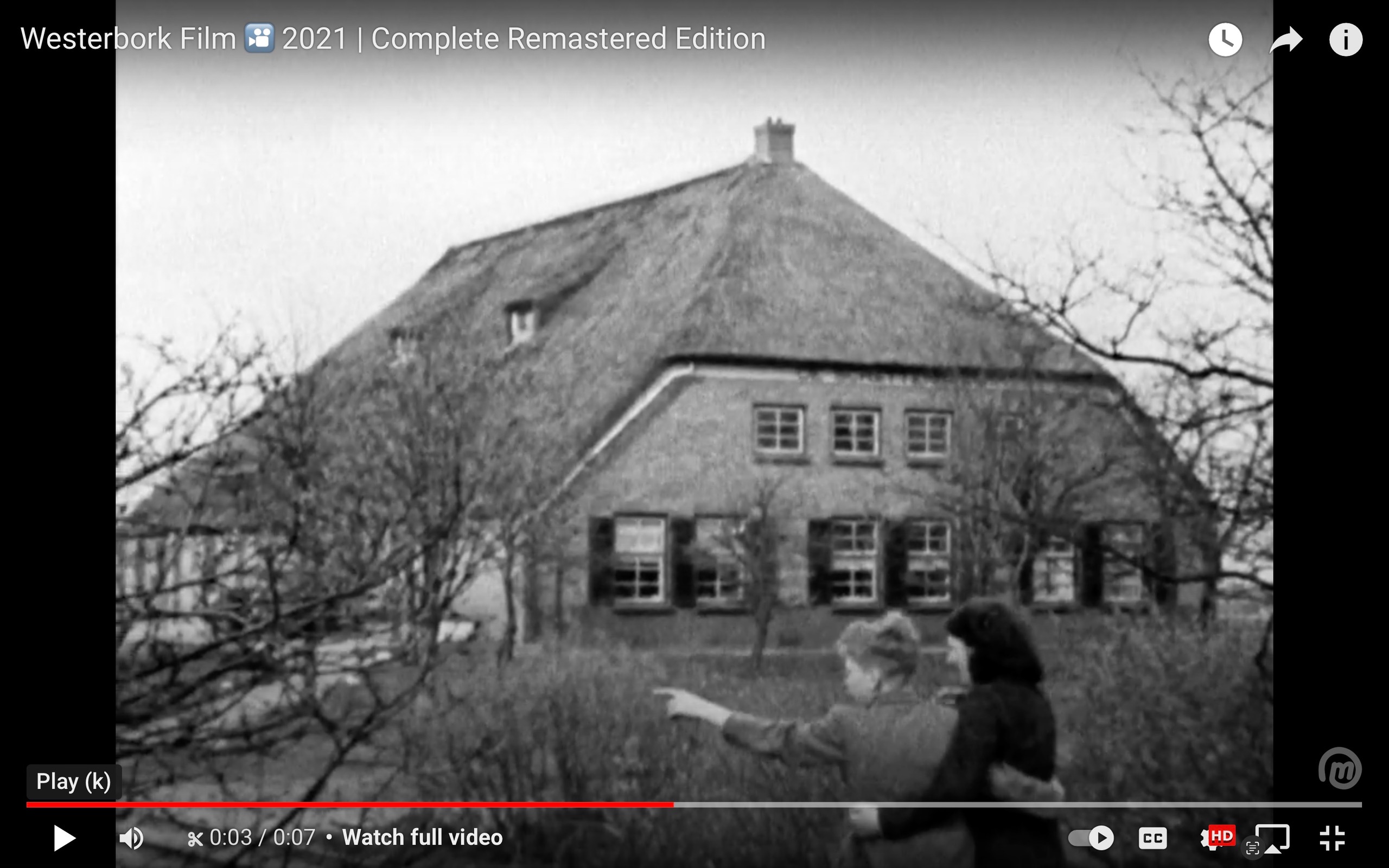
Images from the Westerborkfilm have been used countless times in documentaries and films about the Second World War.
Here Westerborkfilm images – clips – screening semi-permanent ten years ago (Feb. 2013) in a museum introduction film (on holocaust, genocides, discrimination, diversity, rights) on one of the huge columns in the entrance hall of the Kazerne Dossin museum in Mechelen, Belgium (a few months after opening of the new Kazerne Dossin building). Note, shortly after this outbound deportation transport to Bergen-Belsen and Auschwitz, had left the Westerbork transit camp on May 19, 1944, the train paused at the nearby railway station of the dutch town Assen, where train cars were added from Belgian Transport XXV (25) with 508 deportees, Jews and the Roma deportee Stevo Caroli, from transit camp Kazerne Dossin (Dossin barracks) in Mechelen, and this combined transport with Jews, Sinti and Roma, including Settela Steinbach, continues to the east…to the Bergen-Belsen and Auschwitz concentration camps. Stevo Caroli survives Auschwitz-Birkenau. After returning to Belgium, Stevo Caroli’s request for a certificate, necessary for the compensation for political deportees or work refusers, is refused by the Belgian Aliens Police for racial reasons ( kazernedossin.memorial/biografie/stevo-karoli/ ).