Islet Transplantation LUMC News Surprise • @1MEMO 20251020

Diabetic (dutch ‘Suikerzieke) … Parool, 6 Jan 1990 • @1MEMO 20251020

Big surprise today , to encounter this nice news article by journalist Rob van Dijk reporting on our pancreatic islet transplantation breakthrough in the Leiden University Hospital (now LUMC) in the Amsterdam based Dutch national newspaper Parool , Saturday 6 January 1990 (1).

I was searching actually for a better copy of a different news article I have archived on my clinical islet transplantation work (Newspaper Volkskrant 10 April 1999) in the Delpher archive of the National Library of the Netherlands , scrolling the search results, and noticed this Parool article – I didn’t know it existed ;)

Journalist Rob van Dijk did not interview me for the Parool, so I assume his source was the interview I gave for publication in Cicero, the biweekly LUMC publication, and the Dutch newspaper ‘Leidsch Dagblad’, and posted a year ago (2).

The articles reports (my translation from dutch*) :

Transplantation

Islet transplantation has been possible for a few years now, but it doesn’t (yet?) work in humans. The technique itself isn’t that complicated: as many islets of Langerhans as possible are extracted from a pancreas, injected into the diabetic patient’s liver or spleen, and thus, start producing insulin. However, that “thus” is still a bit tricky… …
The major problems lie in the fact that the yield of properly functioning islets is too small (at least 30 percent of the islets must be obtained undamaged to achieve sufficient insulin production after a transplant) and that the suspensions are too impure. Nevertheless, progress is being made.
The best news comes from Leiden University Hospital. There, biologist M. van der Burg, MSc has developed a method to isolate a very high and pure yield of islets from a dog’s pancreas. Van der Burg succeeded in isolating 40 percent of the vital islets from a dog’s pancreas. Through special processing, he was able to completely purify these cell clumps of 90 percent of excess and complicating pancreatic tissue. These islets were injected into the spleen of the same dog, where they produced sufficient insulin. This initial experiment has since been repeated in Leiden with several dogs with the same success. However, major challenges remain, not the least of which is the rejection problem. The Leiden experiments used the dog’s own tissue. The big question remains how the human immune system reacts when islets from a donor are injected.

*NL (dutch) quote :

Transplantatie

Sinds een paar jaar is eilandjestransplantatie wel mogelijk, alleen, bij de mens werkt het (nog?) niet. De techniek is op zichzelf niet zo ingewikkeld: men haalt zoveel mogelijk eilandjes van Langerhans uit een pancreas, spuit die bij de suikerzieke in lever of milt in en dan gaan ze dus insuline maken. Met dat ‘dus’ ligt het echter nog moeilijk… …
De grote problemen schuilen hem erin dat de oogst aan goed werkende eilandjes te gering is (men moet ten minste 30 procent van de eilandjes onbeschadigd te pakken krijgen om na een transplantatie voldoende insulineproduktie te verkrijgen) en dat de suspensies te onzuiver zijn. Toch zit er schot in.
Het beste nieuws komt uit het academisch ziekenhuis te Leiden. Daar heeft de bioloog drs. M. van der Burg een methode ontwikkeld om uit een hondepancreas een zeer hoge en zuivere oogst aan eilandjes te isoleren. Van der Burg slaagde erin uit de alvleesklier van een hond 40 procent van de vitale eilandjes te isoleren, door een speciale bewerking kon hij deze celklompjes voor 90 procent absoluut zuiveren van overbodig en complicerend pancreasweefsel. Deze eilandjes werden ingespoten in de milt van dezelfde hond en produceren daar voldoende insuline. Dit eerste experiment is in Leiden intussen met meerdere honden met hetzelfde succes herhaald. Maar er zijn nog grote problemen op te lossen en bepaald niet het geringste daarvan is dat van de afstoting. Bij de Leidse experimenten werd gebruik gemaakt van eigen weefsel van de hond. De grote vraag blijft hoe het immuunsysteem van de mens reageert als er eilandjes van een donor worden ingespoten.

Notes

1) Transplantatie. “Het Parool”. Amsterdam, 06-01-1990. Retrieved in Delpher on 20-10-2025, https://resolver.kb.nl/resolve?urn=ABCDDD:010834140:mpeg21:p017

2) Islet Transplantation Breakthrough in Leiden University Hospital • 20240830 • Michel van der Burg • michelvanderburg•com • URL https://michelvanderburg.com/2024/08/30/islet-transplantation-breakthrough-in-leiden-university-hospital-20240830/

Citation info : Islet Transplantation LUMC News Surprise • Michel van der Burg • Miracles.Media • @1MEMO 20251020 • URL michelvanderburg.com/2025/10/20/

Islet Transplantation LUMC News Surprise • @1MEMO 20251020

Diabetic (dutch ‘Suikerzieke) … Parool, 6 Jan 1990 • @1MEMO 20251020

Big surprise today , to encounter this nice news article by journalist Rob van Dijk reporting on our pancreatic islet transplantation breakthrough in the Leiden University Hospital (now LUMC) in the Amsterdam based Dutch national newspaper Parool , Saturday 6 January 1990 (1).

I was searching actually for a better copy of a different news article I have archived on my clinical islet transplantation work (Newspaper Volkskrant 10 April 1999) in the Delpher archive of the National Library of the Netherlands , scrolling the search results, and noticed this Parool article – I didn’t know it existed ;)

Journalist Rob van Dijk did not interview me for the Parool, so I assume his source was the interview I gave for publication in Cicero, the biweekly LUMC publication, and the Dutch newspaper ‘Leidsch Dagblad’, and posted a year ago (2).

The articles reports (my translation from dutch*) :

Transplantation

Islet transplantation has been possible for a few years now, but it doesn’t (yet?) work in humans. The technique itself isn’t that complicated: as many islets of Langerhans as possible are extracted from a pancreas, injected into the diabetic patient’s liver or spleen, and thus, start producing insulin. However, that “thus” is still a bit tricky… …
The major problems lie in the fact that the yield of properly functioning islets is too small (at least 30 percent of the islets must be obtained undamaged to achieve sufficient insulin production after a transplant) and that the suspensions are too impure. Nevertheless, progress is being made.
The best news comes from Leiden University Hospital. There, biologist M. van der Burg, MSc has developed a method to isolate a very high and pure yield of islets from a dog’s pancreas. Van der Burg succeeded in isolating 40 percent of the vital islets from a dog’s pancreas. Through special processing, he was able to completely purify these cell clumps of 90 percent of excess and complicating pancreatic tissue. These islets were injected into the spleen of the same dog, where they produced sufficient insulin. This initial experiment has since been repeated in Leiden with several dogs with the same success. However, major challenges remain, not the least of which is the rejection problem. The Leiden experiments used the dog’s own tissue. The big question remains how the human immune system reacts when islets from a donor are injected.

*NL (dutch) quote :

Transplantatie

Sinds een paar jaar is eilandjestransplantatie wel mogelijk, alleen, bij de mens werkt het (nog?) niet. De techniek is op zichzelf niet zo ingewikkeld: men haalt zoveel mogelijk eilandjes van Langerhans uit een pancreas, spuit die bij de suikerzieke in lever of milt in en dan gaan ze dus insuline maken. Met dat ‘dus’ ligt het echter nog moeilijk… …
De grote problemen schuilen hem erin dat de oogst aan goed werkende eilandjes te gering is (men moet ten minste 30 procent van de eilandjes onbeschadigd te pakken krijgen om na een transplantatie voldoende insulineproduktie te verkrijgen) en dat de suspensies te onzuiver zijn. Toch zit er schot in.
Het beste nieuws komt uit het academisch ziekenhuis te Leiden. Daar heeft de bioloog drs. M. van der Burg een methode ontwikkeld om uit een hondepancreas een zeer hoge en zuivere oogst aan eilandjes te isoleren. Van der Burg slaagde erin uit de alvleesklier van een hond 40 procent van de vitale eilandjes te isoleren, door een speciale bewerking kon hij deze celklompjes voor 90 procent absoluut zuiveren van overbodig en complicerend pancreasweefsel. Deze eilandjes werden ingespoten in de milt van dezelfde hond en produceren daar voldoende insuline. Dit eerste experiment is in Leiden intussen met meerdere honden met hetzelfde succes herhaald. Maar er zijn nog grote problemen op te lossen en bepaald niet het geringste daarvan is dat van de afstoting. Bij de Leidse experimenten werd gebruik gemaakt van eigen weefsel van de hond. De grote vraag blijft hoe het immuunsysteem van de mens reageert als er eilandjes van een donor worden ingespoten.

Notes

1) Transplantatie. “Het Parool”. Amsterdam, 06-01-1990. Retrieved in Delpher on 20-10-2025, https://resolver.kb.nl/resolve?urn=ABCDDD:010834140:mpeg21:p017

2) Islet Transplantation Breakthrough in Leiden University Hospital • 20240830 • Michel van der Burg • michelvanderburg•com • URL https://michelvanderburg.com/2024/08/30/islet-transplantation-breakthrough-in-leiden-university-hospital-20240830/

Citation info : Islet Transplantation LUMC News Surprise • Michel van der Burg • Miracles.Media • @1MEMO 20251020 • URL michelvanderburg.com/2025/10/20/

Islet Transplantation Breakthrough in Leiden University Hospital • 20240830

Breakthrough Islet Transplantation • 20240830_1 • michelvanderburg•com • TakeNode e12ae9d5-6a93-444f-b5e2-8c83434d7d6e

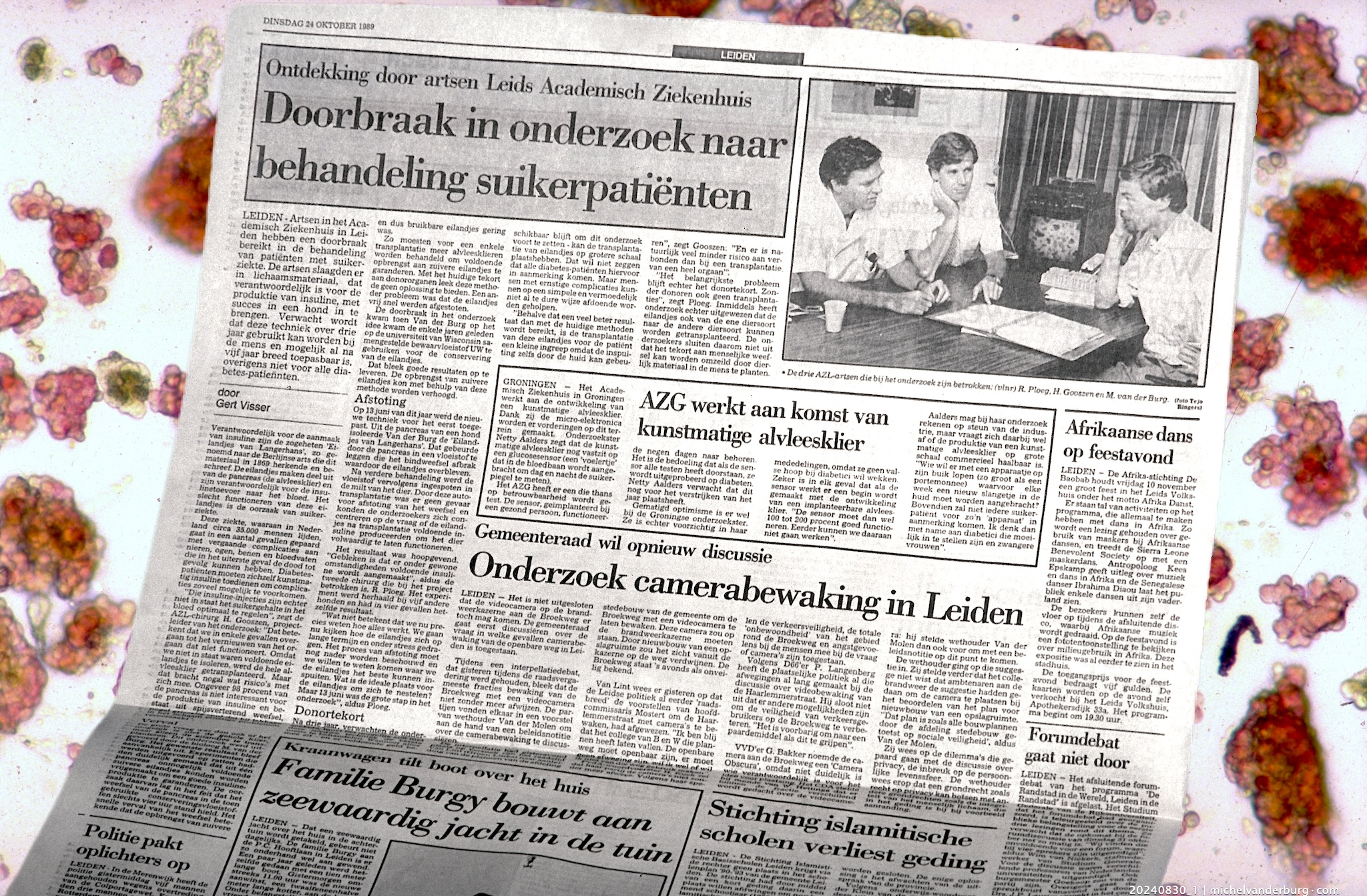
“Breakthrough in research into treatment of diabetics. Discovery by doctors of Leiden University Hospital” …headlines the Dutch newspaper ‘Leidsch Dagblad’ (1).

The dutch newspaper ‘Leidsch Dagblad’ reports October 24, 1989, on a breakthrough in the treatment of diabetic patients…successful transplantation of the insulin producing ‘islets’ in dogs, after isolation of the islets ​​using the UW organ storage solution (UWS)

The first successful transplant June 13, 1989 was a big step. Generally multiple pancreases are needed for an adequate number of purified islets for one transplant. Here the dog’s pancreas was used for the isolation of islets, that were injected back in the animals’ spleen.

‘The breakthrough in the research came when Van der Burg came up with the idea of ​​using the UW organ storage solution — developed several years ago at the University of Wisconsin — for the preservation of the islets. This turned out to yield good results. The yield of pure islets could be increased using this method.’

Cicero

News based on story published Sep. 15th, 1989 by journalist Sylvia Van Leeuwen in Cicero, the biweekly publication of the Academic Hospital and Leiden Medical Faculty (2).


Ploeg, Gooszen and Van der Burg (left to right) discuss the achieved results, Monday Sep 4, 1989 at the Department of Surgery, University Hospital Leiden. Photo Tejo Ringers • 20240830_2 • michelvanderburg•com • TakeNode 3fc69a06-04bf-4f0d-bc77-cedb6d7b7f75

One more thing

We reported long-term function of the islet transplants (3,4). Failure after 3.5 years of a well-functioning islet transplant is puzzling. Nowadays, in clinical islet transplantation, failure of long-term functioning grafts in diabetic patients is still puzzling. Therefore, note (data not published before), that body weight of this autografted animal had increased to almost 150%, from 12.5 kg at the time of islet transplantation, to 18.0 kg at the time of graft failure 3.5 years later (Dec. 1992) — obviously, with an increased insulin demand that may have contributed to graft failure.

Notes

1) Doorbraak in onderzoek naar behandeling suikerpatiënten. Ontdekking door artsen Leids Academisch Ziekenhuis. (EN tr. “Breakthrough in research into treatment of diabetics. Discovery by doctors of Leiden University Hospital”) | by Gert Visser, in Leidsch Dagblad, Oct 24, 1989 | Dutch newspaper, URL https://leiden.courant.nu/issue/LD/1989-10-24/edition/0/page/15

The background in the image here (20240830_1), is the original color slide of the ‘Islets of Langerhans’ showing in the newspaper.

2) ‘Eilandjes’ getransplanteerd | by Sylvia van Leeuwen in Cicero, Sep. 15th, 1989 (ISSN 0920-2900), the biweekly publication of the Academic Hospital and Leiden Medical Faculty | 20240830_3 • michelvanderburg•com Download PDF article, file 20240830_3_CICERO

3) Function and survival of intrasplenic islet autografts in dogs. In : Pancreatic islet transplantation (doctoral thesis, 1994) by Michel van der Burg. ISBN 9789080216402. Scholarly Publications repository of Leiden University. URL https://scholarlypublications.universiteitleiden.nl/access/item%3A3486614/view

4) Van der Burg MPM, Guicherit OR, Jansen JBMJ, Frölich M, Lamers CBHW, Lemkes HHPJ, Bruijn JA, Gooszen HG. Function and survival of intrasplenic islet autografts in dogs. Diabetologia 39, 37–44 (1996). https://doi.org/10.1007/BF00400411

5) Van der Burg MPM, Gooszen HG, Ploeg RJ, Guicherit OR, Scherft JP, Terpstra JL, Bruijn JA, Frölich M. Pancreatic islet isolation with UW solution: a new concept. 4th Congress of the European Society for Organ Transplantation, Barcelona (Spain) November 1–4, 1989.

6) The islet transplant news was first reported by me at an invited lecture July 8, 1989 for the Anglo Danish Dutch Diabetes Group meeting in St Edmund Hall, University of Oxford, Oxford (UK) :
Van der Burg MPM, Gooszen HG, Scherft JP, Terpstra JL, Frölich M, Guicherit OR, Lemkes HHPJ, Bruijn JA. The isolation of canine pancreatic islets for transplantation. Seventh Annual Meeting Anglo Danish Dutch Diabetes Group, Oxford (UK) July 5–9, 1989.

7) Leiden Islet Laboratory History • 20240803 | Michel van der Burg | michelvanderburg•com

Citation info : Islet Transplantation Breakthrough in Leiden University Hospital • 20240830 • Michel van der Burg • michelvanderburg•com