
Van der Burg MPM, Rijkelijkhuizen JKRA, Zwaan RP, Bouwman E. Culture of isolated pig islets pre-xenotransplantation greatly improves the quality and survival of the graft (Kweek van geïsoleerde varkenseilandjes pre-xenotransplantatie verbetert aanzienlijk de kwaliteit en overleving van het transplantaat). Tenth Congress of the Dutch Transplantation Society (Bootcongres 1998), Kerkrade (The Netherlands) April 21–23, 1998.
Download (pdf) NTV bulletin (abstract) & poster , file 1MEMO_20250201
EN – Abstract
PRE-TRANSPLANT SHORT-TERM CULTURE OF ISOLATED PIG ISLETS MARKEDLY IMPROVES THE QUALITY AND SURVIVAL OF THE XENOGRAFT
Van der Burg MPM,* Rijkelijkhuizen JKRA, Zwaan RP, and Bouwman E, Leiden University Medical Centre, Leiden, The Netherlands.
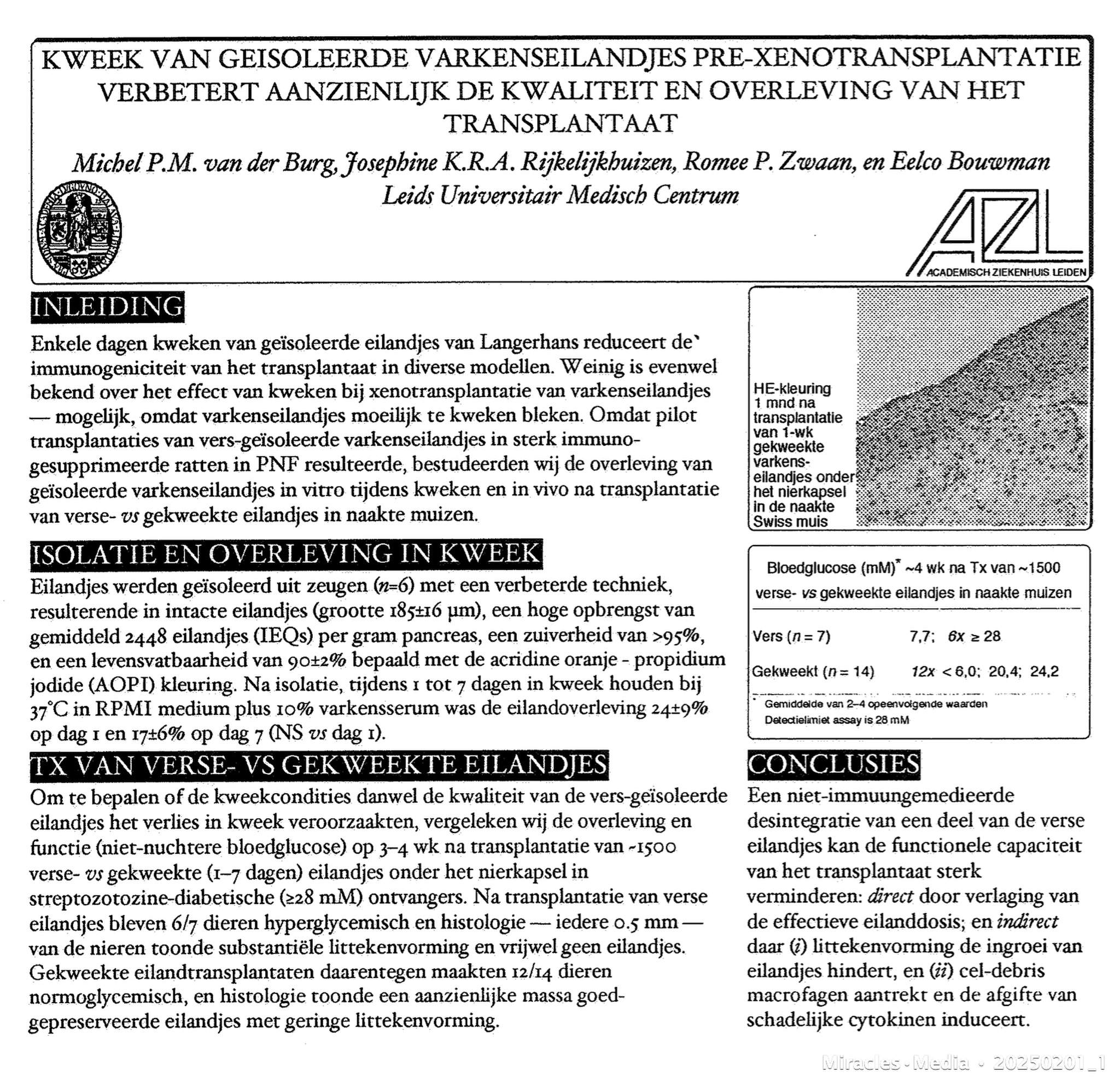
Pre-transplant culture of isolated islets reduces the graft’s immunogenicity in various models. Little is known, however, on the effect of culture in pig islet xenotransplantation — probably, because porcine islets have been found difficult to culture. Because pilot transplants of freshly-isolated pig islets in strongly immunosuppressed rats resulted in primary non function, we first studied 1-7 day culture of the isolated pig islets at 37°C in RPMI plus 10% porcine serum. Islets were isolated from large sows (n =6) by an improved method, resulting in intact islets (size 185±16 µm) and no loss during purification, yielding 2448 islets (IEQs)/g with a >95% purity and 90±2% viability as assessed by acridine orange – propidium iodide (AOPI) staining. During culture, however, islet recovery was 24±9% at day 1 and 17±6% at day 7 (NS vs day 1). In order to delineate whether the culture conditions or the quality of freshly isolated islets caused the islet loss during culture, we compared graft survival in nude mice at 1 mo after transplantation under the kidney capsule of ~2500 fresh islets in normoglycemic recipients or ~1000 cultured islets in STZ-diabetic (>20 mM) recipients. After transplanting fresh islets, histology of the kidneys — sectioned every 500 µm — demonstrated substantial scarring and (near-)absence of islets. Cultured islet transplants, by contrast, rendered 5/6 recipients normoglycemic, and showed a substantial mass of well-preserved islets with little scarring at the grafts’ site. Thus, viability by AOPI-staining of fresh islets poorly predicts the survival in vivo and in vitro. A non-immune mediated disintegration of part of the fresh islets may substantially reduce the functional capacity of the graft, both direct by lowering the effective islet dose, and indirect first because scarring may hamper the engraftment of viable tissue, and second because the cellular debris most probably will attract macrophages and induce the release of harmful cytokines.
Citation info : Fresh vs Cultured Pig Islets for Xenografts • NTV Bootcongres 1998 • Michel van der Burg • Miracles.Media • @1MEMO 20250201 • URL michelvanderburg.com/2025/02/01/
