Lezing Marc Michiels : De verzetsactie op het 20ste transport Mechelen-Auschwitz. Studiedag CegeSoma & Kazerne Dossin , 20 nov 2013, in Kazerne Dossin , Mechelen , Belgium.
Camera notities van Joods Verzet & Transport XX door Michel van der Burg. Ik was nog net op tijd voor deze lezing van Marc Michiels. De dag daarvoor filmde ik Simon Gronowski de hele dag en avond in Saint Sépulcre, Luik. Plan was om na overnachting in Luik , van daar uit naar de studiedag te gaan. Maar al onderweg in de auto toen ik borden Brussel zag herinnerde ik mij plots dat Simon Gronowski terloops iets gezegd had over ‘actie’ ‘morgen’ ‘Waterloo’ (dat drong niet tot me door toen tijdens filmen) en besloot ik dat op te zoeken in Brussel, nog net op tijd voor de speech van Amir Jafari, 12 jaar en Afghaanse vluchteling. Na maken van reportage daar in Brussel, besloten alsnog naar Kazerne Dossin te rijden voor rest van studiedag : de Afternoon Session …
Moderator Ward Adriaens – met bijdragen van Thierry Rozenblum, Herman Van Goethem, Laurence Schram, Marc Michiels, Arnaud Bozzini, en Rudi Van Doorslaer.
On 20 November 2013, roughly 70 years after the attack on the 20th Convoy from Mechelen to Auschwitz in Boortmeerbeek, Kazerne Dossin and Cegesoma jointly organized a study day about Jews and the Resistance. The symposium languages were Dutch and French.
License info: Jews and the Resistance | Marc Michiels | 20221120 | Michel van der Burg | michelvanderburg•com | TakeNode ID: 21438c65-6185-4efe-b3fb-9ce630db30b5
Samudaripen Book Cover | 20221118 | Settela•Com
For Settela•Com , Michel worked with Elisabeth Obadia at the small publishing house L’Esprit Frappeur in Paris and the Tokyo based French visual artist Benoit Dupuis (eden-olympia.net), by preparing a high quality camera-original still image of Settela (Ref 1) from the Westerbork film (Ref 2, 3) for the cover of the 3rd edition of the book Samudaripen, le génocide des Tsiganes (Ref 4) — the genocide of the Gypsies – by author, historian, Claire Auzias. Proud with the result. Waiting for the book to arrive …
The Old Fortress of Corfu , Greece – here filmed 29 September 2022 – was used at the end of World War II by the Nazis to imprison the Jews of Corfu prior to their deportation from the island (Ref 1). Greek resistance fighter Manolis Glézos (Sep 1922 – Mar 2020) – who tore down the swastika from the Acropolis in May 1941 – was confined in a cellar there (Ref 2, 3). Last month, 28 September 2022, holocaust survivor Mr Simon Gronowski – escapee from the 20th prisoners’ train convoy to Auschwitz (Ref 4) – spoke in the European Parliament at the Centennial celebration of the birth of Manolis Glézos, on the resistance against fascism, nazism, imperialism and the daily fight for democracy (Ref 5, 6, 7) . Mr Simon Gronowski (born 12 oktober 1931 in Brussels) is celebrating today his 91th birthday … congrats … La vie est belle !
License info: Old Fortress Corfu Prison | 20221012 | Michel van der Burg | michelvanderburg•com | TakeNode ID: 3c70ef13-05db-4ad7-9b8b-4d7598c42b62
Atelier Marcel Hastir 2020 | 20220805 | 1-memo•com | Sonja filming Michel filming Francine Legrand’s 1938 oil painting portrait Woman in Window by the Belgian painter, theosophist, resistance fighter Marcel Hastir (1906-2011) in his Brussels’ Atelier, Feb 2020.
New 2022 slow motion edition based on the newly found camera-original footage (the original negative film used in Breslauer’s camera May 19, 1944) as published last year in Deportation Westerbork Film | 20210719 (REF 1).
Before in 2017 a similar first slow-motion film was published (Settela | 20170721) (REF 2) that was using the ‘duplicate’ footage (not original footage) from the 1986 RVD film (REF 3).
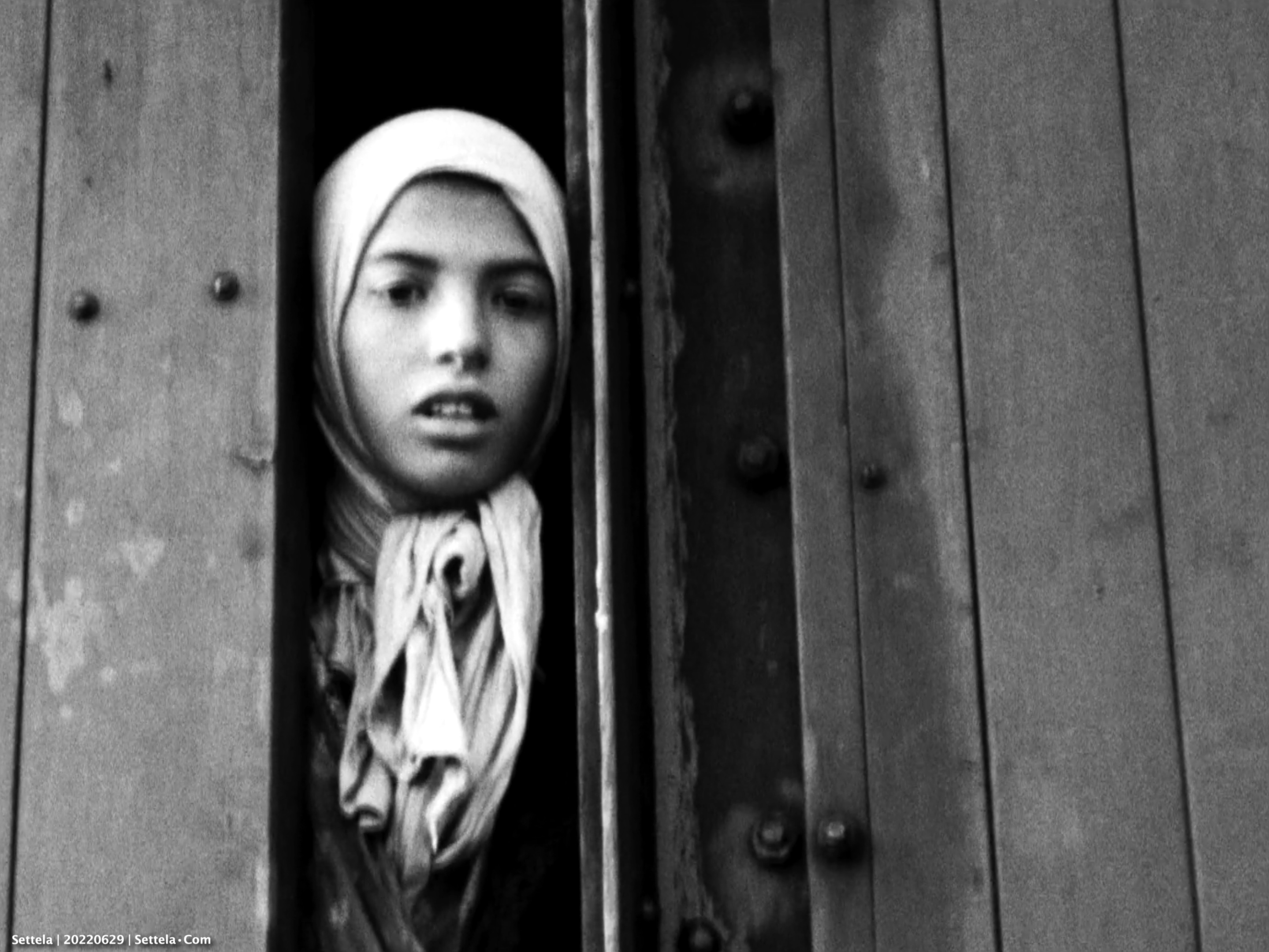
The 9-year-old dutch Sinti-girl Anna Maria ‘Settela’ Steinbach peeks outside , at the last moment just before the sliding door is closed , standing inside a freight wagon with 74 people on May 19 , 1944 in the Westerbork concentration camp in Holland , when this deportation train leaves for Auschwitz-Birkenau – where Settela is murdered a few months later in one of the gas chambers. Here she wears a headscarf made from a torn sheet, because the Nazis had her head shaved , and while Settela peeks outside , her mother cries behind her in the car : “Get out of there, or soon your head gets in between!”
She was filmed by the Jewish prisoner filmmaker Rudolf Breslauer as part of a documentary film being made on the Westerbork camp (REF 4,5). More info in previous posts (REF 1–10).
This film starts with a slow-motion edition (15% original speed) , followed by the unedited 3-4 seconds clip taken from the 2021 Deportation Westerbork Film (REF 1) . Note : the images bounce occasionally , due to a technical artifact — a defect in Breslauer’s camera (REF 10).
Credit
Settela Film | 20220630 | Michel van der Burg | Settela•Com – CC BY 4.0
Settela | 20220629 | Settela•Com – CC BY 4.0 | Scan camera original negative film May 19, 1944 footage Westerbork Film
The 9-year-old dutch Sinti-girl Anna Maria ‘Settela’ Steinbach peeks outside , at the last moment just before the sliding door is closed , standing inside a freight wagon with 74 people on May 19 , 1944 in the Westerbork concentration camp in Holland , when this deportation train leaves for Auschwitz-Birkenau – where Settela is murdered a few months later in one of the gas chambers. Here she wears a headscarf made from a torn sheet, because the Nazis had her head shaved , and while Settela peeks outside , her mother cries behind her in the car : “Get out of there, or soon your head gets in between!”
She was filmed by the Jewish prisoner filmmaker Rudolf Breslauer as part of a documentary film being made on the Westerbork camp (REF 1). More info in references (REF 1, 2, 3, 4).
Credit
Still image from Westerbork Film 🎦 2021 | 20220302 | Settela•Com – CC BY 4.0
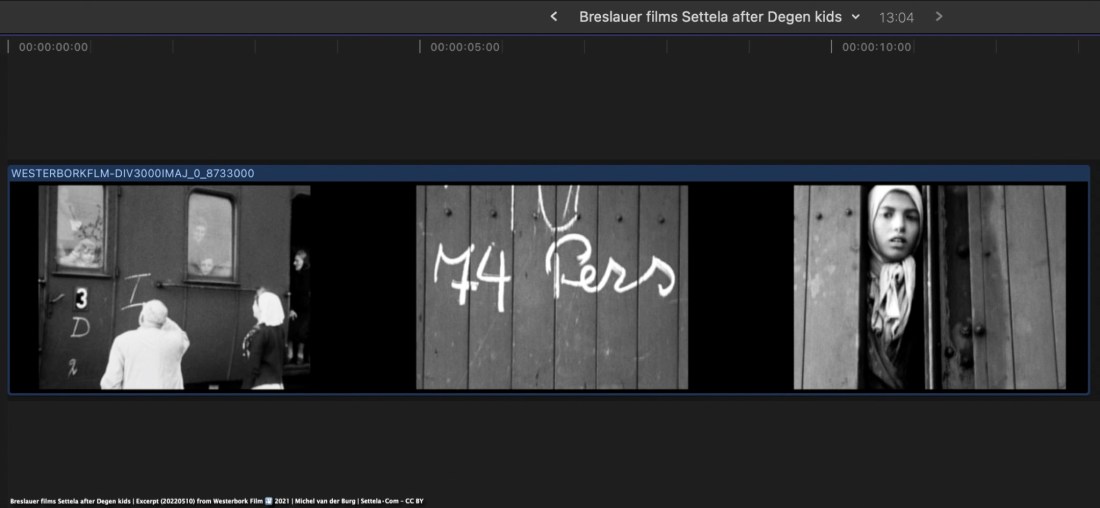
Breslauer films Settela after Degen kids | Excerpt (20220510) from Westerbork Film 🎦 2021 | Michel van der Burg | Settela•Com – Click image for video clip (Link in REF 10).
The original deportation footage of the annotated 2021 Westerbork film (REF 1) provides insight into Breslauer’s way of filming.
Focussing on film roll 2 of the deportation reel it is evident that Breslauer — right after filming the toddlers Marc and Stella Degen (REF 11) in 3rd class carriage I at the front of the train ( 00:16:49 ) — for his next shot ( 00:16:52 ) went all the way to the rear of the train for a close-up of the 9-year-old Settela Steinbach in cattle car number 16 — with Romani and Sinti people bound for Auschwitz (REF 6,12).
Further note that the first shot that day also focusses on a child, here in cattle car #7 with Jewish people (REF 6) bound for Auschwitz (00:20:18 start of roll 4/4 of reel E198).
The 2021 Westerbork film as mentioned in the recently presented Westerborkfilm Introduction (REF 2) is the outcome of a thorough search that started Spring 2019 for all available film cans in the Dutch media archives of Sound & Vision and the EYE Filmmuseum. All restored unique shots using both the camera original film and film copies (duplicates – when no original is known) were used for the new restored Westerbork film compilation made available as ‘display edition’.
Sound & Vision curator Valentine Kuypers reported in her dutch blog 12 May 2021 (REF 3) that a total of 23 film cans were found, including 2 cans with camera-original negative film – a discovery , because before only reels with film duplicates (copies) were known with only a few minutes section of original footage (see below). For the new 2021 Westerbork film “a compilation of unique scenes in the highest quality was made. Eight films from the archives of Sound & Vision and Eye were used for the compilation, consisting of: 16 mm original negative, duplicate negative, duplicate positive and original reversal film. ” [my translation].
Digital restoration with a conservative approach was used to stabilize and reframe the images , deflicker , and remove dust, scratches, and visible splices (REF 4). The display copy for distribution was color graded and adjusted for the correct playback speed.
Examination of the Westerbork Film for annotation showed the film starts with the two newly discovered camera-original reels E325 and E198, resp.
The first reel (E325) has sections of footage shot at various work sites of the Westerbork camp — starting 00:00:29 and ending at 00:14:22 — that can be traced back in the 1986 RVD Westerbork Film duplicates Act 2 and Act 3 , listed with numbers 5 , 17 , 12 , 5, 18, 9, 10, 9, 10, 19, 20 resp. in the post (REF 5) Westerbork Film – full version (RVD). The last scene on this reel E325 – a newly discovered clip of a few seconds – is showing a soldier standing guard at the camp entrance.
Dutch researchers Koert Broersma and Gerard Rossing reported in their new book on the film (REF 6) that the footage on both reels – although original – has been cut — with reel E325 showing 7 splices. I wasn’t able to discover splices, probably because of the digital restoration. The next reel E198, however, with the deportation footage, clearly does show 2 of the 3 spices reported by Broersma and Rossing — these show up as white transitions in this digital display edition around 0:16:22 and 0:18:14 resp. The location of that 3rd splice that is no longer showing in this restored film could be traced with help of the image of that splice published in Broersma and Rossing ‘s book , page 110 (REF 6) – right after Gemmeker looking up , starting 00:20:18 .
Since the splices between the film rolls on this reel could be identified here , the film roll numbers 1 to 4 are specified in the annotations.
The display edition of this deportation footage shows the order of the rolls found on reel E198. For the correct chronological order clearly rolls 1 and 4 have to change places, as shown before in the reconstruction Deportation Westerbork Film | 20210719 (REF 7).
The reels E325 and E198 with original film are followed by reels with restored duplicate films – omitting scenes already shown as original footage :
i) first, the 4 reels (acts) of the restored RVD film (REF 5);
ii) next, the so-called Unknown Westerbork Film Reel…F1014 (REF 8) starting with the Transport data animation at 02:03:31 ;
iii) and finally, the so-called Forgotten Westerbork Film Reel…F1015 (REF 9) starting at 02:11:53 with the Gevaert logo. Footage of the Religuous service on this F1015 reel was reported by Broersma and Rossing (REF 6) to be original film also .
CREDITS
Special thanks to researchers, authors, Koert Broersma, Gerard Rossing, and Aad Wagenaar, to curator Valentine Kuypers and her Sound & Vision colleagues Gerard Nijssen and others. The new Westerbork film project is a joint effort of four dutch organizations : the Dutch media archive Sound & Vision, Camp Westerbork Memorial Centre , the NIOD Institute for War, Holocaust and Genocide Studies, and the Jewish Cultural Quarter in Amsterdam.
Westerbork Film Shots Order | 20220511 | Michel van der Burg | Settela•Com – CC BY 4.0
12 – Settela, het meisje heeft haar naam terug (1995-2007) by Aad Wagenaar ISBN 9789089751898 / English translation by Janna Eliot ‘Settela’ (2005-2016) ISBN 978-0-9933898-2-5 .