TRANSPORT XX — installation Brussels February 28th, 2009, Brussels. Day two, of my encounter with the TRANSPORT XX installation outside in the Royal park in Brussels, that presented 1200 photographic portraits of Jews deported from Malines (Belgium) to Auschwitz in 1943. One of the stills and establising video shots made that Saturday morning after finishing long take video recordings of the installation, during a walk from our hotel in the Leopold (European) Quarter via the Royal park direction the historic centre of Brussels. That weekend break in Brussels, today 15 years ago, turned out to be a turning point in my life. Two months later – April 19, 2009 – the film TRANSPORT XX — installation Brussels was published.
8. First Encounter TRANSPORT XX … | 20240227 | Michel van der Burg | Miracles•Media | URL https://michelvanderburg.com/2024/02/27 | TakeNode cf0dd64d-4512-4846-8bce-6b2d8cca24ef
9. Camera used for both photo and video (720p HD video) of the TRANSPORT XX installation in Brussels is the Sony DSC-T500 which has a CCD sensor – with global shutter – thus not affected by rolling shutter distortion while panning the installation.
Citation info : Encounter TRANSPORT XX … | 20240228 | Michel van der Burg | Miracles•Media | URL https://michelvanderburg.com/2024/02/28 | TakeNode a8317838-7470-4538-b788-40e6cc07b55a
February 28th, 2009, Brussels — my first encounter with the TRANSPORT XX installation in Brussels, that presented 1200 photographic portraits of Jews deported from Malines (Belgium) to Auschwitz in 1943. Turning point in my life. Two months later – April 19, 2009 – the film was published.
Citation info : First Encounter TRANSPORT XX … | 20240227 | Michel van der Burg | Miracles•Media | URL https://michelvanderburg.com/2024/02/27 | TakeNode cf0dd64d-4512-4846-8bce-6b2d8cca24ef
Images from the Westerborkfilm have been used countless times in documentaries and films about the Second World War. Here images screening in the virtual opera PUSH – based on the story of Simon Gronowski – an 11 year old Jewish boy who was pushed from the train – Transport XX – by his mother on the way to Auschwitz — Video clip https://youtube.com/clip/UgkxsM6Rj_HB0xEh4TksbjhIm4EzY81dc4H0
A virtual performance, during the April 2020 Corona virus lockdown, of the epilogue of the community opera PUSH , entitled : Ma Vie N’est Que Miracles | My life is only miracles – hosted by composer Howard Moody. It premiered on the night of the 19th April 2020, exactly 77 years after three Brussels resistance heroes stopped the Nazi train Transport XX, transporting 1600 Jewish deportees to Auschwitz, and more than 200 prisoners escaped from the train before the German border. Info : michelvanderburg.com/2020/04/19 .
Images from the Westerborkfilm have been used countless times in documentaries and films about the Second World War.
Here Westerborkfilm images – clips – screening semi-permanent ten years ago (Feb. 2013) in a museum introduction film (on holocaust, genocides, discrimination, diversity, rights) on one of the huge columns in the entrance hall of the Kazerne Dossin museum in Mechelen, Belgium (a few months after opening of the new Kazerne Dossin building). Note, shortly after this outbound deportation transport to Bergen-Belsen and Auschwitz, had left the Westerbork transit camp on May 19, 1944, the train paused at the nearby railway station of the dutch town Assen, where train cars were added from Belgian Transport XXV (25) with 508 deportees, Jews and the Roma deportee Stevo Caroli, from transit camp Kazerne Dossin (Dossin barracks) in Mechelen, and this combined transport with Jews, Sinti and Roma, including Settela Steinbach, continues to the east…to the Bergen-Belsen and Auschwitz concentration camps. Stevo Caroli survives Auschwitz-Birkenau. After returning to Belgium, Stevo Caroli’s request for a certificate, necessary for the compensation for political deportees or work refusers, is refused by the Belgian Aliens Police for racial reasons ( kazernedossin.memorial/biografie/stevo-karoli/ ).
The new 2021 Westerbork Film is missing part of the image in every frame …
The new high quality restored Westerbork film, presented first May 2021 by the Netherlands Institute for Sound & Vision and the NIOD Institute for War, Holocaust and Genocide Studies, has numerous advantages over the previous well known first edition of the Westerborkfilm made in 1986 in 4 acts by the dutch Rijksvoorlichtingsdienst (RVD ; the Dutch National Centre for Information) .
The full 1986 film including all 4 acts , was first published in 2019 at Settela•Com (Ref 1), with annotations for the various scenes. That 1986 Westerborkfilm however does not include all of the footage shot by Rudolf Breslauer, Spring 1944 in Camp Westerbork, in the Netherlands.
Footage not used in the 1986 Westerbork film compilation was presented in a series of posts published later in 2019 at Settela•Com.
Next, a film compilation of all that known footage was posted online as the WESTERBORK FILMS COLLECTION – UNESCO ALBUM (Ref 2). That film compilation was also made available for download 20 January 2020 by Michel van der Burg | Miracles.Media via the Open Images bank of Sound & Vision (Ref 3). That compilation was prepared without checking / deleting duplicate copies of footage, and thus contains redundant footage.
The 2021 restored Westerbork film is a major upgrade from the 1986 Westerborkfilm edition. Important advantages of the 2021 Westerbork film are , (i) new high quality 4K scans were made of the footage, (ii) containing a complete selection of all known footage, (iii) using only the best copies of all footage found in the archives, (iv) based on an extensive new inventory of all known archives, with the discovery of 2 canisters with ‘camera-original’ footage, and a hitherto unknown clip, and (v) with conservative, digital, restoration applied. Details on that new restored Westerbork film were discussed July 2021 with the co-publication of an important part of the 2021 Westerbork film : the new high quality deportation footage — a film compilation of scans of the newly discovered original camera negative film used by Rudolf Breslauer 19 May 1944 in Camp Westerbork, in the Netherlands (Ref 4).
The complete Westerbork Film 2021 was published too at Settela•Com on May 7, 2022 with all scenes annotated (Ref 5), together with a short introductory film : Westerborkfilm Introduction (Ref 6).
Note that additional digital restoration has been applied by Sound & Vision for the publicly made available so-called ‘display edition’ of this new 2021 Westerbork film according to Conservator Valentine Kuypers | Sound and Vision (Ref 7) – as discussed previously at Settela•Com (Ref 4).
Missing Part Images
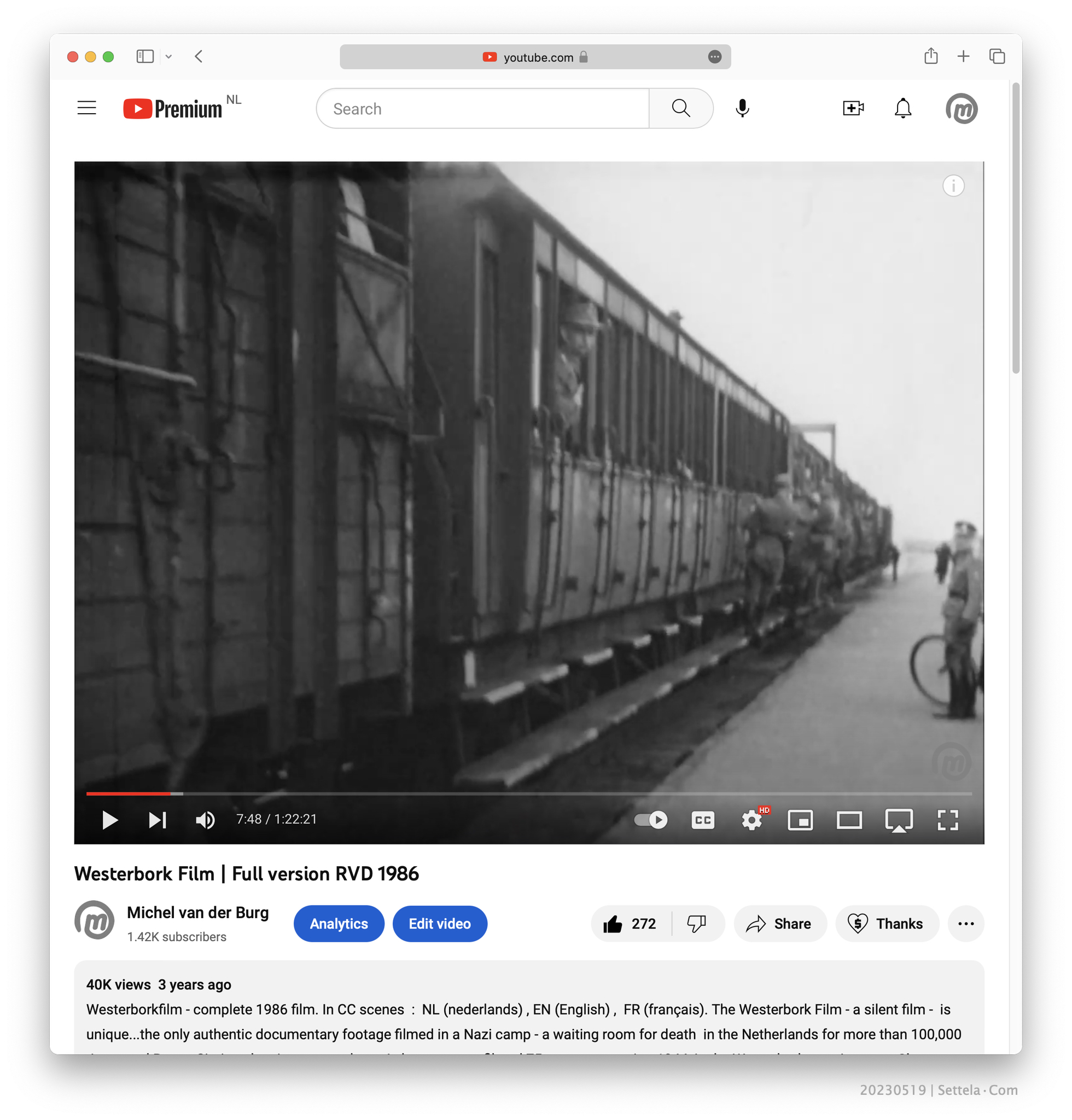
It should be noted that the released 2021 ‘display edition’ of the Westerbork film – due to the applied image stabilization – does show less of the actual image in each frame as compared to the 1986 edition.
Below some examples illustrating the crop in the display edition.
2021 edition | not showing ‘nazi with bike’ | 20230519 | Settela•Com
2021 edition – not showing ‘nazi with bike’ in same scene, near identical frame — though he shows up in later frames a few seconds later, walking away ) – https://youtu.be/ZiLNDziwEtc?t=882
Settela’s car (not) showing 74p•
Next a comparison of the frame displaying “74 p.” (chalked on the car with Settela). The dot is shown in the 1986 film. That dot is missing in the 2021 film due to the cropped image resulting from the image stabilization.
Of note : first news clips presented by Sound & Vision announcing the new restored film , are apparently not based on the ‘display edition’, and do show that dot in the original 4K scan.
The full image — including the dot ’74 p.” — was shown in a first news item Sep 12, 2019 on the daily dutch ‘Nieuwsuur’ national news show , on colorized high quality deportation footage, that mentioning the new original footage. Item “Iconische beelden Tweede Wereldoorlog na 75 jaar in kleur” ; URL https://nos.nl/nieuwsuur/artikel/2301340-iconische-beelden-tweede-wereldoorlog-na-75-jaar-in-kleur
Jan 2020 Sound & Vision publicly showed and announced the newly discovered camera original footage via the daily dutch news show NOS (Ref 8) showing the images with no crop — including the dot ’74 p.” and presented an 8 min film compilation a few days later via their Vimeo channel also (at 0021) shwoing 74 Pers • (with dot) . URL https://vimeo.com/386667241
In 2021 Sound & Vision apparently started using the ‘display edition’ for publications on the new found original Westerbork deportation footage ; such as the YouTube uploads “De Westerborkfilm 📽️🎞️” (uploaded Apr 8, 2021) – https://youtu.be/8Y-A4BkWY18?t=2 , a video presented first I believe April 18, 2021 in an online Media Café event by Sound & Vision , and May 18, 2021 on the occasion of the public release of the restored film (Ref 9), in the 20 min presentation “Gerestaureerde filmbeelden Westerbork (1944)” of a compilation of selected images from the restored film – missing again the dot at 0:47 – https://youtu.be/-zCmr6PSNcI?t=47
Missing Image Westerbork Film 2021 | 20230519 | Michel van der Burg | Settela•Com | ISSN 2949-9313
References
1. Westerbork Film | Full version RVD 1986 | 20190605 | Michel van der Burg | Settela•Com | ISSN 2949-9313
2. WESTERBORK FILMS COLLECTION – UNESCO ALBUM | 20200120 | Michel van der Burg | Settela•Com | ISSN 2949-9313
3. WESTERBORK FILMS COLLECTION – UNESCO ALBUM (20200120) Michel van der Burg | Settela•Com | ISSN 2949-9313 | CC BY 4.0 | Open Images – URL https://www.openimages.eu/media/1223905
5. Westerbork Film 🎦 2021 | 20220302 | Michel van der Burg | Settela•Com | ISSN 2949-9313 | Display edition film annotated online in CC
6. Westerborkfilm Introduction | 20220507 | Michel van der Burg | Settela•Com | ISSN 2949-9313 | Introduction by Michel van der Burg on the Westerborkfilm screening in METRO Kinokulturhaus , Vienna , Austria at the DOCUMENTS OF DESTRUCTION | DOKUMENTE DER VERNICHTUNG Symposium 6-7 May, 2022 curated by Florian Widegger. Presented by Filmarchiv Austria in cooperation with the Vienna Jewish Film Festival and the Mauthausen Memorial.
Samudaripen – Genocide of the Gypsies – Claire Auzias
The French author, historian and libertarian, Claire Auzias researches social movements, women’s history and Roma’s history (1). She has written several works on the Roma’s history in the last 20 years. Samudaripen, the Genocide of the Gypsies, first appeared in 1999/2000 (2,3), and is now followed by the 3rd edition (4) published by L’Esprit Frappeur (Paris).
In her book Samudaripen, Claire Auzias sheds light on this poorly documented genocide in the III Reich , Eastern Europe, and Western Europe. This entirely revised 3rd edition now includes two new chapters — one on Switzerland by Claire Auzias, and one on The Netherlands by Erik Van Den Muijzenberg. Claire Auzias , in her foreword (5) : “…the patient discovery of the identity of an anonymous icon of the deportation, in the guise of a Dutch Sinti girl, made the chapter on the Netherlands obligatory, at least for those of the French gypsies who do not read foreign languages.”
2 – Claire Auzias interview (2009) “Samudaripen” – Un entretien avec Claire Auzias, auteure du livre “Samudaripen, le génocide des Tziganes” aux éditions L’Esprit frappeur. Réalisé fin octobre 2009 par Bruno Boudiguet pour Télé Liberté / Le Cobaye international . Dailymotion URL https://dai.ly/xb9lah
5 – Claire Auzias (2022) Samudaripen, le génocide des Tsiganes (Samudaripen, the Genocide of the Gypsies), Paris, L’Esprit Frappeur (3nd edition 2022) ISBN 978-2-85103-051-1 | Avant Propos : “…la découverte patiente de l’identité d’une icône anonyme de la déportation, sous les traits d’une fillette sinti hollandaise, rendait obligatoire le chapitre sur les Pays-Bas, a minima à l’attention de ceux des Tsiganes français qui ne lisent pas les langues étrangères.”
License info :
Samudaripen – Genocide of the Gypsies – Claire Auzias | 20221210 | Settela•Com