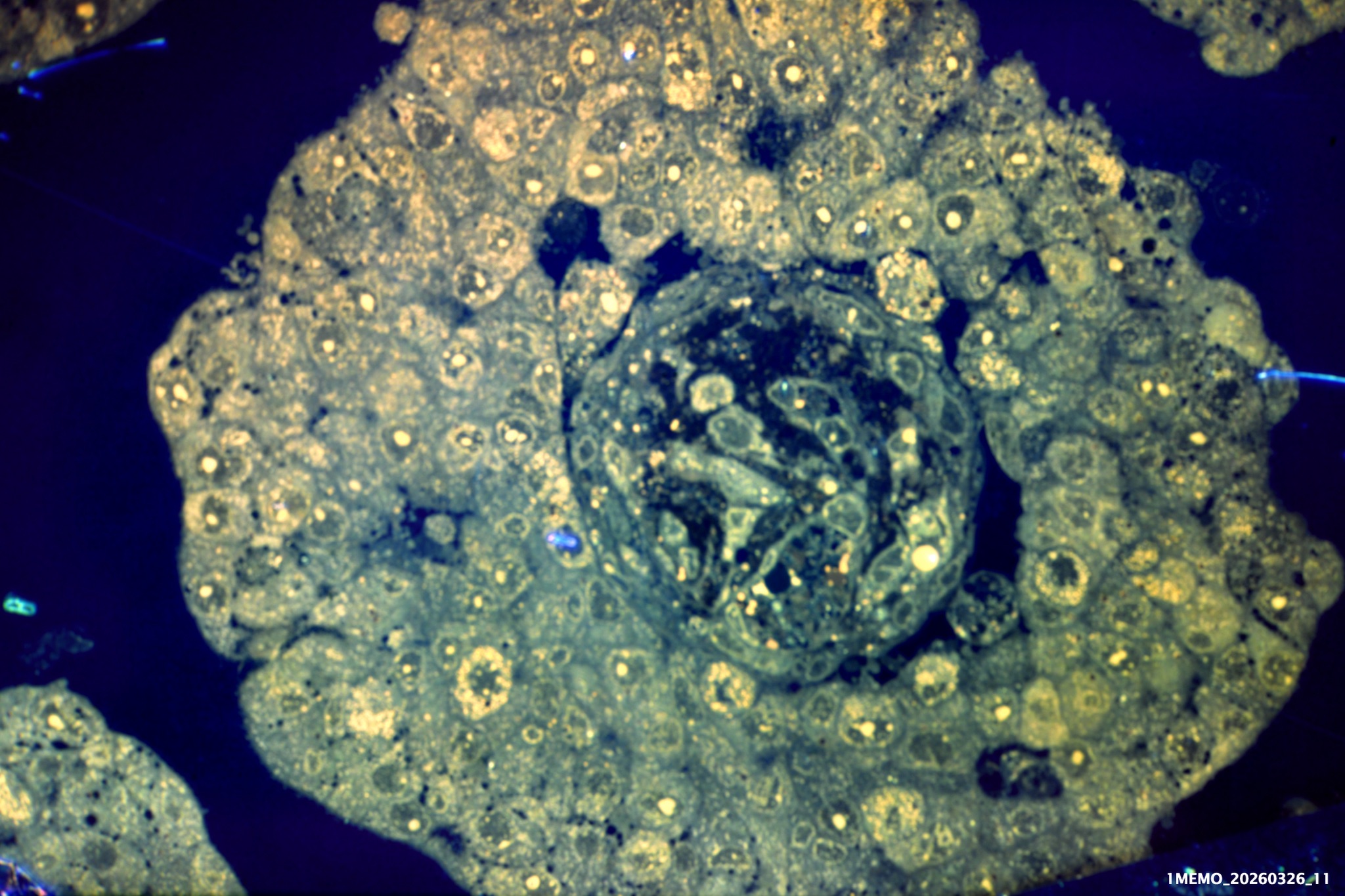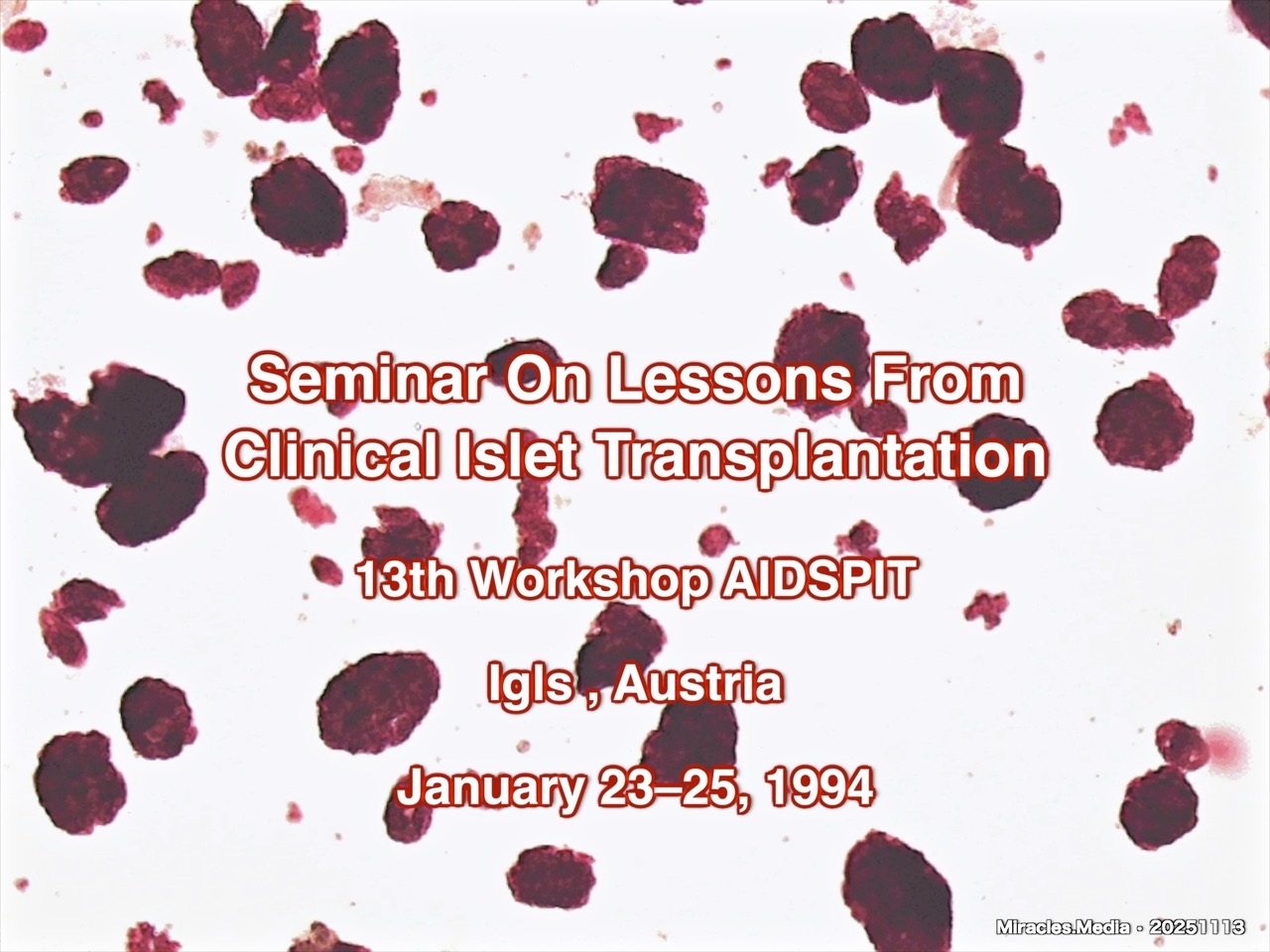
Seminar on lessons from clinical islet transplantation
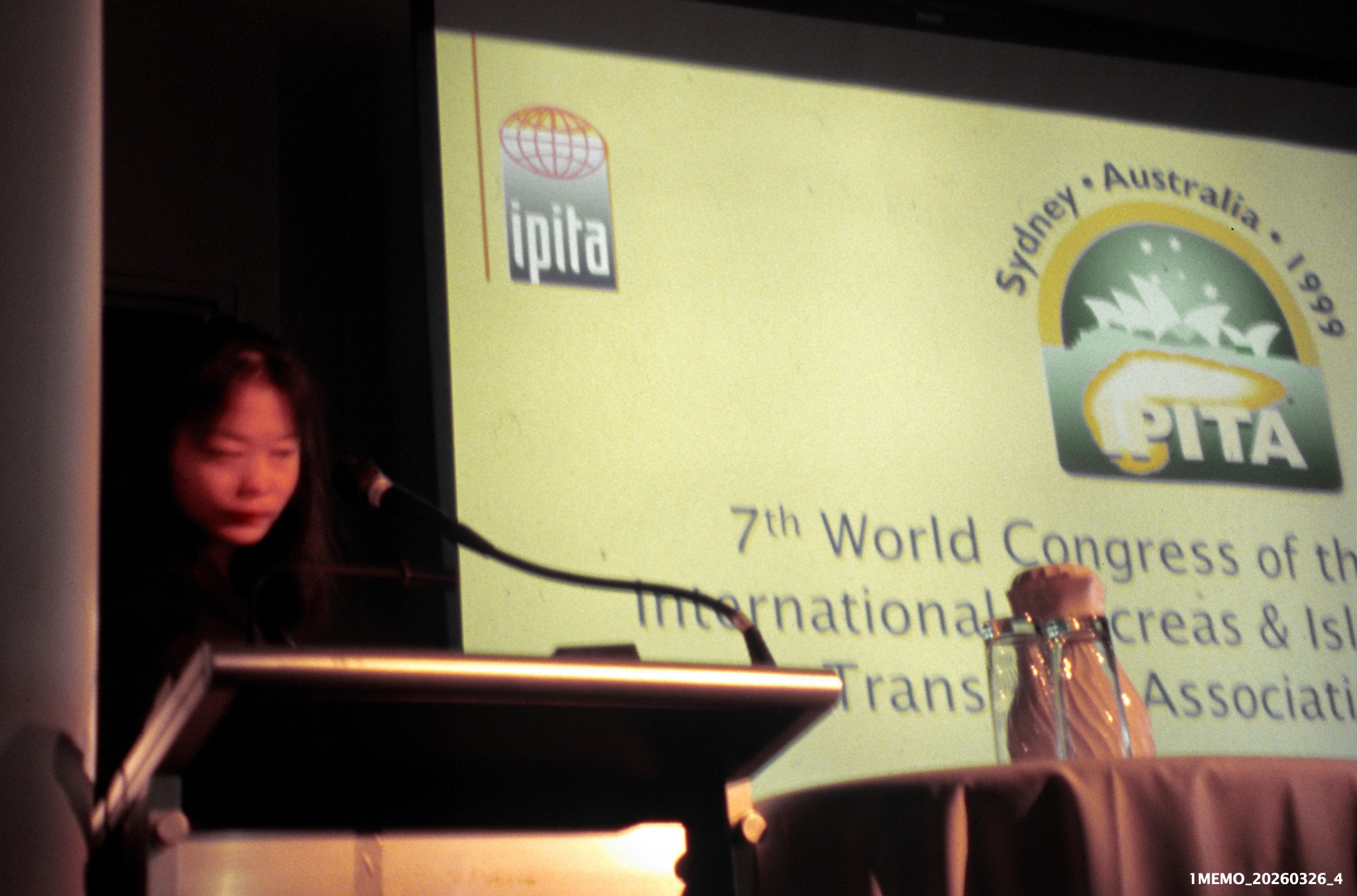
Chairman K. Federlin (Giessen, Germany) opened the seminar Tuesday, January 25, 1994 and David Scharp began with his lesson from the Center in St. Louis (USA) at the 13th Workshop of the AIDSPIT * Study Group , Igls, Austria, January 23–25, 1994.
Notes
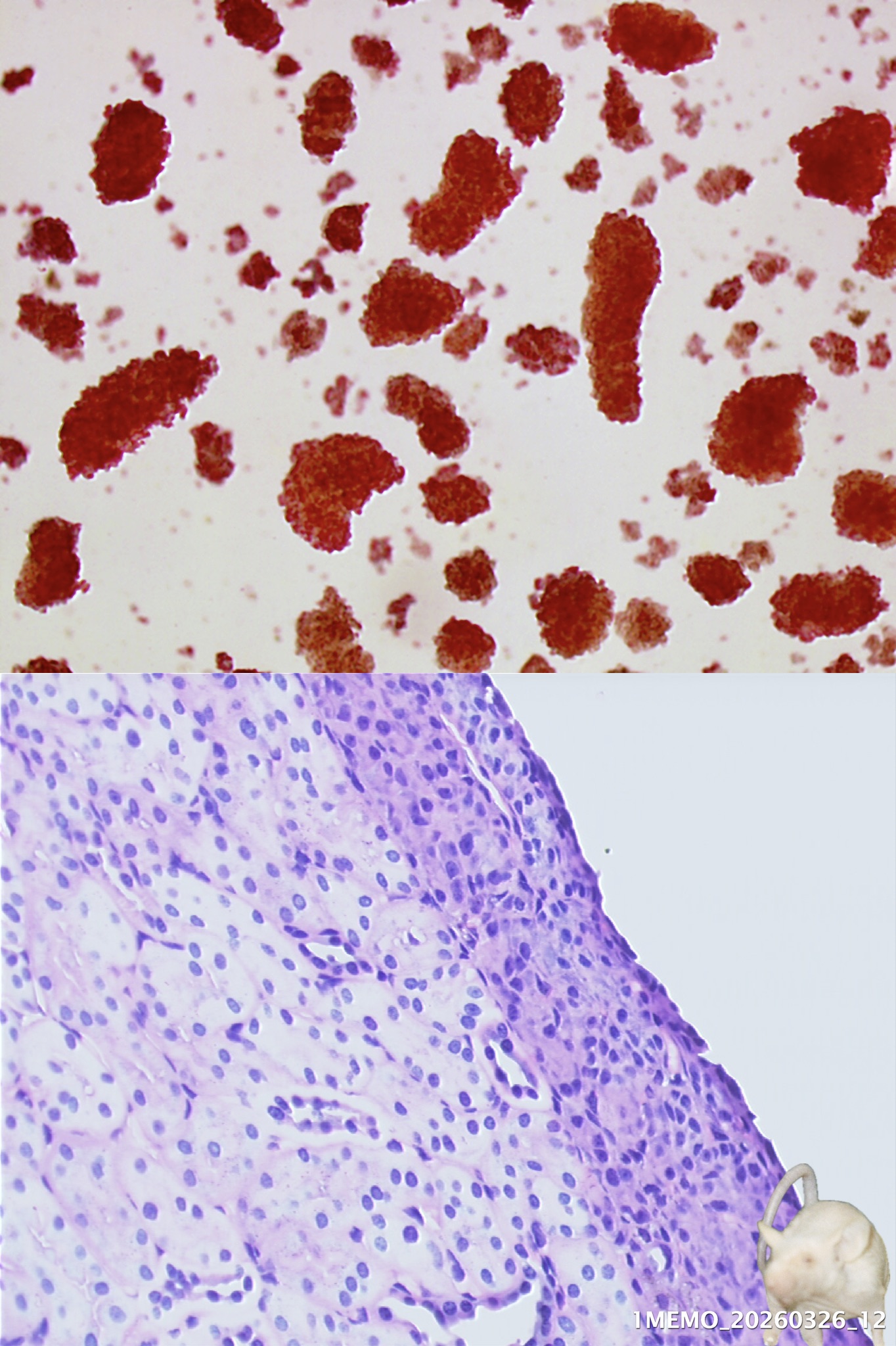
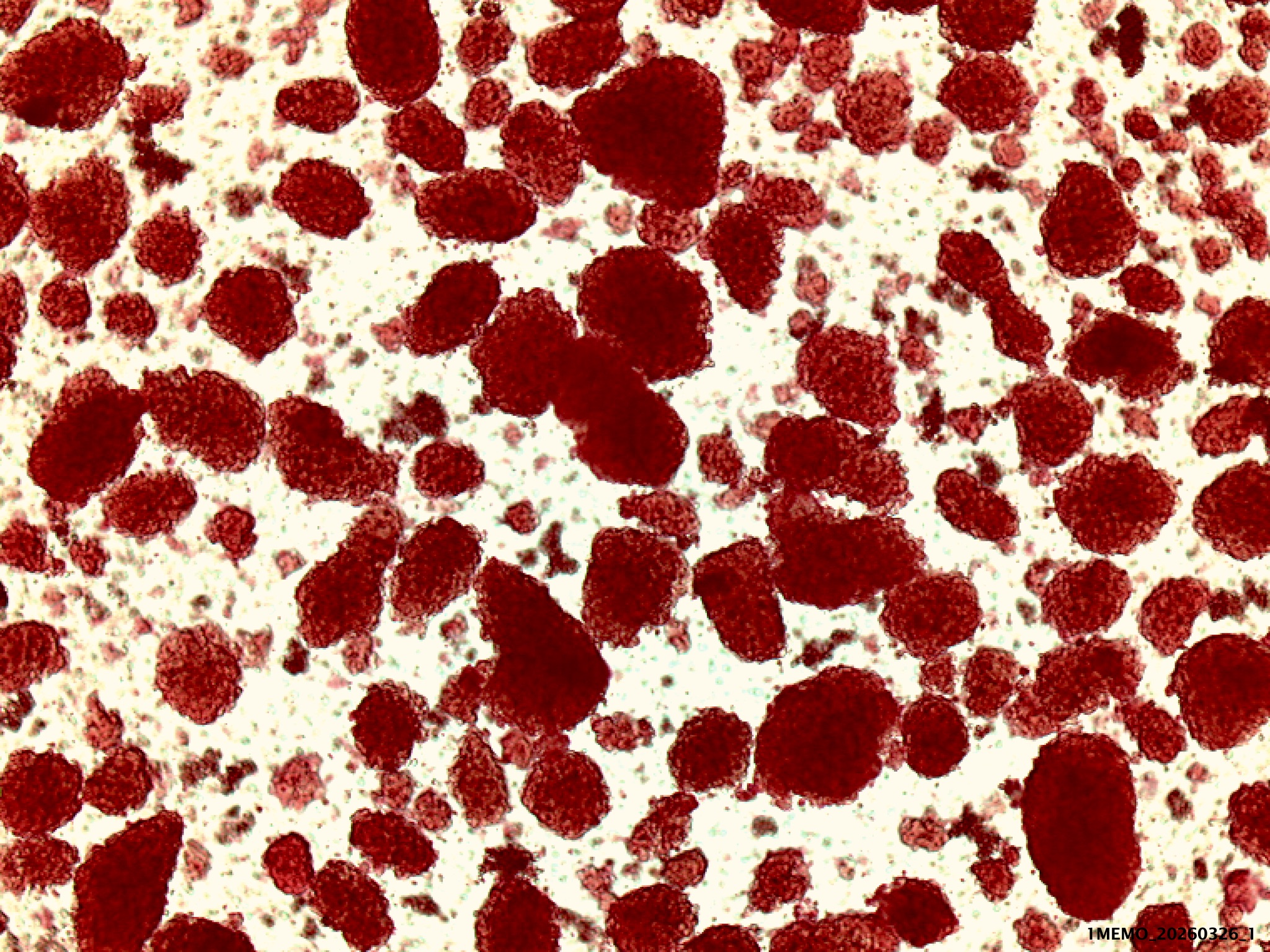
Video image: Iodixanol-UWS purified human islets, stained with dithizone (March 18, 1999) • Michel van der Burg , Leiden Islet Laboratory LUMC .
Second, remastered, edition created from the 1st video edition published 20170208 via Vimeo at 1-memo.com .
* AIDSPIT later known as AIDPIT.
Recorded with Olympus mini-tape dictaphone, and re-recorded from the speaker of the dictaphone.
My presentations at the event
Cell preservation in University of Wisconsin solution during isolation of canine islets of Langerhans. Van der Burg M.P.M., Guicherit O.R., Frölich M., Gooszen H.G. (Leiden, The Netherlands) . Horm metab Res 1994; 26: 63. (Abstract). File 1MEMO_20251113_2
Metabolic control after canine islet transplantation. Van der Burg M.P.M., Guicherit O.R., van Suylichem P.T.R., Frölich M., van Deijnen J.H.M. , Gooszen H.G. (Leiden, The Netherlands; Groningen, The Netherlands). Horm metab Res 1994; 26: 63. (Abstract). File 1MEMO_20251113_2
Front page Acta Diabetologica • Download Abstract Below
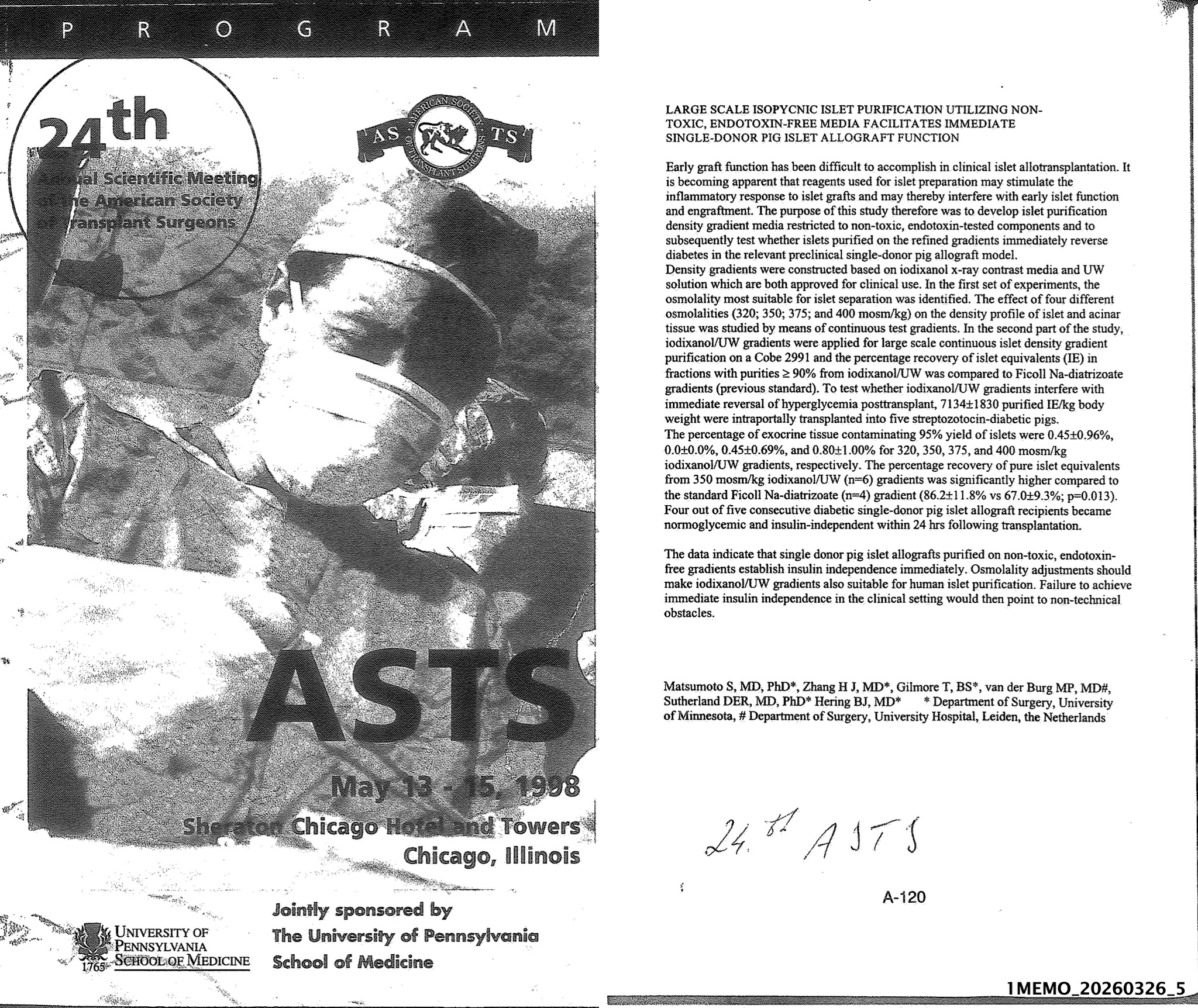
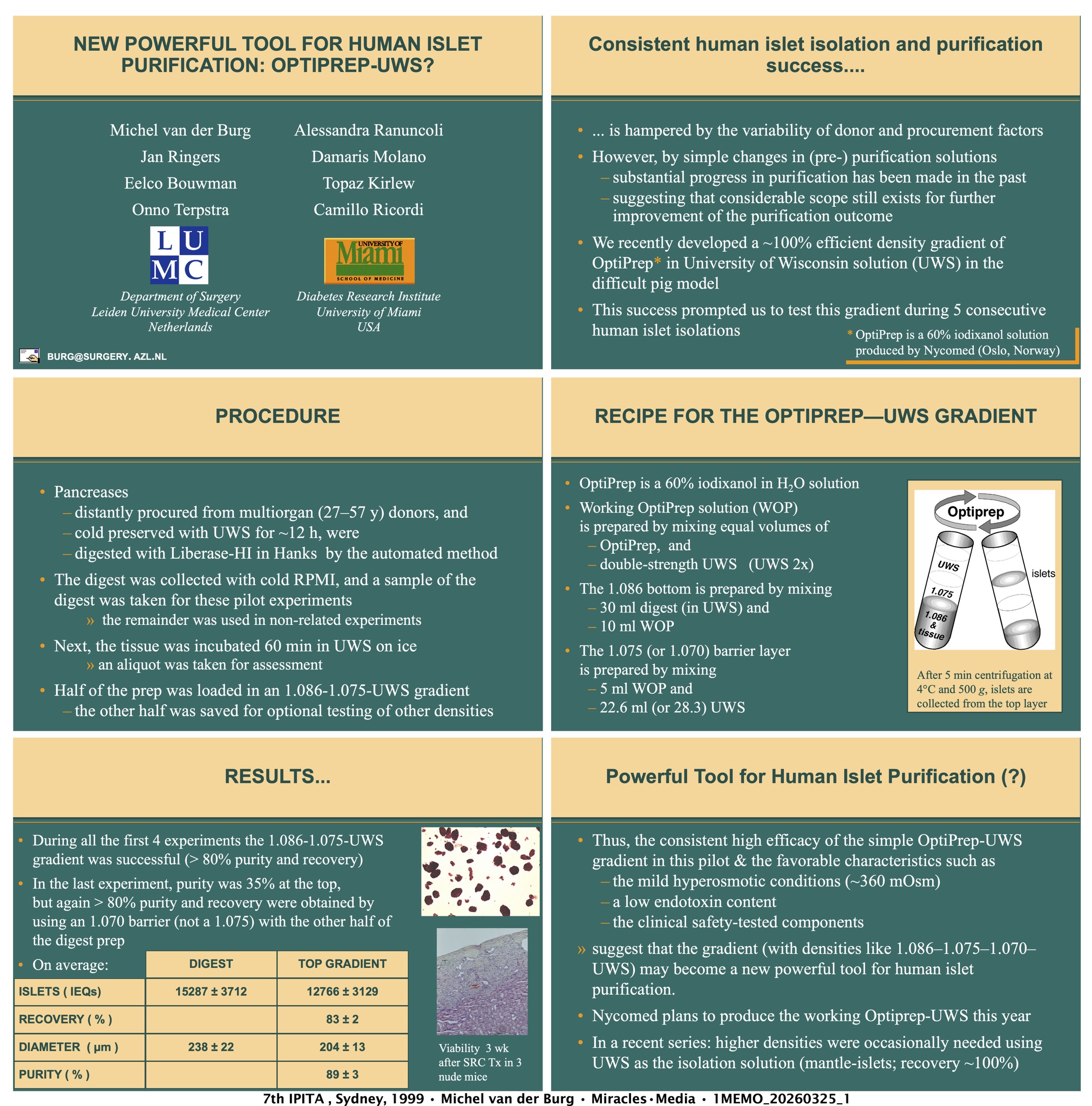
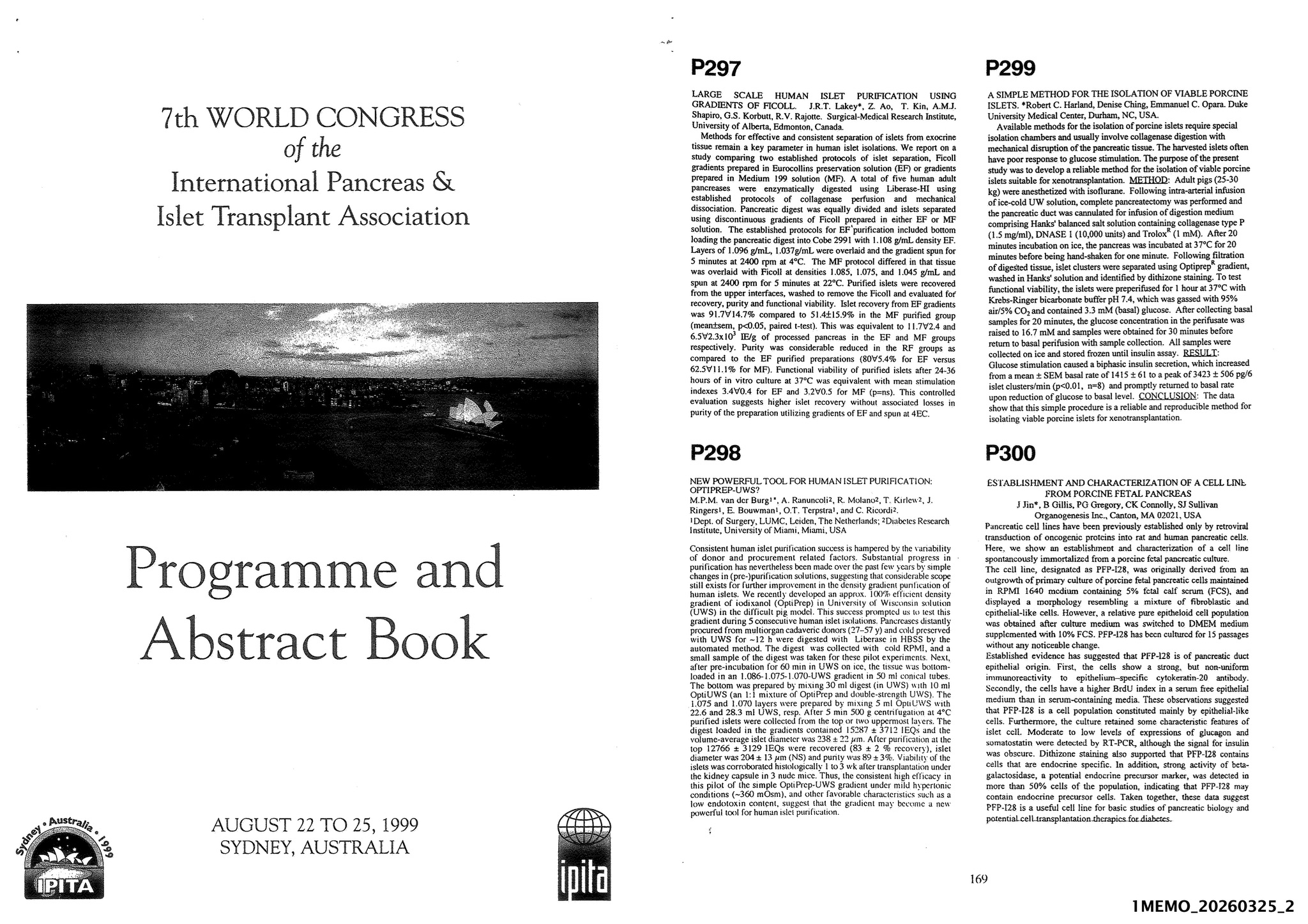
Abstract published in Acta Diabetologica 1998 of Iodixanol-UWS Human Islet Purification in 1998 at the Diabetes Research Institute in Miami. Abstracts book of the 18th Workshop of the AIDSPIT Study Group in Igls, Austria, Jan 1999.
Van der Burg MPM, Ranuncoli A, Molano R, Kirlew T, Ringers J, Bouwman E, Ricordi C. Efficacy of the novel iodixanol-UWS density gradient for human islet purification (Abstract). Acta Diabetol 1998; 35: 247. View / Download abstract (file 1MEMO_20251102_1.pdf) below .
Abstract added in full post : Efficacy of the novel iodixanol-UWS density gradient for human islet purification • Igls Aidspit 1999 • 20241202 • URL michelvanderburg.com/2024/12/02 •
Citation info : Iodixanol-UWS Human Islet Purification 1998 Abstract • Michel van der Burg • Miracles.Media • @1MEMO 20251102 • URL michelvanderburg.com/2025/11/02/
Big surprise today , to encounter this nice news article by journalist Rob van Dijk reporting on our pancreatic islet transplantation breakthrough in the Leiden University Hospital (now LUMC) in the Amsterdam based Dutch national newspaper Parool , Saturday 6 January 1990 (1).
I was searching actually for a better copy of a different news article I have archived on my clinical islet transplantation work (Newspaper Volkskrant 10 April 1999) in the Delpher archive of the National Library of the Netherlands , scrolling the search results, and noticed this Parool article – I didn’t know it existed ;)
Journalist Rob van Dijk did not interview me for the Parool, so I assume his source was the interview I gave for publication in Cicero, the biweekly LUMC publication, and the Dutch newspaper ‘Leidsch Dagblad’, and posted a year ago (2).
The articles reports (my translation from dutch*) :
Transplantation
Islet transplantation has been possible for a few years now, but it doesn’t (yet?) work in humans. The technique itself isn’t that complicated: as many islets of Langerhans as possible are extracted from a pancreas, injected into the diabetic patient’s liver or spleen, and thus, start producing insulin. However, that “thus” is still a bit tricky… …
The major problems lie in the fact that the yield of properly functioning islets is too small (at least 30 percent of the islets must be obtained undamaged to achieve sufficient insulin production after a transplant) and that the suspensions are too impure. Nevertheless, progress is being made.
The best news comes from Leiden University Hospital. There, biologist M. van der Burg, MSc has developed a method to isolate a very high and pure yield of islets from a dog’s pancreas. Van der Burg succeeded in isolating 40 percent of the vital islets from a dog’s pancreas. Through special processing, he was able to completely purify these cell clumps of 90 percent of excess and complicating pancreatic tissue. These islets were injected into the spleen of the same dog, where they produced sufficient insulin. This initial experiment has since been repeated in Leiden with several dogs with the same success. However, major challenges remain, not the least of which is the rejection problem. The Leiden experiments used the dog’s own tissue. The big question remains how the human immune system reacts when islets from a donor are injected.
*NL (dutch) quote :
Transplantatie
Sinds een paar jaar is eilandjestransplantatie wel mogelijk, alleen, bij de mens werkt het (nog?) niet. De techniek is op zichzelf niet zo ingewikkeld: men haalt zoveel mogelijk eilandjes van Langerhans uit een pancreas, spuit die bij de suikerzieke in lever of milt in en dan gaan ze dus insuline maken. Met dat ‘dus’ ligt het echter nog moeilijk… …
De grote problemen schuilen hem erin dat de oogst aan goed werkende eilandjes te gering is (men moet ten minste 30 procent van de eilandjes onbeschadigd te pakken krijgen om na een transplantatie voldoende insulineproduktie te verkrijgen) en dat de suspensies te onzuiver zijn. Toch zit er schot in.
Het beste nieuws komt uit het academisch ziekenhuis te Leiden. Daar heeft de bioloog drs. M. van der Burg een methode ontwikkeld om uit een hondepancreas een zeer hoge en zuivere oogst aan eilandjes te isoleren. Van der Burg slaagde erin uit de alvleesklier van een hond 40 procent van de vitale eilandjes te isoleren, door een speciale bewerking kon hij deze celklompjes voor 90 procent absoluut zuiveren van overbodig en complicerend pancreasweefsel. Deze eilandjes werden ingespoten in de milt van dezelfde hond en produceren daar voldoende insuline. Dit eerste experiment is in Leiden intussen met meerdere honden met hetzelfde succes herhaald. Maar er zijn nog grote problemen op te lossen en bepaald niet het geringste daarvan is dat van de afstoting. Bij de Leidse experimenten werd gebruik gemaakt van eigen weefsel van de hond. De grote vraag blijft hoe het immuunsysteem van de mens reageert als er eilandjes van een donor worden ingespoten.
Citation info : Islet Transplantation LUMC News Surprise • Michel van der Burg • Miracles.Media • @1MEMO 20251020 • URL michelvanderburg.com/2025/10/20/
Big surprise today , to encounter this nice news article by journalist Rob van Dijk reporting on our pancreatic islet transplantation breakthrough in the Leiden University Hospital (now LUMC) in the Amsterdam based Dutch national newspaper Parool , Saturday 6 January 1990 (1).
I was searching actually for a better copy of a different news article I have archived on my clinical islet transplantation work (Newspaper Volkskrant 10 April 1999) in the Delpher archive of the National Library of the Netherlands , scrolling the search results, and noticed this Parool article – I didn’t know it existed ;)
Journalist Rob van Dijk did not interview me for the Parool, so I assume his source was the interview I gave for publication in Cicero, the biweekly LUMC publication, and the Dutch newspaper ‘Leidsch Dagblad’, and posted a year ago (2).
The articles reports (my translation from dutch*) :
Transplantation
Islet transplantation has been possible for a few years now, but it doesn’t (yet?) work in humans. The technique itself isn’t that complicated: as many islets of Langerhans as possible are extracted from a pancreas, injected into the diabetic patient’s liver or spleen, and thus, start producing insulin. However, that “thus” is still a bit tricky… …
The major problems lie in the fact that the yield of properly functioning islets is too small (at least 30 percent of the islets must be obtained undamaged to achieve sufficient insulin production after a transplant) and that the suspensions are too impure. Nevertheless, progress is being made.
The best news comes from Leiden University Hospital. There, biologist M. van der Burg, MSc has developed a method to isolate a very high and pure yield of islets from a dog’s pancreas. Van der Burg succeeded in isolating 40 percent of the vital islets from a dog’s pancreas. Through special processing, he was able to completely purify these cell clumps of 90 percent of excess and complicating pancreatic tissue. These islets were injected into the spleen of the same dog, where they produced sufficient insulin. This initial experiment has since been repeated in Leiden with several dogs with the same success. However, major challenges remain, not the least of which is the rejection problem. The Leiden experiments used the dog’s own tissue. The big question remains how the human immune system reacts when islets from a donor are injected.
*NL (dutch) quote :
Transplantatie
Sinds een paar jaar is eilandjestransplantatie wel mogelijk, alleen, bij de mens werkt het (nog?) niet. De techniek is op zichzelf niet zo ingewikkeld: men haalt zoveel mogelijk eilandjes van Langerhans uit een pancreas, spuit die bij de suikerzieke in lever of milt in en dan gaan ze dus insuline maken. Met dat ‘dus’ ligt het echter nog moeilijk… …
De grote problemen schuilen hem erin dat de oogst aan goed werkende eilandjes te gering is (men moet ten minste 30 procent van de eilandjes onbeschadigd te pakken krijgen om na een transplantatie voldoende insulineproduktie te verkrijgen) en dat de suspensies te onzuiver zijn. Toch zit er schot in.
Het beste nieuws komt uit het academisch ziekenhuis te Leiden. Daar heeft de bioloog drs. M. van der Burg een methode ontwikkeld om uit een hondepancreas een zeer hoge en zuivere oogst aan eilandjes te isoleren. Van der Burg slaagde erin uit de alvleesklier van een hond 40 procent van de vitale eilandjes te isoleren, door een speciale bewerking kon hij deze celklompjes voor 90 procent absoluut zuiveren van overbodig en complicerend pancreasweefsel. Deze eilandjes werden ingespoten in de milt van dezelfde hond en produceren daar voldoende insuline. Dit eerste experiment is in Leiden intussen met meerdere honden met hetzelfde succes herhaald. Maar er zijn nog grote problemen op te lossen en bepaald niet het geringste daarvan is dat van de afstoting. Bij de Leidse experimenten werd gebruik gemaakt van eigen weefsel van de hond. De grote vraag blijft hoe het immuunsysteem van de mens reageert als er eilandjes van een donor worden ingespoten.
Citation info : Islet Transplantation LUMC News Surprise • Michel van der Burg • Miracles.Media • @1MEMO 20251020 • URL michelvanderburg.com/2025/10/20/
Pancreatic Islet Transplantation • Isolation & Transplantation of Islets of Langerhans • 1988 to early 1990s • Islet Transplant Laboratory • Leiden University Hospital • 20240912_1 (Note 1)
Grants
In 1988, we started a project with unique integration of two important trends in research into the treatment of diabetes by transplantation at the Leiden University Hospital (AZL) in Leiden, with major grants from the dutch Ministry of Welfare, Health and Culture (WVC) and the dutch Diabetes Fund (Diabetes Fonds Nederland).
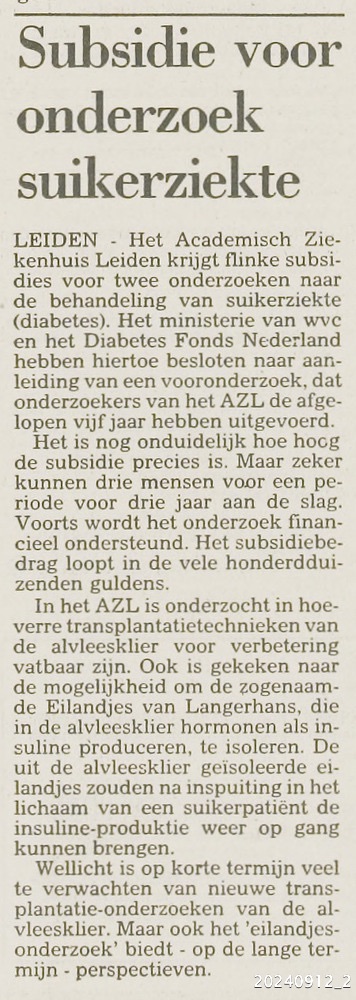
Grants diabetes research • Newspaper Leidsch Dagblad, June 24, 1988 (Note 2)
The generous grants were received — as reported June 24, 1988 in both the dutch newspaper Leidsch Dagblad (2) and in Cicero, the biweekly publication of the Leiden Medical Faculty and University Hospital (3), as a result of our preliminary research over the previous five years into improving the technique of pancreas transplantation, and more recently the development of a technique for isolating the Islets of Langerhans from the pancreas, which produce hormones such as insulin. The idea behind this is, that these isolated islets, after injection into the body, will restart and maintain insulin production.
Questions
What is the consequence of the loss of normal nerve connections to the islets during transplantation? What are the consequences of transplantation of only a segment of the pancreas, or islet transplantation, when fewer islets are available? What is the consequence after transplantation of the different insulin drainage route, where the insulin does not follow the normal path directly to the liver? To what extent do transplantation procedures disrupt the normal architecture and interactions of islets, the pancreas, and other parts of the gastro-intestinal system, and the blood sugar regulation in the body?
Project
With the hope of answering these questions, the grants supported an ambitious new project supervised by Hein Gooszen, integrating two concomitant PhD projects for detailed islet function studies in both experimental pancreas transplantation, by Onno Guicherit (4) , as well as islet isolation by Michel van der Burg (5) in the same model.
A special feature of the experimental design in this preclinical model is that the results of functional studies in the experimental animal can be compared with such functional studies with the isolated islets from the pancreas, where the direct effect on the islets is investigated during perifusion tests in our laboratory (6).
That same month, June 1988, we began research to improve the method of islet isolation in our laboratory, with the assistance of Jane Field, who had come over that month at our invitation from Minneapolis, where she was a key member of the Surgical Research lab, University of Minnesota (led by David Sutherland).
The introduction of this Minneapolis method for islet isolation significantly improved the yield of isolated islets in our Islet Transplant Lab.
New concept : University of Wisconsin solution (UWS) for islet isolation
Next , early 1989 , our Islet Transplant Lab took a major step forward in a new approach to isolation and purification of the islets by replacing the islet isolation solution (the general used basic physiological salt solution or tissue culture solution) with a novel organ preservation solution : the University of Wisconsin solution (UWS). The method of choice nowadays in clinical islet transplantation centers. More on this introduction of UWS will soon be posted here. A reprint of a first poster presented in Minneapolis, Sep. 1989, is now online here (7).
Program
June 1989 our Surgery Department (Leiden University) started an additional project, for ‘auto’ transplantation of isolated islets : Isolation of the islets from the canine pancreas and transplantation of the isolated islets ca 4 hours later in the same animal (8).
Thus, from 1989, we studied the insulin secretion of the isolated islets in perifusion experiments in the laboratory (‘in vitro’) in comparison with both the islet function ‘in vivo’ after transplantation of the isolated islets, and in the concomitant pancreas transplantation experiments — in support of our clinical pancreas transplantation program in Leiden.
Notes
1) Pancreatic Islet Transplantation • Isolation & Transplantation of Islets of Langerhans • 1988 to early 1990s • Islet Transplant Laboratory • Leiden University Hospital • 20240912_1 • michelvanderburg•com | TakeNode 5b5ca362-2adf-497a-b2be-a83e47617017 | Image edit based on : Pancreatic islet transplantation • Michel van der Burg • Miracles.Media • Thesis Repository Leiden University https://hdl.handle.net/1887/3486604
Captions in Note 9
2) Subsidie voor onderzoek suikerziekte. Leidsch Dagblad, June 24, 1988 (leiden.courant.nu) • 20240912_2 • michelvanderburg•com
3) Diabetesonderzoek | AZL krijgt grote subsidies voor diabetesonderzoek | by Sylvia van Leeuwen in Cicero, June 24th, 1988 (ISSN 0920-2900), the biweekly publication of the Academic Hospital and Leiden Medical Faculty | 20240912_3 • michelvanderburg•com | Download PDF article below : file 20240912_3_CICERO
4) Onno R. Guicherit. Long-term metabolic sequelae of beta cell mass reduction, systemic venous drainage and denervation of the canine pancreas : experimental studies in relation to clinical pancreas transplantation. (Doctoral Thesis, Faculty of Medicine, Leiden University Medical Center (LUMC) , Leiden University)(S.l.: s.n.), (ISBN print: 9789090072319, 9090072314), 1994: 149 p. URL WorldCat https://search.worldcat.org/en/title/69433794
5) Michael P.M. van der Burg. Pancreatic islet transplantation: studies on the technique and efficacy of islet isolation and transplantation. (Doctoral Thesis, Faculty of Medicine, Leiden University Medical Center (LUMC) , Leiden University), Boskoop: M.P.M. van der Burg | Miracles.Media (ISBN electronic, pdf, 9789080216402 ; ISBN print 9789080216419, 9080216410), 1994: 192 p. URL Thesis Repository Leiden University https://hdl.handle.net/1887/3486604
9) Pancreatic Islet Transplantation • Isolation & Transplantation of Islets of Langerhans 1988 to early 1990s • Islet Transplant Laboratory • Leiden University Hospital • 20240912_1 • michelvanderburg•com | TakeNode 5b5ca362-2adf-497a-b2be-a83e47617017 |
Captions Image 20240912_1 :
1. Paul Langerhans
2. Section of the normal dog pancreas showing islets stained reddish-brown (immunostained for insulin)
3. Michel van der Burg, watching the dog islet isolation procedure in the Minneapolis surgical research laboratory (University of Minnesota), September 1989, with Philippe Morel and Pericles Tzardis
4. Experimental Surgery Laboratory in Leiden, June 1988, with (left to right) Hein Gooszen, Jane Field (Minneapolis), and Onno Guicherit, starting the surgical procedure for canine islet isolation
5. The pancreas (segment) is removed
6. Islet Transplant Laboratory in Leiden, at the start of islet isolation, with infusion of the collagenase solution via the ducts in the dog pancreas (whole gland for islet transplantation) – collagenase leaking from the pancreas is recirculated using a roller pump
7. During collagenase digestion at 37-39°C the pancreas falls apart, shown here in a low magnification microscopy image of pancreatic exocrine tissue, and a free-ed small blood vessel
8. Dissociated pancreatic tissue, on ice
9. Tissue is further dispersed in the cold isolation solution (here RPMI tissue culture solution is used), by aspiration in a syringe, and sieved to remove undigested fragments, ducts and vessels ~ demonstrated here by Jane Field (Minneapolis), with the introduction of the Minneapolis isolation procedure, June 1988, in our Islet Transplant Laboratory in Leiden
10. Microscopy of tissue suspension, with a low purity of the islets (stained red by dithizone) obtained by density separation in Dextran gradients (in Hanks’ solution) after islet isolation in the RPMI tissue culture solution (dark-brown exocrine fragments remain unstained)
11. Pure islet suspension obtained by density separation in Percoll gradients (in University of Wisconsin solution) after islet isolation in the University of Wisconsin solution (islets are only slightly stained due to poor diffusion over the cell membrane in the preservation solution)
12. Section of highly purified islets obtained by Dextran density separation after isolation in the University of Wisconsin solution
13. Islets are autotransplanted by infusion in the spleen of the dog
14. Transplanted islet in section of the spleen of one of the dogs shortly after the onset of fasting hyperglycemia at three months posttransplant (immunostained for insulin), 1989
15. Highly purified human islets obtained by Percoll density separation after isolation in the University of Wisconsin solution (immunostained with gold for insulin; not counterstained), July 1990
Pancreatic islet transplantation • Michel van der Burg • Miracles.Media | QR code (link to Thesis Repository Leiden University) https://hdl.handle.net/1887/3486604
Citation info : Pancreas & Islet Transplantation Program • 20240912 | Michel van der Burg | michelvanderburg•com
“Breakthrough in research into treatment of diabetics. Discovery by doctors of Leiden University Hospital” …headlines the Dutch newspaper ‘Leidsch Dagblad’ (1).
The dutch newspaper ‘Leidsch Dagblad’ reports October 24, 1989, on a breakthrough in the treatment of diabetic patients…successful transplantation of the insulin producing ‘islets’ in dogs, after isolation of the islets using the UW organ storage solution (UWS)
The first successful transplant June 13, 1989 was a big step. Generally multiple pancreases are needed for an adequate number of purified islets for one transplant. Here the dog’s pancreas was used for the isolation of islets, that were injected back in the animals’ spleen.
‘The breakthrough in the research came when Van der Burg came up with the idea of using the UW organ storage solution — developed several years ago at the University of Wisconsin — for the preservation of the islets. This turned out to yield good results. The yield of pure islets could be increased using this method.’
Cicero
News based on story published Sep. 15th, 1989 by journalist Sylvia Van Leeuwen in Cicero, the biweekly publication of the Academic Hospital and Leiden Medical Faculty (2).
Ploeg, Gooszen and Van der Burg (left to right) discuss the achieved results, Monday Sep 4, 1989 at the Department of Surgery, University Hospital Leiden. Photo Tejo Ringers • 20240830_2 • michelvanderburg•com • TakeNode 3fc69a06-04bf-4f0d-bc77-cedb6d7b7f75
One more thing
We reported long-term function of the islet transplants (3,4). Failure after 3.5 years of a well-functioning islet transplant is puzzling. Nowadays, in clinical islet transplantation, failure of long-term functioning grafts in diabetic patients is still puzzling. Therefore, note (data not published before), that body weight of this autografted animal had increased to almost 150%, from 12.5 kg at the time of islet transplantation, to 18.0 kg at the time of graft failure 3.5 years later (Dec. 1992) — obviously, with an increased insulin demand that may have contributed to graft failure.
Notes
1) Doorbraak in onderzoek naar behandeling suikerpatiënten. Ontdekking door artsen Leids Academisch Ziekenhuis. (EN tr. “Breakthrough in research into treatment of diabetics. Discovery by doctors of Leiden University Hospital”) | by Gert Visser, in Leidsch Dagblad, Oct 24, 1989 | Dutch newspaper, URL https://leiden.courant.nu/issue/LD/1989-10-24/edition/0/page/15
The background in the image here (20240830_1), is the original color slide of the ‘Islets of Langerhans’ showing in the newspaper.
2) ‘Eilandjes’ getransplanteerd | by Sylvia van Leeuwen in Cicero, Sep. 15th, 1989 (ISSN 0920-2900), the biweekly publication of the Academic Hospital and Leiden Medical Faculty | 20240830_3 • michelvanderburg•com Download PDF article, file 20240830_3_CICERO
4) Van der Burg MPM, Guicherit OR, Jansen JBMJ, Frölich M, Lamers CBHW, Lemkes HHPJ, Bruijn JA, Gooszen HG. Function and survival of intrasplenic islet autografts in dogs. Diabetologia 39, 37–44 (1996). https://doi.org/10.1007/BF00400411
5) Van der Burg MPM, Gooszen HG, Ploeg RJ, Guicherit OR, Scherft JP, Terpstra JL, Bruijn JA, Frölich M. Pancreatic islet isolation with UW solution: a new concept. 4th Congress of the European Society for Organ Transplantation, Barcelona (Spain) November 1–4, 1989.
6) The islet transplant news was first reported by me at an invited lecture July 8, 1989 for the Anglo Danish Dutch Diabetes Group meeting in St Edmund Hall, University of Oxford, Oxford (UK) : Van der Burg MPM, Gooszen HG, Scherft JP, Terpstra JL, Frölich M, Guicherit OR, Lemkes HHPJ, Bruijn JA. The isolation of canine pancreatic islets for transplantation. Seventh Annual Meeting Anglo Danish Dutch Diabetes Group, Oxford (UK) July 5–9, 1989.
7) Leiden Islet Laboratory History • 20240803 | Michel van der Burg | michelvanderburg•com
Citation info : Islet Transplantation Breakthrough in Leiden University Hospital • 20240830 • Michel van der Burg • michelvanderburg•com
Out Of Service | 20140911 | 1-memo•com | In the morning of 9/11 2001 logistics forced me to officially announce a temporarily – 1 week – ‘out of service’ of our Leiden islet isolation and transplant center. Our center was started earlier that summer of 2001 at the Leiden University Medical Center. So, I decided to have a short vacation abroad – heaven, after being on call 24/7 almost non stop for years. Later that day at home, I was downstairs watching TV — because upstairs near my workroom the central heating was being replaced – when I saw the CNN breaking news about the plane crashing into the World Trade Center. That day would become a landmark in history and the course of my life.
Background image : Microscopy picture I took of purified human Islets of Langerhans – tiny clumps (size around 1/10 mm or 1/25 inch) of 10s to 1000s of cells that produce hormones like insulin – these cells are just visible when you enlarge this 50x microscopy picture : as tiny translucent ‘balls’ or ‘spheres’. The red color is from a stain that binds to the insulin cells.
Iodixanol-UWS purified human islets, stained with dithizone. Original magnification 50x.
25 Years of the Ricordi Automated Method for Islet Isolation. Piemonti L, Pileggi A. in CellR4 2013; 1(1): e128. – URL https://www.cellr4.org/article/128
Credit : Out Of Service | 20140911 | 1-memo•com | TakeNode ID e22f209c-14da-40d8-b11a-74a29b1e80b4