Efficacy of the novel iodixanol-UWS density gradient for human islet purification • Igls Aidspit 1999 • Michel van der Burg • Miracles.Media • 20241202_1
I started an archive at Archive.org November 11, 2010 with this slideshow (pdf) of my January 1999 oral presentation in Igls (Innsbruck), Austria, at the 18th Workshop of the AIDSPIT (Artificial Insulin Delivery Systems, Pancreas and Islet Transplantation) Study Group. (Now known as AIDPIT).
The presented results of this innovative islet purification method — developed over nearly 10 years (from 1989) in our Leiden islet laboratory (LUMC) — were the outcome of work I had done spring 1998 with the human islet transplantation group of Camillo Ricordi at the Diabetes Research Institute in Miami , Florida, USA.
Slideshow (pdf) Archive.org
Description
Efficacy of the novel iodixanol-UWS density gradient for human islet purification • Igls Aidspit 1999
Slides oral presentation Michel van der Burg, Aidspit meeting 25 Jan 1999, in Igls, Austria
Van der Burg MPM, Ranuncoli A, Molano R, Kirlew T, Ringers J, Bouwman E, Ricordi C. Efficacy of the novel iodixanol-UWS density gradient for human islet purification. 18th Workshop Aidspit, Igls (Austria) Jan. 24-26, 1999
Program : 18TH WORKSHOP OF THE AIDSPIT STUDY GROUP – JANUARY 24-26, 1999 – IGLS/AUSTRIA . MONDAY, JAN 25, 1999 – KONGRESSHAUS IGLS, MAIN LECTURE HALL SESSION 2 – ISLET ISOLATION AND TRANSPLANTATION CHAIRMEN:K. FEDERLIN, GIESSEN, GERMANY – G. POZZA, MILAN, ITALY 9.00 – 10.30 FREE COMMUNICATIONS 9.45- Efficacy of the novel iodixanol-UWS density gradient for human islet purification. Van der Burg MPM, Ranuncoli A, Molano R, Kirlew T, Ringers J, Bouwman E, Ricordi C; Leiden, The Netherlands and Miami, USA
File : mvdb19990118_1534_AIDSPIT.pdf | Uploaded 20101111 and replaced by the same pdf with updated metadata of the document on 20101112 (see Notes section).
The slideshow video embedded below, was first posted in 2018 as Human Islet Purification Miami 1998 • 20181102
Notes
The slideshow pdf file is available for download at Archive.org. I advise against the other download options presented by Archive.org , which do not correctly represent the slideshow.
Van der Burg MPM, Ranuncoli A, Molano R, Kirlew T, Ringers J, Bouwman E, Ricordi C. Efficacy of the novel iodixanol-UWS density gradient for human islet purification (Abstract). Acta Diabetol 1998; 35: 247.
Citation info (this post) : Efficacy of the novel iodixanol-UWS density gradient for human islet purification • Igls Aidspit 1999 • Michel van der Burg • Miracles.Media • 20241202 • URL michelvanderburg.com/2024/12/02/
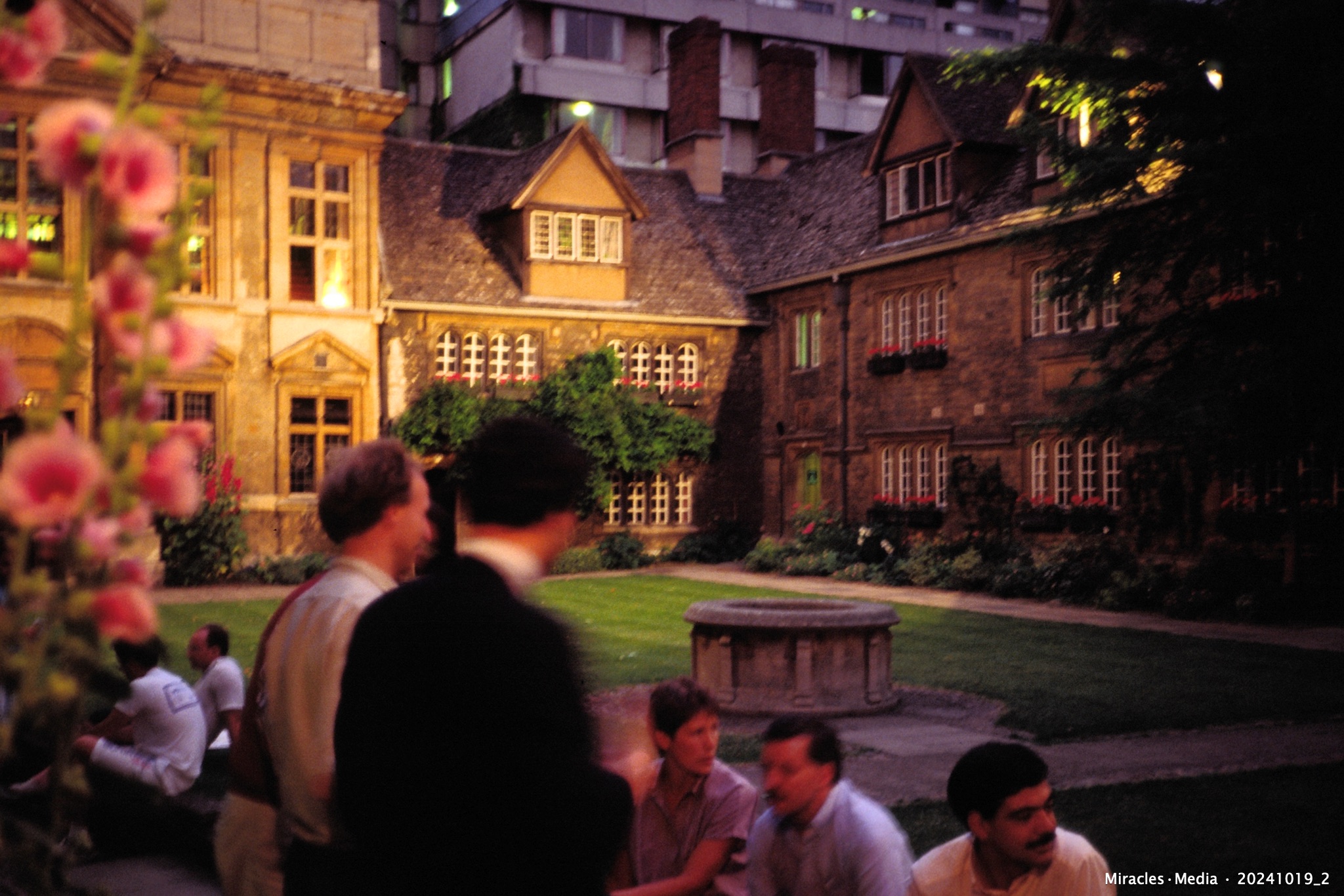
St Edmund Hall, University of Oxford, July 1989 • Michel van der Burg • Miracles•Media • 20241019_1 • TakeNode af426345-4fb3-48a3-8d5e-4368c56826aa
Venue of the Seventh Annual Meeting of the Anglo–Danish–Dutch Diabetes Group*, Oxford (UK) July 5–9, 1989.
The first international meeting were our new concept was presented, of pancreatic islet isolation in the University of Wisconsin Solution (UW-Solution or UWS) a solution designed recently for preservation of a donor pancreas during cold storage prior to transplantation.
Quote :
“…A few months ago, we adopted an entirely new approach to islet isolation. Recently a new cold storage organ preservation solution was developed at the University of Wisconsin, the UW solution, allowing long term, 24 to 72 h, cold storage of the canine pancreas. Since islet isolation is largely performed in the cold, we tested this preservation solution as the isolation medium throughout the isolation procedure. This slide shows that using the UW solution, purity has increased to over 90%…”
In addition our first successful pre-clinical transplant, we had performed the last month, was reported as breaking news at the end of the talk.
Quote :
“Three weeks ago we did our first autotransplantation of isolated islets from the whole gland by retrograde infusion into the spleen. The dog is doing fine: fasting glucose amounts to 5-6 mM and postprandial glucose between 6-8 mM ; postprandial insulin increases 6-7 fold. Thank you.”
St Edmund Hall, Oxford, 1989, 7th Meeting ADDD Group • Michel van der Burg • Miracles•Media • 20241019_2 • TakeNode ca40adf0-3b86-4ada-93a8-126c6768d420
Notes
Seventh Annual Meeting Anglo Danish Dutch Diabetes Group • Michel van der Burg • Miracles•Media • 20241019_3 • TakeNode bffdea47-9464-4f7b-8299-ec299d41ca4d
* Group supported through the Nordisk UK Professional Programme.
Van der Burg MPM, Gooszen HG, Scherft JP, Terpstra JL, Frölich M, Guicherit OR, Lemkes HHPJ, Bruijn JA. The isolation of canine pancreatic islets for transplantation. Seventh Annual Meeting Anglo Danish Dutch Diabetes Group, Oxford (UK) July 5–9, 1989.
Van der Burg MPM, Gooszen HG, Guicherit OR, Jansen JBMJ, Frölich M, Lamers CBHW. The mechanism of pancreatic duct obliteration induced hyperglycemia. Seventh Annual Meeting Anglo Danish Dutch Diabetes Group, Oxford (UK) July 5–9, 1989.
Citation info : ADD Diabetes Group 1989, St Edmund Hall, Oxford • Michel van der Burg • Miracles•Media • 20241019 • URL 1-memo•com
Greek Poster • Michel van der Burg • Miracles•Media • 20241009
Funny. LibreOffice Vanilla Issue.
Greek characters appeared in this poster originally designed with english text and produced on a Macintosh computer and Imagewriter dotmatrix printer, September 3, 1990, using the MacDraw II application, with graphs from Cricket Graph. That 1990 Mac file was remastered today in LibreOffice Vanilla (other minor issues in graphs not corrected). Generally LibreOffice does a great job with these ancient files. I recently posted several of such posters at site michelvanderburg.com. However, some of the posters retrieved from my archive show up with Greek characters when opened in LibreOffice, like this poster produced in English (with roman characters). Those problematic posters have in common that the Apple Chicago font was used – the interface font in Apple’s early versions of Mac OS from 1984 to 1997. Clearly LibreOffice cannot handle this Chicago font correctly. I have not found a solution for this. Text in other posters, produced with Helvetica, had only minor issues in LibreOffice, Helvetica italics text appeared as regular Times.
The original poster and abstract (below) were presented at the 8th International Symposium on Gastrointestinal Hormones, in Timmendorfer Strand Baltic Sea (FRG) September 4–8, 1990.
Abstract
Contribution of gut factors to canine isolated islet function M.P.M. van der Burg, O.R. Guicherit, J.B.M.J. Jansen, C.B.H.W. Lamers, J.P. Scherft, M. Frölich, H.G. Gooszen. Departments of Surgery, Gastroenterology. Endocrinology and Cel Biology. University Hospital, Leiden, The Netherlands. Techniques for isolating islets of Langerhans from the large mammalian pancreas have improved to the point where islet transplantation as a therapeutical approach to human diabetes has become more realistic. The quality of metabolic control is however largely unknown. We studied canine isolated-islet function both in vivo after autotransplantation, as well as in vitro by perifusion. Five normal dogs underwent total pancreatectomy. Islets were isolated from the excised pancreas by collagenase digestion, dispersion and purification with filtration and density gradients. Isolated islets were autotransplanted into the spleen of the dog by retrograde venous infusion. Graft function was assessed up to 3 mo by determining the glucose and insulin response to an intravenous glucose injection (IVGTT), i.v. arginine injection during 35 mM glucose clamp (AT), and a meal. In addition (n = 4) the in vitro insulin response of overnight cultured canine islets was studied by perifusion with cholecystokinin (CCK-33) and glucose-dependent insulinotropic polypeptide (GIP). The islet dose at transplantation ranged from 3500 – 13000 islets/kg b.w. One animal became overtly hyperglycemic (fasting glucose 18 mM) within 7 days after receiving 3500 islets/kg b.w. The other grafts (> 6000 islets/kg b.w.) were successful (fasting glucose <7mM) but demonstrated, compared to pre-operative values, a 50% reduced glucose clearance and insulin response at IVGTT, and a 90% reduced insulin secreting capacity at AT. Postprandially hyperglycemia (~ 10 mM) and in contrast to i.v. glucose and arginine, a normal insulin response was observed. The in vitro insulin response at 7.5 mM glucose to equimolar (0.1-1- 10 nM) concentrations of either CCK, GIP or both, demonstrated a sustained dose-response to GIP (up to 5x basal values) and a significant albeit small and transient effect of CCK as of 1 nM. No synergistic effect was observed. In dogs ‘one-to-one’ transplantation was successful in 4/5 recipients of isolated islets. The difference in the effect of islet transplantation on the insulin response to intravenous glucose or – arginine and a meal, may be related to the postprandial, hyperglycemia enhanced, activation of the entero-insular axis, especially GIP.
Van der Burg MPM, Guicherit OR, Jansen JBMJ, Lamers CBHW, Scherft JP, Frölich M, Gooszen HG. Contribution of gut factors to canine isolated islet function (Abstract). Digestion 1990; 46 (Suppl 1): 14–15. https://doi.org/10.1159/000200356
PDF abstract shown below – file 20241009_1_Digestion.pdf
Citation info : Greek Poster • Michel van der Burg • Miracles•Media • 20241009 • URL michelvanderburg.com/2024/10/09 | TakeNode 10afaddd-08b7-4dcd-ad7a-43228420ad59
Pancreatic Islet Transplantation • Isolation & Transplantation of Islets of Langerhans • 1988 to early 1990s • Islet Transplant Laboratory • Leiden University Hospital • 20240912_1 (Note 1)
Grants
In 1988, we started a project with unique integration of two important trends in research into the treatment of diabetes by transplantation at the Leiden University Hospital (AZL) in Leiden, with major grants from the dutch Ministry of Welfare, Health and Culture (WVC) and the dutch Diabetes Fund (Diabetes Fonds Nederland).
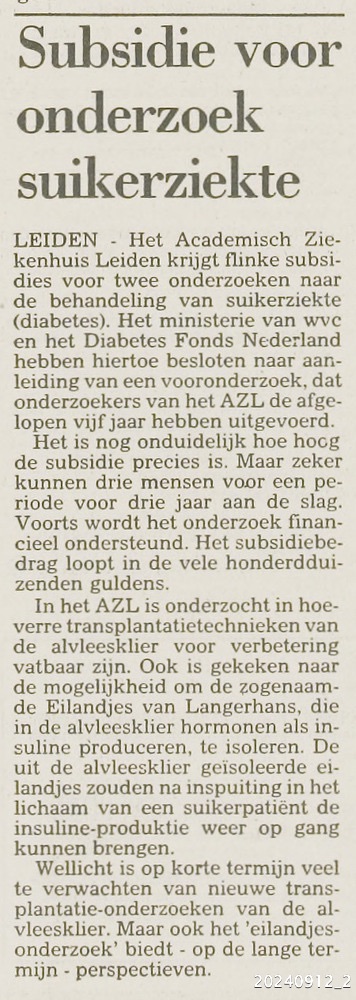
Grants diabetes research • Newspaper Leidsch Dagblad, June 24, 1988 (Note 2)
The generous grants were received — as reported June 24, 1988 in both the dutch newspaper Leidsch Dagblad (2) and in Cicero, the biweekly publication of the Leiden Medical Faculty and University Hospital (3), as a result of our preliminary research over the previous five years into improving the technique of pancreas transplantation, and more recently the development of a technique for isolating the Islets of Langerhans from the pancreas, which produce hormones such as insulin. The idea behind this is, that these isolated islets, after injection into the body, will restart and maintain insulin production.
Questions
What is the consequence of the loss of normal nerve connections to the islets during transplantation? What are the consequences of transplantation of only a segment of the pancreas, or islet transplantation, when fewer islets are available? What is the consequence after transplantation of the different insulin drainage route, where the insulin does not follow the normal path directly to the liver? To what extent do transplantation procedures disrupt the normal architecture and interactions of islets, the pancreas, and other parts of the gastro-intestinal system, and the blood sugar regulation in the body?
Project
With the hope of answering these questions, the grants supported an ambitious new project supervised by Hein Gooszen, integrating two concomitant PhD projects for detailed islet function studies in both experimental pancreas transplantation, by Onno Guicherit (4) , as well as islet isolation by Michel van der Burg (5) in the same model.
A special feature of the experimental design in this preclinical model is that the results of functional studies in the experimental animal can be compared with such functional studies with the isolated islets from the pancreas, where the direct effect on the islets is investigated during perifusion tests in our laboratory (6).
That same month, June 1988, we began research to improve the method of islet isolation in our laboratory, with the assistance of Jane Field, who had come over that month at our invitation from Minneapolis, where she was a key member of the Surgical Research lab, University of Minnesota (led by David Sutherland).
The introduction of this Minneapolis method for islet isolation significantly improved the yield of isolated islets in our Islet Transplant Lab.
New concept : University of Wisconsin solution (UWS) for islet isolation
Next , early 1989 , our Islet Transplant Lab took a major step forward in a new approach to isolation and purification of the islets by replacing the islet isolation solution (the general used basic physiological salt solution or tissue culture solution) with a novel organ preservation solution : the University of Wisconsin solution (UWS). The method of choice nowadays in clinical islet transplantation centers. More on this introduction of UWS will soon be posted here. A reprint of a first poster presented in Minneapolis, Sep. 1989, is now online here (7).
Program
June 1989 our Surgery Department (Leiden University) started an additional project, for ‘auto’ transplantation of isolated islets : Isolation of the islets from the canine pancreas and transplantation of the isolated islets ca 4 hours later in the same animal (8).
Thus, from 1989, we studied the insulin secretion of the isolated islets in perifusion experiments in the laboratory (‘in vitro’) in comparison with both the islet function ‘in vivo’ after transplantation of the isolated islets, and in the concomitant pancreas transplantation experiments — in support of our clinical pancreas transplantation program in Leiden.
Notes
1) Pancreatic Islet Transplantation • Isolation & Transplantation of Islets of Langerhans • 1988 to early 1990s • Islet Transplant Laboratory • Leiden University Hospital • 20240912_1 • michelvanderburg•com | TakeNode 5b5ca362-2adf-497a-b2be-a83e47617017 | Image edit based on : Pancreatic islet transplantation • Michel van der Burg • Miracles.Media • Thesis Repository Leiden University https://hdl.handle.net/1887/3486604
Captions in Note 9
2) Subsidie voor onderzoek suikerziekte. Leidsch Dagblad, June 24, 1988 (leiden.courant.nu) • 20240912_2 • michelvanderburg•com
3) Diabetesonderzoek | AZL krijgt grote subsidies voor diabetesonderzoek | by Sylvia van Leeuwen in Cicero, June 24th, 1988 (ISSN 0920-2900), the biweekly publication of the Academic Hospital and Leiden Medical Faculty | 20240912_3 • michelvanderburg•com | Download PDF article below : file 20240912_3_CICERO
4) Onno R. Guicherit. Long-term metabolic sequelae of beta cell mass reduction, systemic venous drainage and denervation of the canine pancreas : experimental studies in relation to clinical pancreas transplantation. (Doctoral Thesis, Faculty of Medicine, Leiden University Medical Center (LUMC) , Leiden University)(S.l.: s.n.), (ISBN print: 9789090072319, 9090072314), 1994: 149 p. URL WorldCat https://search.worldcat.org/en/title/69433794
5) Michael P.M. van der Burg. Pancreatic islet transplantation: studies on the technique and efficacy of islet isolation and transplantation. (Doctoral Thesis, Faculty of Medicine, Leiden University Medical Center (LUMC) , Leiden University), Boskoop: M.P.M. van der Burg | Miracles.Media (ISBN electronic, pdf, 9789080216402 ; ISBN print 9789080216419, 9080216410), 1994: 192 p. URL Thesis Repository Leiden University https://hdl.handle.net/1887/3486604
9) Pancreatic Islet Transplantation • Isolation & Transplantation of Islets of Langerhans 1988 to early 1990s • Islet Transplant Laboratory • Leiden University Hospital • 20240912_1 • michelvanderburg•com | TakeNode 5b5ca362-2adf-497a-b2be-a83e47617017 |
Captions Image 20240912_1 :
1. Paul Langerhans
2. Section of the normal dog pancreas showing islets stained reddish-brown (immunostained for insulin)
3. Michel van der Burg, watching the dog islet isolation procedure in the Minneapolis surgical research laboratory (University of Minnesota), September 1989, with Philippe Morel and Pericles Tzardis
4. Experimental Surgery Laboratory in Leiden, June 1988, with (left to right) Hein Gooszen, Jane Field (Minneapolis), and Onno Guicherit, starting the surgical procedure for canine islet isolation
5. The pancreas (segment) is removed
6. Islet Transplant Laboratory in Leiden, at the start of islet isolation, with infusion of the collagenase solution via the ducts in the dog pancreas (whole gland for islet transplantation) – collagenase leaking from the pancreas is recirculated using a roller pump
7. During collagenase digestion at 37-39°C the pancreas falls apart, shown here in a low magnification microscopy image of pancreatic exocrine tissue, and a free-ed small blood vessel
8. Dissociated pancreatic tissue, on ice
9. Tissue is further dispersed in the cold isolation solution (here RPMI tissue culture solution is used), by aspiration in a syringe, and sieved to remove undigested fragments, ducts and vessels ~ demonstrated here by Jane Field (Minneapolis), with the introduction of the Minneapolis isolation procedure, June 1988, in our Islet Transplant Laboratory in Leiden
10. Microscopy of tissue suspension, with a low purity of the islets (stained red by dithizone) obtained by density separation in Dextran gradients (in Hanks’ solution) after islet isolation in the RPMI tissue culture solution (dark-brown exocrine fragments remain unstained)
11. Pure islet suspension obtained by density separation in Percoll gradients (in University of Wisconsin solution) after islet isolation in the University of Wisconsin solution (islets are only slightly stained due to poor diffusion over the cell membrane in the preservation solution)
12. Section of highly purified islets obtained by Dextran density separation after isolation in the University of Wisconsin solution
13. Islets are autotransplanted by infusion in the spleen of the dog
14. Transplanted islet in section of the spleen of one of the dogs shortly after the onset of fasting hyperglycemia at three months posttransplant (immunostained for insulin), 1989
15. Highly purified human islets obtained by Percoll density separation after isolation in the University of Wisconsin solution (immunostained with gold for insulin; not counterstained), July 1990
Pancreatic islet transplantation • Michel van der Burg • Miracles.Media | QR code (link to Thesis Repository Leiden University) https://hdl.handle.net/1887/3486604
Citation info : Pancreas & Islet Transplantation Program • 20240912 | Michel van der Burg | michelvanderburg•com
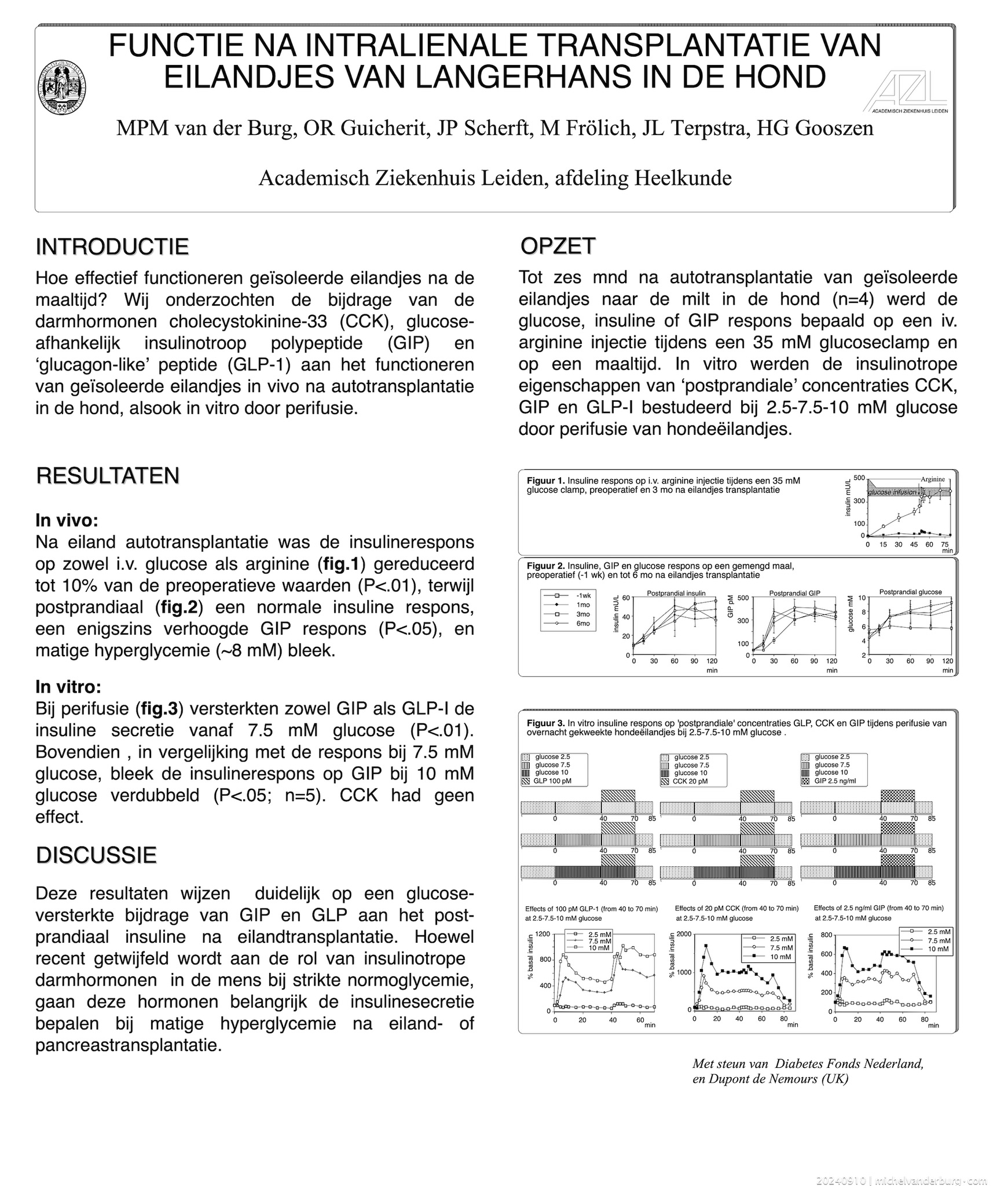
Function after intrasplenic transplantation of islets of Langerhans in dogs.
The effect of gut hormones GLP-1 , GIP , and CCK-33 together with glucose on the insulin secretion capacity of isolated islets tested during storage of the islets in the laboratory (in vitro by perifusion), and after transplantation (in vivo).
Dutch poster (1) presented at the Surgeon Days ’92 of the Dutch Surgery Society, Rotterdam (The Netherlands) May 21–22, 1992.
An English edition of this presentation was presented in 1991, without the GLP-1 data (2) and posted again Sep 6, 2024 (3).
The poster was originally designed and produced on a Macintosh computer and Imagewriter dotmatrix printer, May 1992, using the MacDraw II application, with graphs from Cricket Graph. That 1992 Mac file was remastered today in LibreOffice Vanilla.
Notes
1. Van der Burg MPM, Guicherit OR, Scherft JP, Frölich M, Terpstra JL, Gooszen HG. Functie na intralienale transplantatie van eilandjes van Langerhans in de hond ( Function after intrasplenic transplantation of islets of Langerhans in dogs ). Surgeon days ’92 of the Dutch Surgery Society, Rotterdam (The Netherlands) May 21–22, 1992.
2. Van der Burg MPM, Guicherit OR, Ebert R, Jansen JBMJ, Creutzfeld W, Lamers CBHW, Frölich M, Gooszen HG. CCK and GIP control of canine isolated islet function. 3rd International Congress on Pancreatic and Islet Transplantation, Symposium on Artificial Insulin Delivery System, Lyon (France) June 6–8, 1991.
4. Van der Burg MPM, Guicherit OR, Frölich M, Gooszen HG. Insulinotropic effects of cholecystokinin, gastric inhibitory polypeptide, and glucagon-like peptide-1 during perifusion of short-term cultured canine isolated islets. Regul Peptides 1995; 60: 61–67.
Citation info : Gut factors controlling pancreatic islets • 20240910 | Michel van der Burg | michelvanderburg•com | TakeNode 56ddc057-ffe9-4b70-bd33-180ea4b07877
The effect of gut hormones together with glucose on the insulin secretion capacity of isolated islets tested during storage of the islets in the laboratory, and after transplantation.
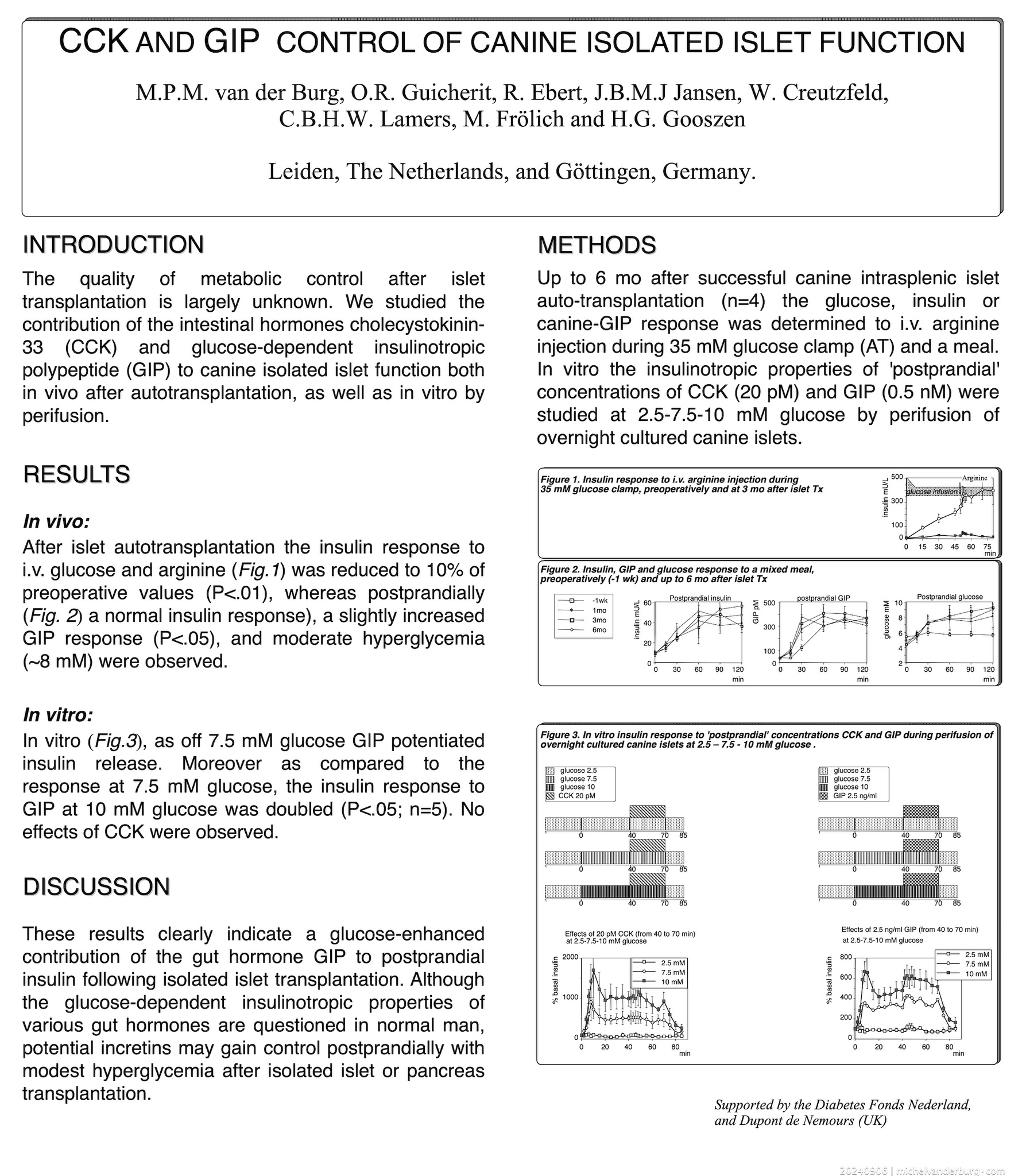
CCK and GIP control of canine isolated islet function.
Poster (1) presented at the 3rd International Congress on Pancreatic and Islet Transplantation, Symposium on Artificial Insulin Delivery System, Lyon (France) June 6–8, 1991.
The poster was originally designed and produced on a Macintosh computer and Imagewriter dotmatrix printer, June 3, 1991, using the MacDraw II application, with graphs from Cricket Graph. That 1991 Mac file was remastered today in LibreOffice Vanilla.
Notes
1. Van der Burg MPM, Guicherit OR, Ebert R, Jansen JBMJ, Creutzfeld W, Lamers CBHW, Frölich M, Gooszen HG. CCK and GIP control of canine isolated islet function. 3rd International Congress on Pancreatic and Islet Transplantation, Symposium on Artificial Insulin Delivery System, Lyon (France) June 6–8, 1991.
Citation info : Gut feelings of pancreatic islets • 20240906 | Michel van der Burg | michelvanderburg•com | TakeNode 5e52cddc-469d-4f91-bd23-e833566be41e
Printing journal on ‘F4UW’ (in porcine islet isolation) …Apple Powerbook 160 , Islet Laboratory, Leiden University Hospital 1990s. Found a snippet correspondence on F4UW :
“Dear Bjørn…I checked my journals re the use of ficoll. I have temporarily used Ficoll-400DL from Sigma in 1996 for making Optiprep-UWS gradients and UWS as the isolation solution. The reason was that I had no more Pentastarch
left from a shipment received from DuPont…Most of the experiments used WOP prepared from 1:1 optiprep and either F4UWS or 8 percent Ficoll in UWS….”