Propaganda on the windows of the shop ‘Goedkoope Winkel’ (Cheap Shop) at Lange Elisabethstraat 2 in Utrecht, Holland, photographed by Wim Bruschwiler , ca 1943.
Nazi anti-semitic slogan ‘JOOD’ (Jew) on one window.
On the other window, the “V” symbol — standing for the English (Anti-Nazi) “Victory” slogan or the later Nazi edition “Victorie”.
On top of that window on the left a small pamphlet showing O…Z…O – W… – V…V – … … … … .
OZO originally was the anti-Nazi slogan ‘Oranje Zal Overwinnen’ (transl. : Holland Will Win). Here probably the Nazi version of OZO was posted (compare image in Notes 1) :
Orde Zal Overwinnen – Want – V=Victorie – Duitschland Wint Voor Europa! .
Translation :
Order Will Win – Because – V=Victory – Germany Wins For Europe!
Clandestine camera shot during World War 2 occupation of Holland from amateur film ‘Bezet Gebied’ (transl. ‘Occupied Territory’ by Ben Postema (Filmpost) of the shop ‘Goedkoope Winkel’ (Cheap Shop) at Lange Elisabethstraat 2 in Utrecht, Holland, the window of which is defaced with the anti-Semitic slogan ‘JOOD’ (Jew) , Aug 14, 1941.
Credits
Source: Bezet Gebied by Ben Postema (1941, Filmpost) courtesy of Netherlands Institute for Sound and Vision (Open Images).
Citation info : Slogan JOOD • Miracles•Media • 20250621 • License : Creative Commons CC BY SA • TakeNode 9e898c3a-04d9-4949-9b22-b6ab6f4f89db
RESCUE RUN : Capt. Jake Rogers’ Daring Return to Occupied Europe • John Winn Miller
After escaping the treacherous waters of WWII, Captain Jake Rogers leads his crew on a daring mission across Nazi-occupied Europe to rescue the father of his beloved, entangled in a web of espionage, betrayal, and relentless pursuit.
Review of John Winn Miller’s novel ‘Rescue Run’
John Winn Miller, a veteran of investigative journalism for decades, masterfully weaves historical detail into his World War II novel Rescue Run. The story follows American ship’s captain Jake Rogers, who, after his U.S. Liberty ship carrying war supplies is wrecked in the North Atlantic, first lands in Ireland. He then sets out with a few of his loyal men on a perilous mission to rescue the father of Miriam Maduro, the love of his life, from the Westerbork transit camp in Nazi-occupied Holland.
A gruelling journey follows from Amsterdam across Nazi-occupied Europe to Spain – on foot, by train, and by boat – via a long series of hiding places, historical locations and events, aided by well-known and lesser-known resistance organisations and historical figures, besieged by con men, double agents, gangsters and pursued by a ruthless Dutch bounty hunter.
As a non-native English speaker, I initially struggled a bit with the first few chapters, particularly the maritime terms and rich language used in the sea adventure with the Liberty ship, besides the introduction of the many characters. However, once past those pages, the novel became a true page-turner. The gripping, almost cinematic narrative had me finishing the book in just two or three days, despite also spending some time online searching for even more historical context, for example when Rogers is helped by the Dutch resistance group ‘Groep 2000’ led by Jacoba van Tongeren, and when characters like Etty Hillesum and Audrey Hepburn appear in the story.
Blending Fiction and Nonfiction
I rarely read fiction these days — almost exclusively occupied with non-fiction — but John Miller’s work intrigued me. I was curious to see how he managed to incorporate the reality of Nazi-occupied Europe, and in particular the Westerbork transit camp, into fiction. The result is exceptional. The blend of fiction and nonfiction strengthens the narrative, bringing the past vividly to life. Miller also provides an extensive set of notes at the end of the book, offering in-depth background information on the events and historical figures featured in the story, detailing also what happened to them after the events of the novel.
I especially appreciate how John Winn Miller brings the wartime past to life in Rescue Run, with accuracy and rich detail, from multiple perspectives. His cinematic storytelling draws readers into a narrative that inspires further exploration of this history.
Michel van der Burg, filmmaker, editor of Settela•Com
Notes
Additional Information:
Title: Rescue Run: Capt. Jake Rogers’ Daring Return to Occupied Europe
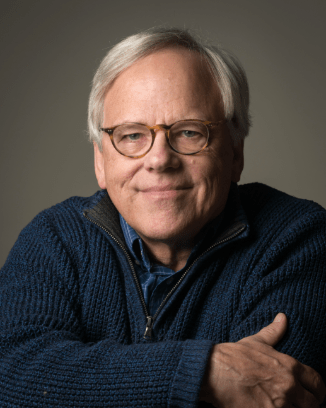
John Winn Miller is an award-winning investigative reporter, foreign correspondent, editor, publisher, screenwriter, indie movie producer and novelist. | Photo Bancroft Press. | More info at Miller’s website URL https://www.johnwinnmiller.com
John Winn Miller
Though Rescue Run is a sequel to Miller’s first novel, The Hunt for the Peggy C, no prior knowledge of the first book is required. A summary of the prequel is included for new readers or those needing a refresher.
Westerbork Film Frame
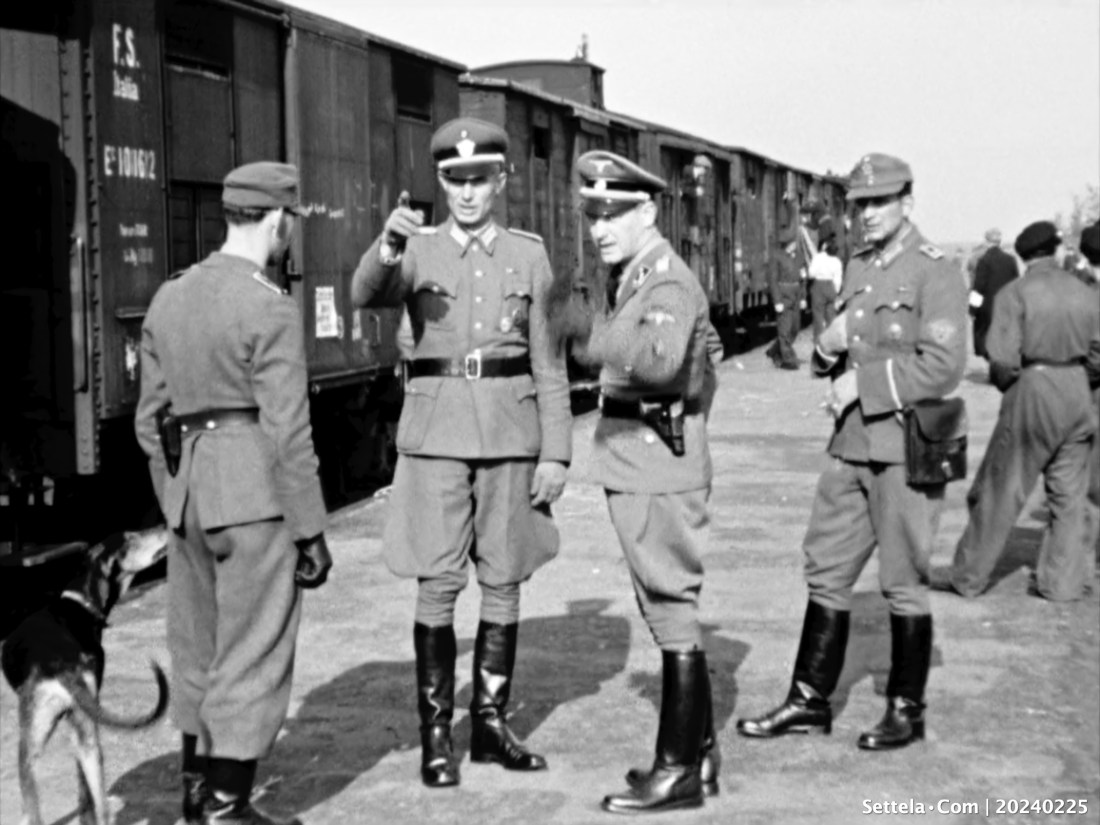
This review was prompted by my contribution of a still (image below) from the Westerbork film for the book jacket/cover, in collaboration with designer Christine Van Bree , and author John Winn Miller. John kindly provided me with a link for a free download of the Advance Reader Copy on the BookSirens’ platform. Since I’m documenting the Westerbork film through the online magazine Settela•Com, I happily accepted BookSiren’s invitation to join the review team.
Deportation | 20240225 | Settela•Com | Commander Albert Gemmeker oversees the deportation of Jews, Sinti, and Roma from the Westerbork transit camp May 19, 1944 | Frame 7426 from Deportation Westerbork Film | 20210719 | Settela•Com | ISSN 2949 9313
Citation info : Review RESCUE RUN • 20240927 • Michel van der Burg • Settela•Com • ISSN 2949-9313
Isolation of Islets of Langerhans from the Canine Pancreas | Fall meeting of the Dutch Association for Calcium and Bone Metabolism, Leiden (The Netherlands) November 13, 1987 • 20240829_1 • michelvanderburg•com • TakeNode 6b80e3a7-af16-41f7-b15f-cdeb85e377f3
Cradle of Islet Transplants
The Laboratory of Cell Biology and Histology in Leiden (headed by Prof J.P. Scherft), was the cradle of our Islet Transplantation Lab, where we made a fresh start Summer 1986 (1), and presented our first poster the following year.
Poster
Our first year of research was presented in this poster (Image 20240829_1) at the Fall Meeting Friday, November 13, 1987 , of the Dutch Association for Calcium- and Bone-metabolism*, in Leiden, Holland (2) in that Cell Biology building of the University Hospital Leiden (‘Building 55’) where our Islet Lab was hosted for the first decade.
The poster shows the results of islet isolations from canine pancreas segments performed with a method developed for human islet isolation by the surgeon Derek Gray (Oxford, UK) with some modifications (3). Pancreas segments were harvested at surgery for our concommitant research on segmental pancreas transplantation in this pre-clinical model (4,5,6,7).
Isolation of Islets of Langerhans from the Canine Pancreas | Islet Transplantation Laboratory, Leiden University Hospital, 1987 • 20240829_2 • michelvanderburg•com • TakeNode a9a389d9-c06f-467a-9ee0-1c2dc5f2403a
The photo collage (Image 20240829_2) also shown in the Methods section of the poster illustrates, resp. : 1) removal of a canine pancreatic segment at surgery; 2) distension of the gland by ductal injection of a collagenase solution; 3) the mucoid appearance after collagenase digestion of the connective tissue in the gland for 20-25 min at 39°C; 4) the digestion end-point, when gentle contusion of a sample of the tissue appears to liberate free islets from the surrounding exocrine tissue; 5) dispersion of the tissue with forceps and aspiration through needles; 6) microscopy of the suspension of purified islets (arrow denotes islet) contaminated with some exocine fragments , after sieving and Ficoll density gradient centrifugation to separate the islets from most of the exocrine fragments.
Figure 1 of the Results shows the relation between islet size and number of the isolated islets. Quantitation of the total volume of islets in the pancreas, and after islet isolation , demonstrated that on average 5-10% of the islets in the pancreas are isolated after purification. Figure 2 shows the timeline of insulin secretion by the isolated islets, in response to stimulation with glucose (sugar) during perifusion with a basic salts solution containing low -, high -, and low sugar levels, resp.
The posters were produced at the Cell Biology department using a pen plotter machine. A corridor in the building with part of the gallery of posters was photographed at the meeting (Image 20240829_3).
Cell Biology – 40th anniversary, 1947-1987
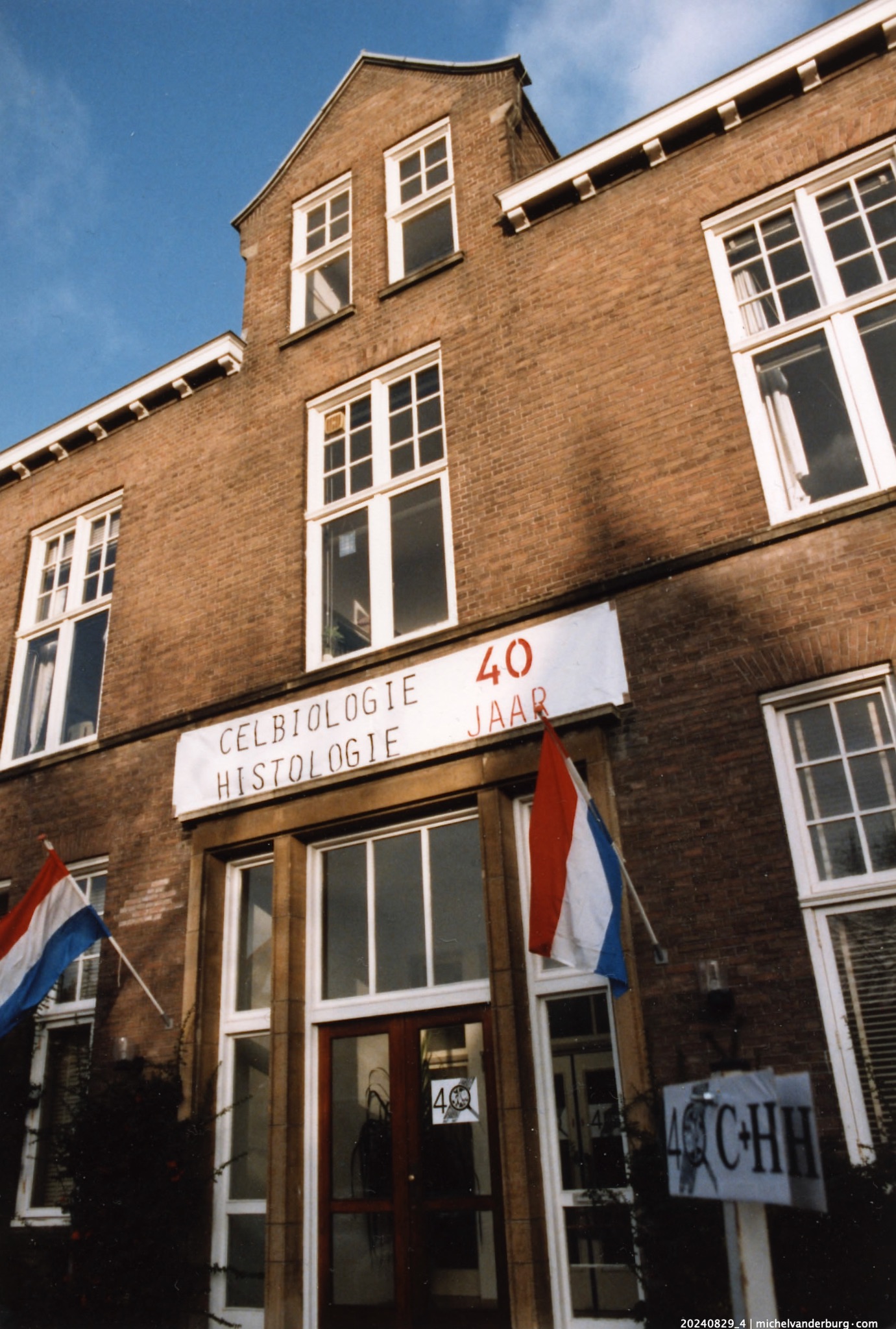
Laboratory of Cell Biology and Histology, Leiden (Holland) celebrating the 40th anniversary, 1947-1987. Front entrance ‘Building 55’ University Hospital Leiden, November 14, 1987 20240829_4 • michelvanderburg•com • TakeNode bcf4674c-0cc7-4545-96b1-1a8e0c451150
The 40th anniversary of the Cell Biology Department was celebrated 13-14 November 1987 (with a banner and flags at the entrance of the building (Image 20240829_4) , with the science meeting Nov. 13th and a get-together with (former) co-workers, including Professor emiritus Pieter J. Gaillard, dutch pioneer of tissue culture and transplantation, and founder of the laboratory when appointed professor of Experimental Histology at the Leiden University, Friday, November 14, 1947 (8,9).
Professor Gaillard’s lab started in 1947 in the cellar of the Anatomical Laboratory, and moved in 1953-1954 to ‘Building 55’ of the University Hospital Leiden; shown above. The name was changed to Cell Biology and Histology, in 1964. Cell Biology is currently part of the Department Of Cell & Chemical Biology , and housed within the research building of the Leiden University Medical Centre.
I photographed the emiritus Gaillard receiving a ‘souvenir’ from Professor Scherft (Image 20240829_5) at the 40th anniversary of the Cell Biology Laboratory in Leiden (Holland), Nov. 14, 1987.
P.J. Gaillard (on the left) & J.P. Scherft, Cell Biology Laboratory in Leiden (Holland), Nov. 14, 1987 • 20240829_5 • michelvanderburg•com • TakeNode 08054d8f-c978-422f-9f3f-5c8507cf8869
First clinical islet cell transplant
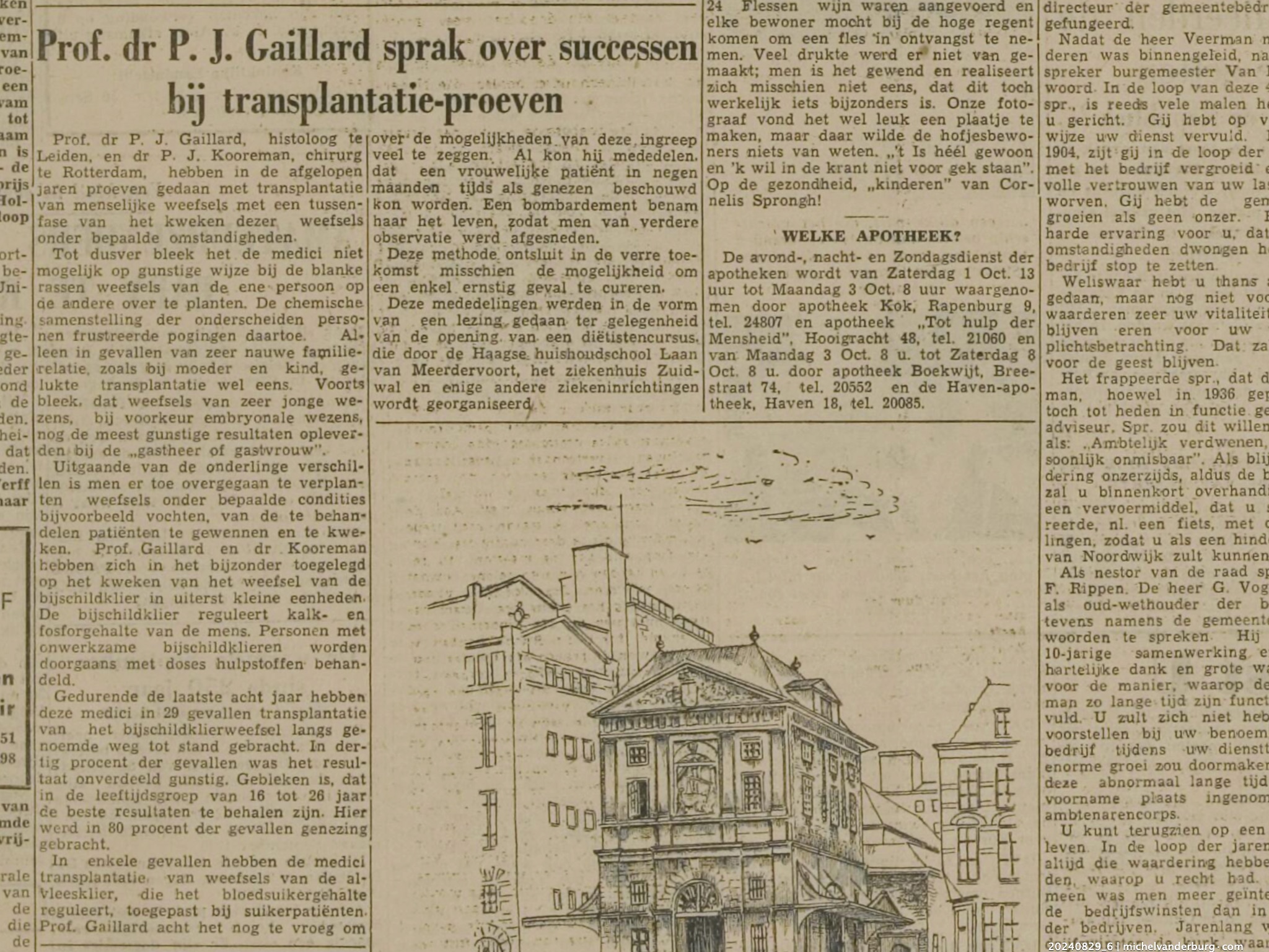
In 1944, during World War II, Gaillard and the Leiden surgeon P.J. Kooreman performed the first successfull clinical (allogeneic) transplant of (cultured) islet cells in Leiden. Dutch newspapers reported (10), Gaillard had spoken at a meeting in 1949 organized by local hospitals in The Hague, Holland, on some of his early transplants in diabetic patients, with success in one patient during the war (Image 20240829_6) : “Prof. Gaillard considers it too early to say much about the possibilities of this intervention. Although he could report that a female patient can be considered cured in nine months. A bombing took her life, so that further observation was cut off.” . The Islet Transplant Registry listed the transplant as the 5th performed in the world (6). Gaillard & Kooreman also performed a successful series of transplants of cultured parathyroid tissue , a firm base of what would become the focus of Gaillards research and the Cell Biology Laboratory , the hormonal regulation of bone metabolism (9,10,11,12).
Prof. Dr. P.J. Gaillard spoke about successes in transplant trials. Nieuwe Leidsche Courant, Oct. 1, 1949 • 20240829_6 • michelvanderburg•com • TakeNode c5be6800-f3da-453e-9d40-d8fafffd27aa
Introduction of collagenase isolation of islets
Also, of note, is the first introduction of pancreatic islet isolation by collagenase digestion in 1965 by the polish researcher Stanislaw Moskalewski with the help of Gaillard working at the Cell Biology Laboratory (13) — the basis of large scale islet isolation and transplantation.
Notes
1) Leiden Islet Laboratory History • 20240803 | Michel van der Burg | michelvanderburg•com
2) Van der Burg MPM, Gooszen HG, Terpstra JL, Scherft JP, Frölich M, Lemkes HHPJ. Isolation of the islets of Langerhans from the canine pancreas. Fall meeting of the Dutch Association for Calcium and Bone Metabolism, Leiden (The Netherlands) November 13, 1987.
3) Gray DWR, McShane P, Grant A, Morris PJ. A Method for Isolation of Islets of Langerhans from the Human Pancreas. Diabetes 1 November 1984; 33 (11): 1055–1061. https://doi.org/10.2337/diab.33.11.1055
4) Gooszen HG. Canine segmental pancreatic autotransplantation. Analysis of the effects of ductobliteration. Thesis, Leiden, 1984
5) Van der Burg MPM, Gooszen HG, Guicherit OR, Jansen JBMJ, Frölich M, Haastert FA, Lamers CBHW. Contribution of partial pancreatectomy, systemic hormone delivery and duct obliteration to glucose regulation in canine pancreas: Importance in pancreas transplantation. Diabetes 1989; 38: 1082–1089.
6) Pancreatic islet transplantation (doctoral thesis, 1994) by Michel van der Burg. ISBN 9789080216402. Scholarly Publications repository of Leiden University. Persistent URL https://hdl.handle.net/1887/3486604
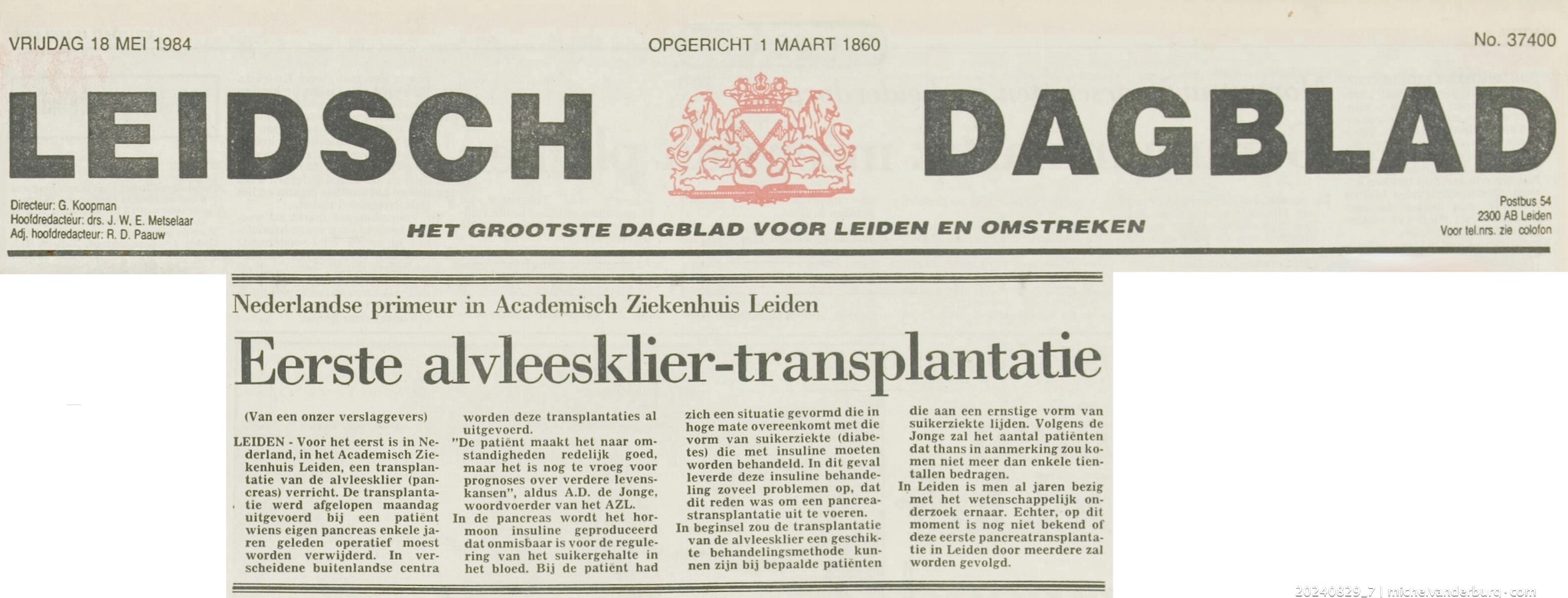
Eerste alvleesklier-transplantatie | Nederlandse primeur in Academisch Ziekenhuis Leiden. Leidsch Dagblad, May 18, 1984 (leiden.courant.nu) • 20240829_7 • michelvanderburg•com • TakeNode 5d3c88a5-4c67-48fd-8a8c-8165a5c2edfe
8) Van CH0 naar CH40 met Ca2+ als katalysator. Scherft J.P. In : Laboratorium voor Celbiologie en Histologie 1947-1987 | Uitgave ter gelegenheid van het veertigjarig bestaan van het Laboratorium voor Celbiologie en Histologie van de Medische Faculteit te Leiden.
9) Enkele notities over het begin van de weefselkweek in Leiden. Gaillard P.J. In : Laboratorium voor Celbiologie en Histologie 1947-1987 | Uitgave ter gelegenheid van het veertigjarig bestaan van het Laboratorium voor Celbiologie en Histologie van de Medische Faculteit te Leiden.
10) Prof. dr P.J. Gaillard sprak over successen bij transplantatie-proeven. Nieuwe Leidsche Courant, Oct. 1, 1949. | Dutch newspaper , URL https://leiden.courant.nu/issue/NLC/1949-10-01/edition/null/page/2 | “Prof. Gaillard acht het nog te vroeg om over de mogelijkheden van deze ingreep veel te zeggen. Al kon hij mededelen, dat een vrouwelijke patiënt in negen maanden tijds als genezen beschouwd kan worden. Een bombardement benam haar het leven, zodat men van verdere observatie werd afgesneden”.
12) Jon van Rood: The pioneer and his personal view on the early developments of HLA and immunogenetics. Martine J. Jagera M.J, Brand A, Claas F.H.J. Transplant Immunology 52 (2019) 1–26
* Strange to find the Dutch Association for Calcium and Bone Metabolism indicates online a start in 1990 – while I visited their fall meeting in 1987 (see also refs 8,9)
Update (20240912) correction text perifusion solution
Citation info : Cradle of Islet Transplants • 20240829 • Michel van der Burg • michelvanderburg•com
First day in Rumble posting … Moonlight Serenade in 1944, by Glenn Miller’s Band of the Allied Expeditionary Forces (the A.E.F. Band ), announced by German speaking “Ilse Weinberger” (pseudonym for Gloria Wagner) in a Musik für die Wehrmacht (Music for the Wehrmacht) European radio propaganda broadcast. Remastered edition. First published in Moonlight Serenade War Radio 1944 by Major Glenn Miller’s A.E.F. Band & Ilse Weinberger | 20240203
Citation info : Rumble Player | 20240207 | 1 Memo | @michelvanderburg
Moonlight Serenade in 1944, by Glenn Miller’s Band of the Allied Expeditionary Forces (the A.E.F. Band ), announced by German speaking “Ilse Weinberger” (pseudonym for Gloria Wagner) in a Musik für die Wehrmacht (Music for the Wehrmacht) European radio propaganda broadcast. Remastered edition.
Citation info : Moonlight Serenade War Radio 1944 by Major Glenn Miller’s A.E.F. Band & Ilse Weinberger | 20240203 | Miracles•Media | @michelvanderburg | TakeNode 0205faad-7d9b-4807-860b-aff2627b943c
In the Mood | Major Glenn Miller’s Band | European Radio Propaganda 1944, Ilse Weinberger | 20240202 | Miracles•Media | @michelvanderburg | TakeNode 6d704373-eb94-4ce6-9436-941409dbd555