4th ESOT Slide #19 • Pancreatic Islets UWS Series 1989 • Kodak PhotoCD • Michel van der Burg • Miracles.Media • 20250103_1 • TakeNode eeb55729-c02b-4f73-ab0e-9f71b65bf85e
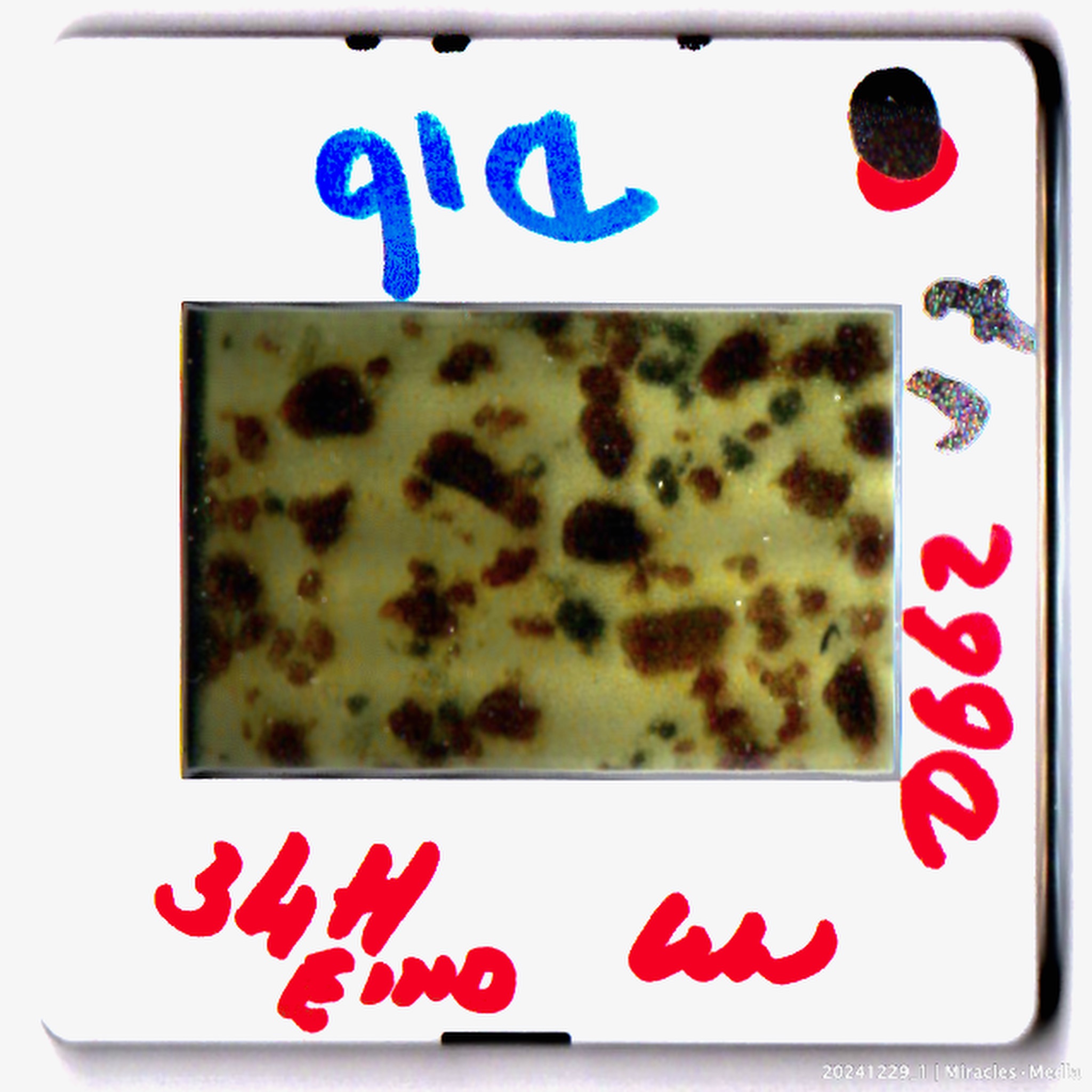
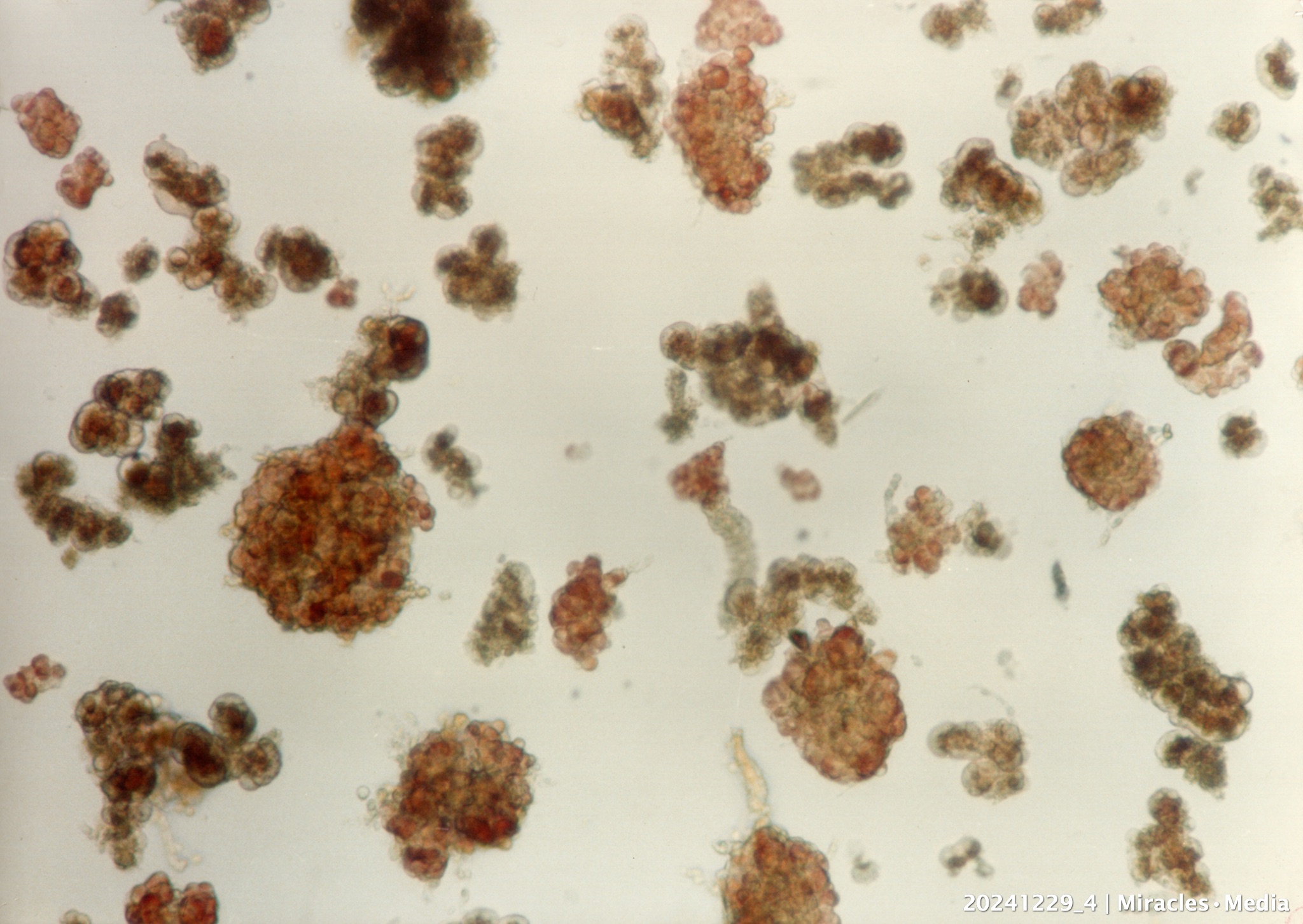
Slide #19 of talk by Michel van der Burg at the 4th ESOT congress in Barcelona (Spain) Nov 1989 on the paper ‘Pancreatic Islet Isolation With UW Solution • A New Concept’ (1,2). Details of this talk were posted recently (2) with a scan of a paper print of slide #19 – slighly cropped with printing. Here the full image of the original slide, scanned by Kodak PhotoCD in 1994, with minor color correction added (20250103_1) in this post.
This ‘Slide #19’ shows the final dithizone stained sample of the UW-isolated islets after dextran density gradient purification — a micrograph made April 18, 1989 , the second islet isolation experiment performed using the UW-Solution as the isolation solution.
In the lab journal of the first isolation experiment with UW-Solution, Wednesday April 12th 1989, I noted on the final purified islet preparation : ‘handpicking for encapsulation was not necessary: preparation more than 90% pure ( translated from dutch : “handpicken voor inkapseling was niet nodig: preparaat meer dan 90% zuiver”)’.
‘Handpicking’ of islets had been done at the start of our islet lab in 1985-1987 for counting rodent islets in cell culture dishes, and monitoring islet insulin secretion in tubes (3). Soon, ‘handpicking’ was no longer needed , when monitoring the insulin secretion of isolated islets in perifusion chambers (4,5). However, the handpicking method was used again in a pilot study on encapsulation of islets in 1989 by medical student Joost Clemens (6). Joost had just started on this research project, and was assisting me with islet ‘counting’ (yield and purity assessment) in the ‘duplo’ samples from this first series of UWS isolations.
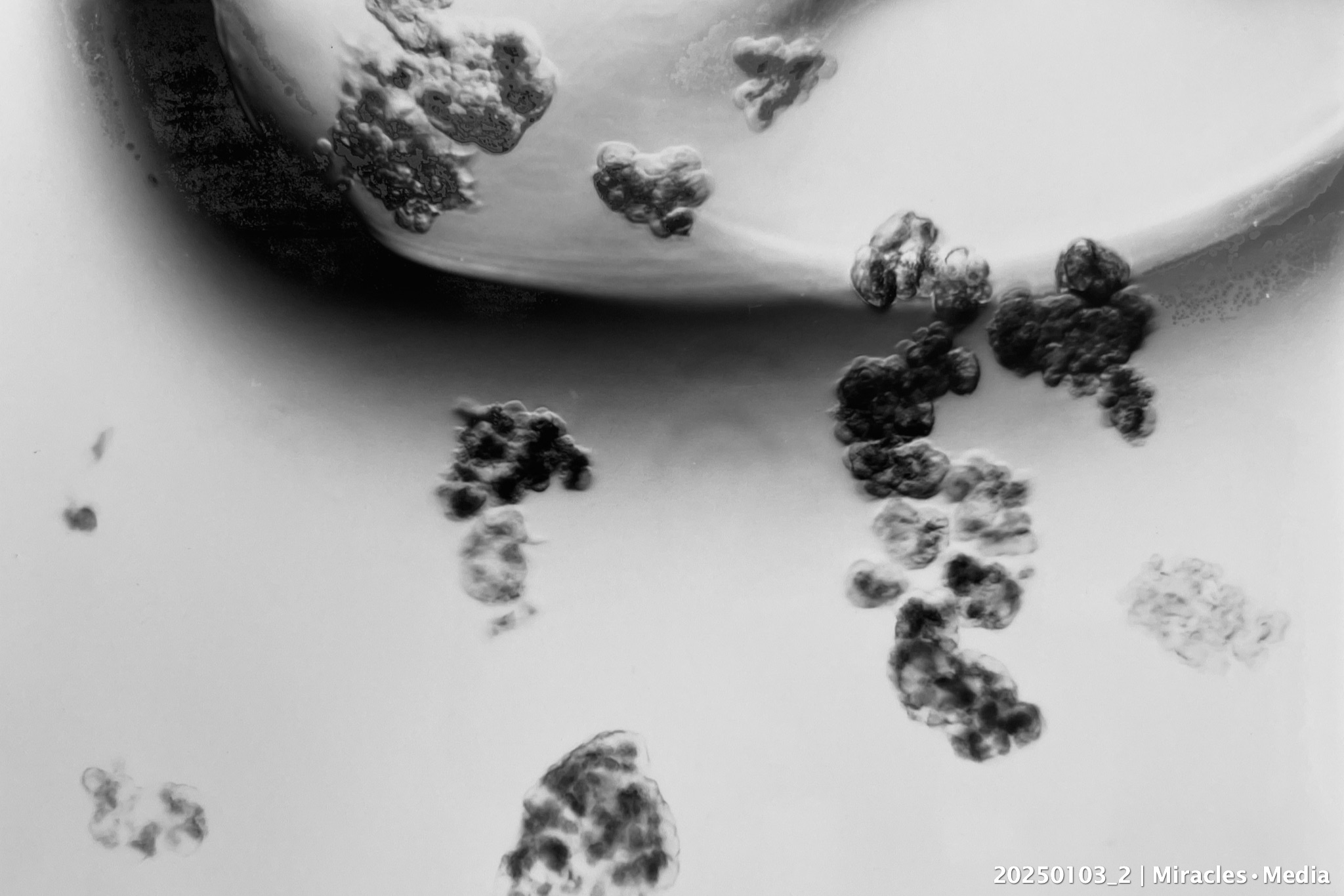
Handpicking Pancreatic Islets • Michel van der Burg • Miracles.Media • 20250103_2 • TakeNode 7988ce39-6777-4db3-82c5-8191acdb13d6
Macro photography (Photo paper print, September 1987, AVC, Leiden University) of the aspiration of isolated canine pancreatic islets, in a suspension still contaminated with exocrine pancreatic fragments, at the tip of a hand blown glass handpicking pipette (custom made at the Leiden University) collected and transferred into tubes for monitoring insulin secretion the first year of pilot work in the Leiden islet laboratory (4).
2) Pancreatic Islet Isolation in UW Solution & Transplantation • ESOT 1989 Talk • Michel van der Burg • Miracles.Media • @1MEMO 20241229 • URL michelvanderburg.com/2024/12/29/
3) Lucky #1 Islet • 20240811 • Michel van der Burg • michelvanderburg•com
4) Cradle of Islet Transplants • 20240829 • Michel van der Burg • michelvanderburg•com
5) Monitoring pancreatic islets in perifusion • 20240911 | Michel van der Burg | michelvanderburg•com
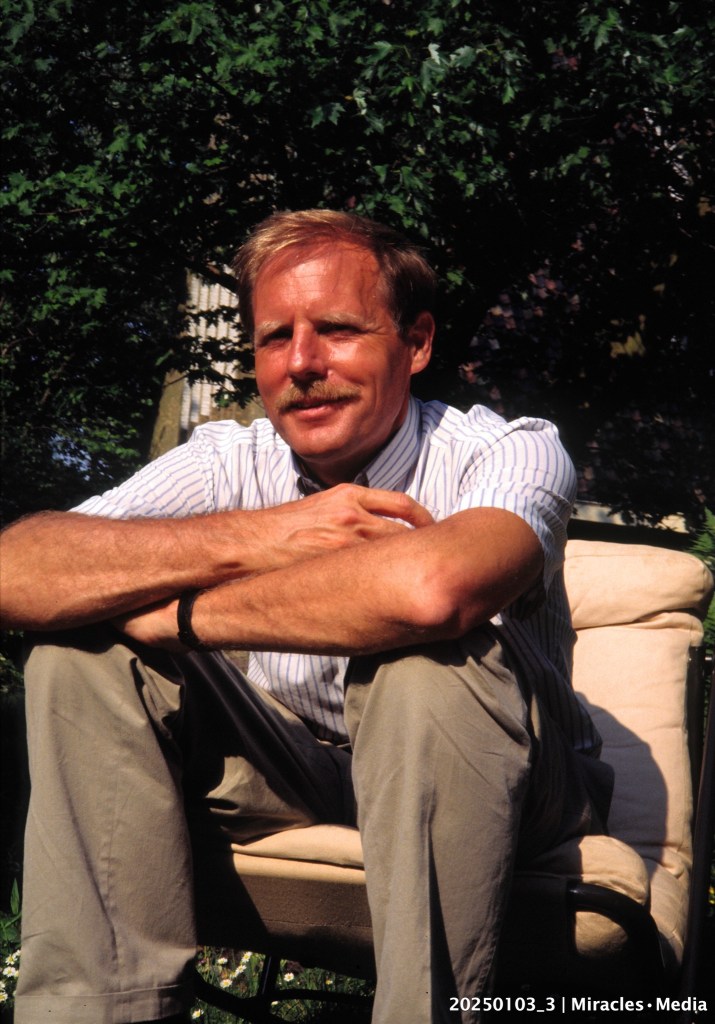
6) Joost A.M. Clemens (MSc student in Medicine) at the Department of Biomaterials (Prof. dr K. de Groot) and Department of Surgery of the Leiden University (Michel van der Burg , Hein Gooszen). Pilot study of the encapsulation of dog islets using the alginate polylysine and poly-HEMA-phospate method (1989). At that time , both the Biomaterials department and the Islet Lab of the Surgery department were housed in the building of the Cell Biology department of the Leiden University Hospital (AZL, now LUMC). Below a portrait snapshot I took of Klaas de Groot at a Garden party organized in 1989 by the Department of Cell Biology, Leiden University.
Klaas de Groot, Biomaterials Department of the Leiden University in 1989. Photo by Michel van der Burg • Miracles.Media • 20250103_3 • TakeNode c25a87b7-09a4-49ce-8c42-14142da1e066
Citation info : Pancreatic Islets UWS Series 1989 • Kodak PhotoCD • Michel van der Burg • Miracles.Media • @1MEMO 20250103 • URL michelvanderburg.com/2025/01/03/
Oral Presentation Slide 19 ~ Pure Islets Isolated in UW Solution • Miracles.Media • 20241229_1 • TakeNode ce420e5a-1df7-4e4f-bcb6-6831434ffac7
In November 1989, I had my first chance for a presentation at a major international conference, the 4th ESOT meeting in Barcelona, of a paper centered on the rationale for employing the University of Wisconsin (UW) organ preservation solution in pancreatic islet isolation.
Venue 4th Congress of the European Society for Organ Transplantation, Barcelona (Spain) November 1–4, 1989 • Michel van der Burg • Miracles.Media • 20241224 • TakeNode 103c4c3c-5d36-4111-a5f8-f60e81c5db4d
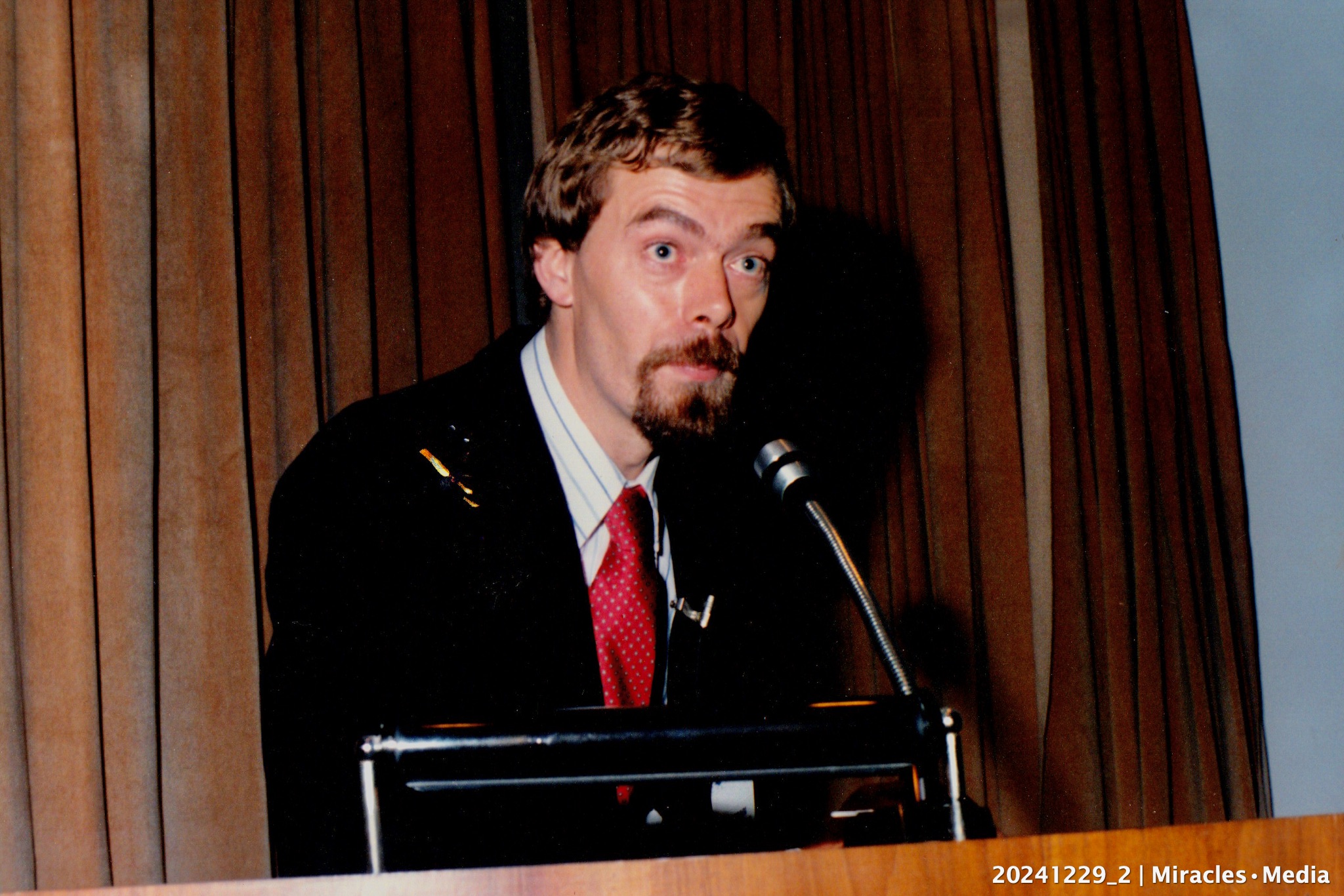
This innovative islet isolation work with the UW-Solution had been accepted as a poster presentation for the 4th ESOT meeting (1). I also took the opportunity to present this new work during a talk on previous isolation work (2,3) at this conference.
Barcelona Nov 1989 4th ESOT • Talk by Michel van der Burg • Miracles.Media • 20241229_2 • Photo : Grup Jaume Muntaner (Barcelona) • TakeNode 96957e2f-1462-48e1-aca1-4745198d9a54
‘Behind the scenes’ I had first remade my lost poster at the congress venue (1), and then I rewrote my speech in the hotel room on the older research (2) updated with the more recent work with the UW-Solution, and including the outcome of our first islet transplantations.
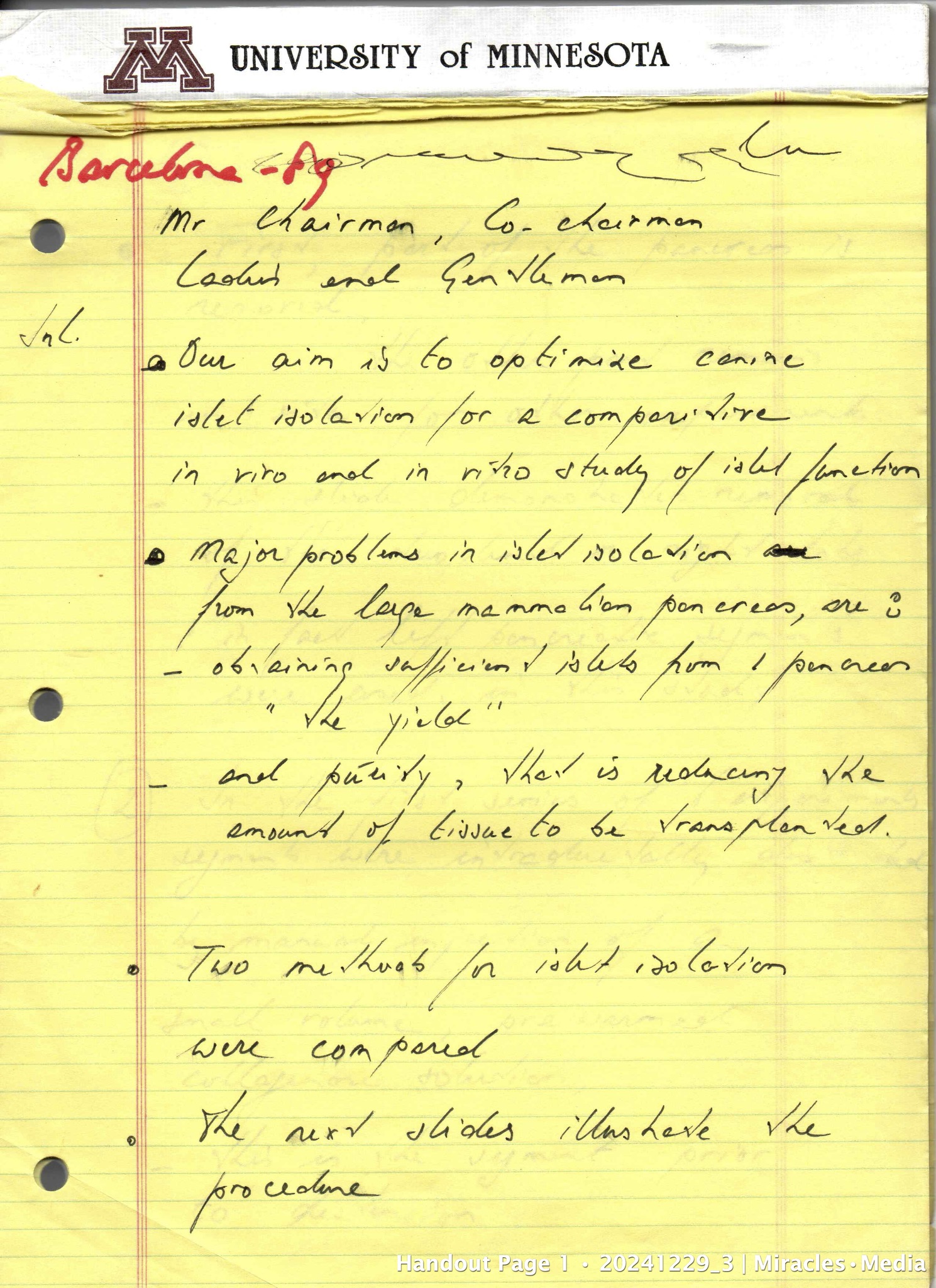
Barcelona 89 • Handout 4th ESOT Talk
Below a scan of that handout of the final speech, written out at full lenght in a notepad from a recent working visit in Minneapolis (4).
Barcelona 89 • Handout 4th ESOT Talk • Michel van der Burg • Miracles.Media • 20241229_3 • TakeNode f8595a82-fba5-4a89-a01f-4c37976d06d7 • PDF FILE 20241229_3 copy is available here
( finishing speech first part on our previous islet isolation methods using the conventional RPMI solution – a solution originally designed for tissue culture, not for cold storage of organs )
Slide 18
Image Slide 18 (scan of print) • Best (Not Usual) Purity Islets RPMI Series • Miracles.Media • 20241229_4 • TakeNode a6afbf29-b3e6-41d0-abd0-07471303be15
This slide shows one of the purest preparations obtained, with an estimated purity of 65% islets. • On the average however a purity of only 30% was obtained.
Recently we adopted an entirely new approach to islet isolation. • Since UW, the new organ cold storage solution has been shown to allow long-term cold storage of the canine pancreas; • and, since islet isolation too is largely performed in the cold; • we tested this preservation solution as the isolation medium, throughout the isolation procedure in another 6 dogs; • as compared to the commonly used solutions like RPMI tissue culture medium.
Slide 19
Image Slide 19 (scan of print) – Usual Purity Islets UWS Series • Miracles.Media • 20241229_5 • TakeNode dacd3b99-5958-44fe-85ed-6abd55db2676
This slide shows the final dithizone stained preparation after dextran purification of UW-isolated islets. • UW did not affect islet yield • however, UW markedly improved purity : • acinar tissue is virtually absent.
2) Van der Burg MPM, Gooszen HG, Field MJ, Scherft JP, Terpstra JL, Van de Woude FT, Guicherit OR, Frölich M, Bruijn JA. Comparison of current islet isolation techniques in dogs. 4th Congress of the European Society for Organ Transplantation, Barcelona (Spain) November 1–4, 1989. Oral presentation. (1)
3) Van der Burg MPM, Gooszen HG, Field MJ, Scherft JP, Terpstra JL, van de Woude FJ, Guicherit OR, Frölich M, Bruijn JA. Comparison of current islet isolation techniques in dogs. Transplant Proc. 1990 Aug;22(4):2044-5. PMID: 1697121. This paper appears to be not readily available online – a reprint copy is available at this site (1)
4) Working visit Sep – Oct 1989, joining the pancreatic islet isolation team of the pioneer transplant surgeon David Sutherland at the University of Minnesota in Minneapolis.
Citation info : Pancreatic Islet Isolation in UW Solution & Transplantation • ESOT 1989 Talk • Michel van der Burg • Miracles.Media • @1MEMO 20241229 • URL michelvanderburg.com/2024/12/29/
Mechelen , Belgium. Friday 20th April 2007. Presentation Project TRANSPORT XX.
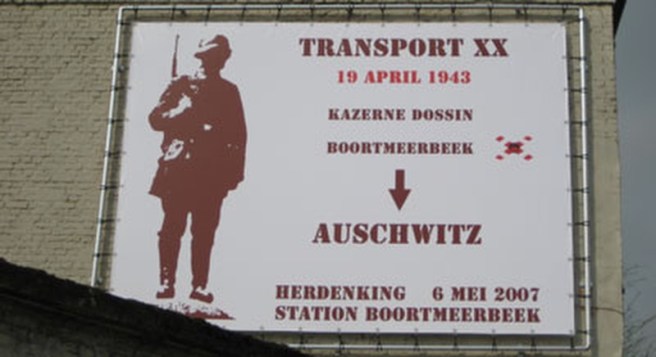
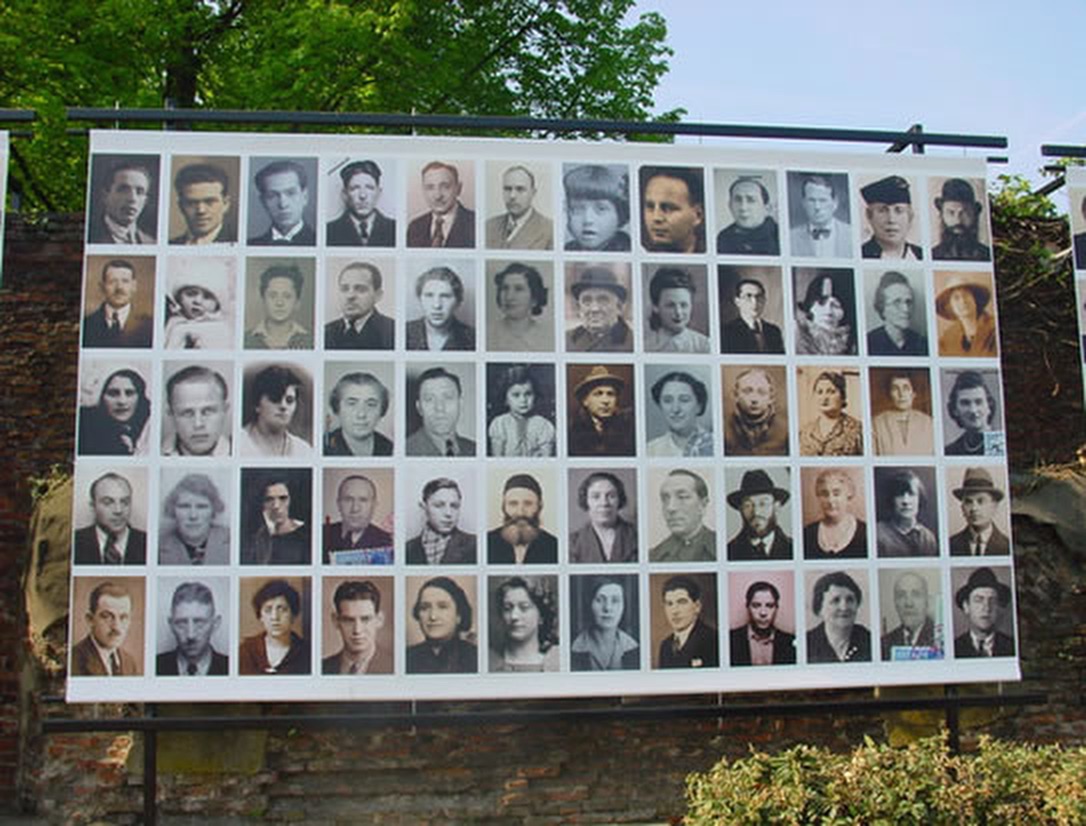
Transport XX Exhibition Poster | Open Memory | Miracles•Media | 20240518_6
Project TRANSPORT XX | April 2007 – June 2007*
Guard | Transport XX installation Mechelen | Miracles•Media | 20240518_1
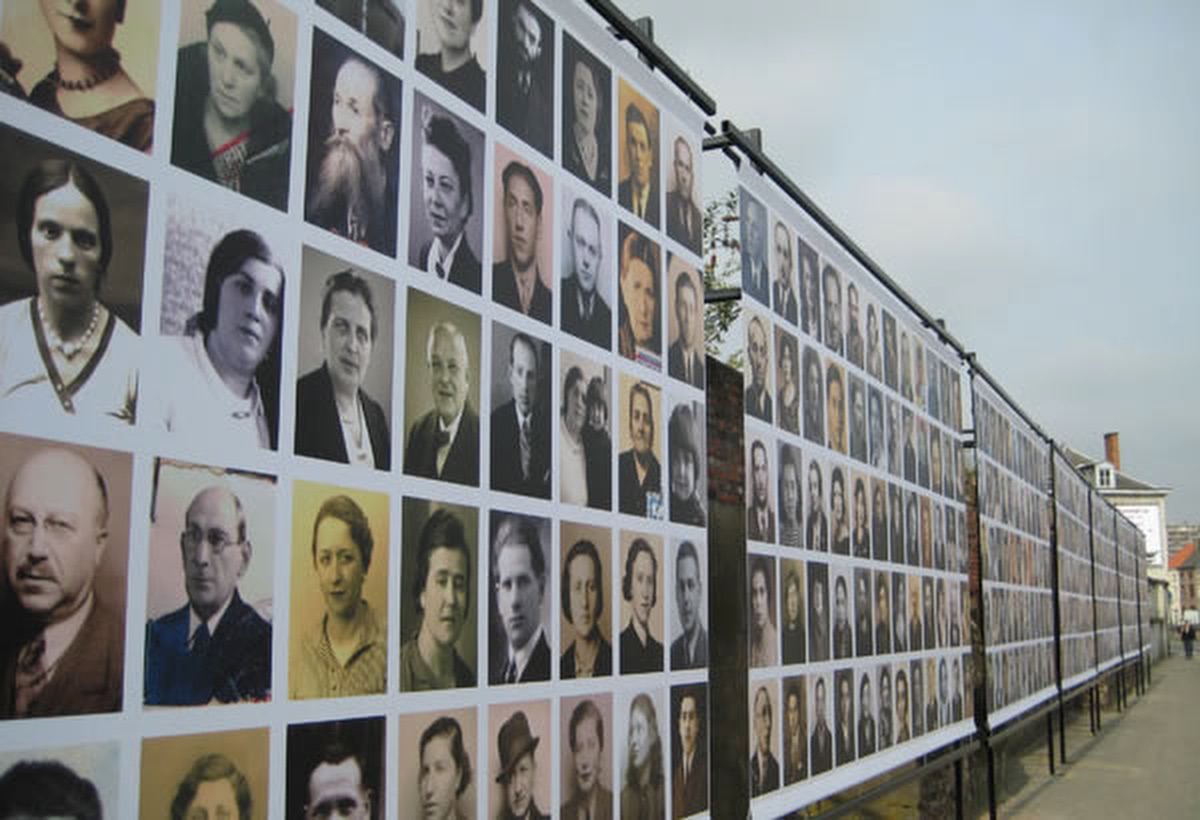
Transport XX is the only train convoy of Jewish deportees in Europe to be stopped by the Resistance in order to rescue prisoners. This unique armed attack took place on 19 April 1943 in Boortmeerbeek, Belgium. TRANSPORT XX is a construction depicting the portraits of 1,200 of the 1,631 prisoners deported on Convoy XX from the Kazerne Dossin (Dossin Barracks) direction Auschwitz-Birkenau. The photographs were displayed outside along a 100 yard stretch of the Edgard Tinellaan, where the old railway line used to run. In this way passers-by were confronted with 1,200 faces of the victims of racial genocide.
On Friday 20 April 2007, in the Jewish Museum of Deportation and Resistance (JMDR), the project TRANSPORT XX was presented to the international press.
The attack on Transport XX
In 1940 nearly 70,000 Jews were living in Belgium. During WW II ca 25,000 were deported from the Dossin Barracks in Mechelen (Belgium) and ca 5,000 via Drancy, close to Paris (France). In two years from the summer of 1942, 28 train convoys left Mechelen with their human cargo of Jews and ca 350 Gypsies. Their destination was, in the main, Auschwitz-Birkenau.
On 19 April 1943 Transport XX departed with 1,631 deportees. Transport XX was an exceptional convoy because it carried an unusually large number of victims (1,631) and it was the first time that the Nazis resorted to the use of a goods train. In previous convoys third class railway carriages had been used and deportees could, from time to time, escape through the carriage doors and windows. The goods wagons of Transport XX were locked from the outside and apertures were secured with barbed wire. Suzanne Kaminsky, the youngest Jewess to be deported from Mechelen, was transported to the East on Transport XX. She was born on 11 March 1943.
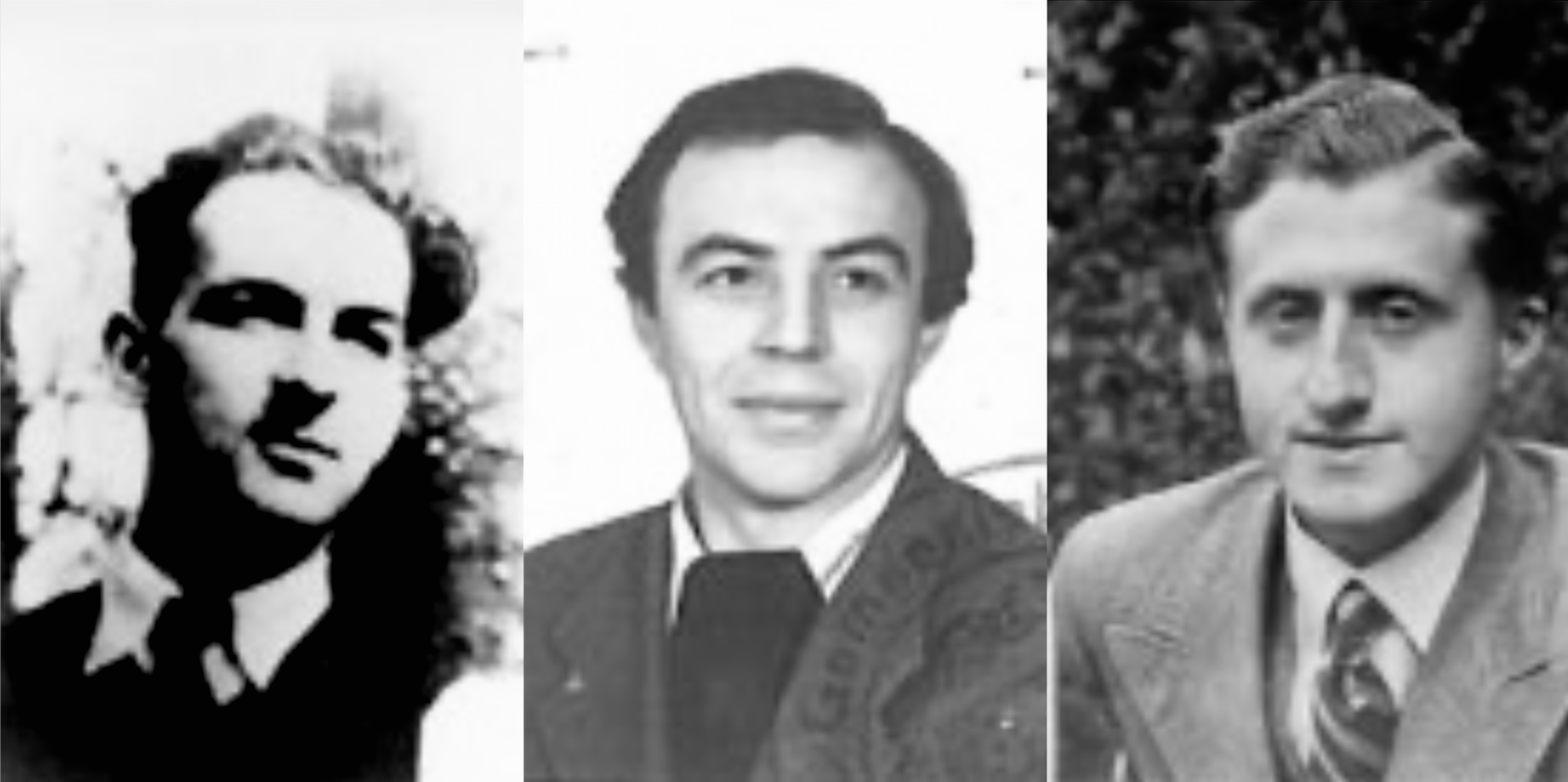
Youra (Georges) Livschitz, Robert Maistriau, and Jean Franklemon, pupils from the Athenaeum in Ukkel, Brussels, armed only with one revolver and a hurricane lamp covered with red paper, succeeded in stopping Transport XX between Mechelen and Louvain in the vicinity of Boortmeerbeek. This was the first and only such undertaking to rescue Jews being transported to the East during WW II.
Youra Livschitz, Jean Franklemon and Robert Maistriau | MJB-JMB , JMDV | Miracles•Media | 20240518_02
Convoy XX was accompanied by a detachment of German Sicherheitspolizei comprising one officer and 40 men. Inspite of the guards Robert Maistriau succeeded in opening one of the goods wagons. 17 people escaped. As the train continued its journey dozens of other prisoners succeeded in escaping. Saws, files, pincers and other tools, which lay hidden in the straw, were used to open the wagons from within. A total of 238 deportees (update 20240518) managed to escape managed to escape from the train, however 90 were soon recaptured and put on the next convoy, 26 were shot dead and 122 succeeded in their escape. The 11 year old Simon Gronowski was long thought to be the youngest escapee. Actually the 6-year-old boy Aron Luksenberg was the youngest who jumped and went into hiding with a family in Wavre, where he survived the war but died of an illness at the age of fifteen (a recent finding by Jo Peeters). The youngest to escape was Viviane , who escaped in the womb of her three-months pregnant mother Isabella Weinreb-Castegnier, and was born 6 months later in Brussels (Miracles.Media).
Regine Krochmal an 18 year old nurse from the Resistance succeeded in escaping from the train by sawing through the wooden battens which were placed over an airhole in the goods wagon. She sprang from the moving train in the vicinity of Haacht. Both Simon Gronowski and Regine Krochmal survived the war.
On 22 April Convoy XX arrived at Auschwitz-Birkenau.
As a result of the attack on Convoy XX all future convoys would be more heavily guarded. A company of guards from Brussels would, henceforth, travel with the train to the German border. The day of the attack on Convoy XX is symbolic, as the date coincides with that marking the beginning of the uprising in the Warsaw ghetto.
Transport XX installation Mechelen | Marc Michiels | Miracles•Media | 20240518_3
Speech by Bart Somers, Mayor of the city of Mechelen, Friday 20th April 2007.
Friends,
On behalf of the City of Mechelen I should like to welcome you to this presentation of TRANSPORT XX (CONVOY XX). I am delighted with the international interest shown in this project.
On account of its geographical situation, between Brussels and Antwerp, Mechelen was the ideal choice of the German occupying forces as an assembly point for Jews and Gypsies prior to their deportation to the notorious camp of Auschwitz-Birkenau. The citizens of Mechelen didn’t have a choice in this matter, however, we will always carry with us and guard the memory of this unseen crime against humanity – the genocide against Jews and Gypsies which took place in Belgium. This responsibility has, in fact, been placed upon us by the historical events in which our city played an integral part.
The city has continually offered its full support to the annual memorial events at the Kazerne Dossin (Dossin Barracks). The Joods Museum van Deportatie en Verzet – JMDV (Jewish Museum of Deportation and Resistance) has always been able to count on assistance from our public services. The police, the firebrigade, the ecological and the cleansing-department, the city archives, local museums, our high-school and last but not least, the staff at city hall, have all, when called upon, offered a helping hand. More than once the city hall, itself has been made available to house events organised by the JMDV.
Furthermore the City of Mechelen, together with the Government of Flanders and the JMDV will be playing a major role in the rebuilding and refurbishing of the present museum. This new project will enable the permanent exhibition over the genocide of the Jews and Gypsies to be extended and to incorporate associated themes and other violations of human rights.The new museum will be called Kazerne Dossin. Museum en Documentatiecentrum van Holocaust Mensenrechten.( Dossin Barracks. Museum and Documentation Centre of the Holocaust and of Human Rights). During the coming months we will keep you abreast of the progress in the development of this project both architecturally and also regarding the planning and organisation of the work. Anyway where we are now situated, the old gaol and the Predikherenklooster (Dominican Monastery) situated adjacent to us will definitely be incorporated into the master plan.
Finally I should like to congratulate the JMDV team for their success in presenting to the general public in such a spectacular and well documented manner one of the 28 train convoys which left Mechelen for the camps in Poland. I hope that the public will be deeply moved by the portraits of these murdered people.
Thank you.
Transport XX installation Mechelen | JMDV | Miracles•Media | 20240518_4
Speech by Ward Adriaens, Curator of The JMDR, Friday 20th April 2007.
Friends,
The Joods Museum van Deportatie en Verzet – JMDV (Jewish Museum of Deportation and Resistance) presents, today, a portrait gallery of 1,200 Jewish deportees. They were prisoners who left here on 19 April 1943 in goods wagons bound for Auschwitz-Birkenau. It was a journey of no return. However more than 200 of them succeeded in escaping before the train reached the German border.
The pictures have been erected alongside the old railway line from the Kazerne Dossin (Dossin Barracks) which previously linked-up with the national railway network.
I believe that it is a unique event that a whole deportation train is once again given a face. It is a photographic reconstruction of one of the 28 convoys which was destined to make the same journey.
The installation of the reconstructed train takes account of the current typology ‘Perpetrators’,‘Victims’, and ‘Bystanders’ : 1 guard on the poster, 1,200 portraits of deportees and 12,000 people who daily ride past.
When we see these photographs we suddenly no longer have to speak solely over numbers or statstics – in this case 1,600 prisoners in a train. We are now able to show you the faces of 1,200 people with flesh and blood that only 60 years ago were registered, ostracised, tracked down, apprehended, robbed and finally murdered. Because they had a mother.
Let us clearly understand that this is the fundamental basis of racism: persecuted because we have a mother. We all have parents and many amongst us have children. In order to protect them it is essential that we do not give an inch to racism. Everyone of us will come under threat should the policy makers be influenced by racism.
That is why monuments and memorials exist ; in order to remind us and to give us the opportunity to reflect upon what went wrong in the past. Therefore there are historical museums such as Fort Breendonk and Flanders Fields. Therefore there are documentation centres and archives to substantiate the truth of the survivors. We have developed educational activities and projects for the general public such as TRANSPORT XX (Convoy XX), which we are presenting to you today.
TRANSPORT XX is a unique convoy in that it was the only train with Jewish deportees destined for the gas chambers that was attacked with the sole objective of rescuing prisoners. A group of the deportees had already taken steps to prepare for an escape attempt from the train. TRANSPORT XX also carried the youngest and oldest victims :
1. Susan Kaminski, 30 days old 2. Jacob Blom, 90 years of age The story of TRANSPORT XX was originally brought into the public domain through the publication of the book written by our dearly departed friend, Marion Schreiber, Stille Rebellen (Silent Rebels). Johan Op de Beeck also made a documentary film over these events for the Belgian TV channel, Canvas. This year Rheingold Films and Skyline Films will commence the production of a feature film over this topic. An historical documentary about the attack on TRANSPORT XX will give the feature film scientific support.
During the preparation for the renovation of the Belgian exhibition in Auschwitz our research staff at the JMDV have re-examined all the available documentation. In June we plan to issue a photograph album of TRANSPORT XX with the latest updated information. Prof. Steinberg and archivist L. Schram are at present working to this end.
Finally the attack on the train in Boortmeerbeek took place on the same day that the uprising in the Warsaw ghetto was launched. As if by coincidence both of these separate events took on a highly symbolic meaning.
Thank you.
Transport XX installation Mechelen | Miracles•Media | 20240518_5
Speech by Claude Marinower, MP and member of the board of the JMDR, Friday 20th April 2007.
Today we have invited you to Mechelen in order to present to you our project TRANSPORT XX. It is a project undertaken on the initiative of the curator of the JMDV, Ward Adriaens, a “spin-off”, in fact from the extensive research done in the archives of the museum.
The realisation of this project would not have been possible without the active intervention of the former Home Office Minister, Patrick Dewael. He responded favourably to my request to release certain archives to the JMDV that they were holding in safe custody. TRANSPORT XX can, therefore, be attributed to the revelations from these archives.
The archive department of the JMDV researches and preserves all relevant historical documents. The museum has, and will continue, to make these documents available to scientific researchers and to relatives, who, still, 60 years after the genocide, are still searching for traces of their loved ones. The archive department aims to assist the JMDV through its teaching programme to enable students and visitors to the museum to visualise the racist persecutions of the Nazi period. TRANSPORT XX is such a visual project.
The Home Office holds the largest data base on the history of Belgium. Amongst other data it retains files drawn up by the Alien Police from the local authorities and which were later centralised under the umbrella of the Home Office.
We were dealing with no less than 2.7 million files drawn up between 1861 and 1945 covering the registration and follow–up of migrants into the kingdom. Migrants were registered upon arrival and amendments to their domicile were noted everytime they moved. A passport photograph accompanied the file. Their social and marital status was continually monitored e.g. workman, self employed etc. This data is a unique source of historical, social, ethnic and genealogical information.
The JMDV has as objective the indentification of the 56,000 Jews who had been registered during WW II . More than 25,000 were actually deported from the Kazerne Dossin, in Mechelen and over 5,000 from Drancy in France.
More than 90% of those who have been identified did not hold the Belgian nationality : they were in fact immigrants. From this we can gather that, bearing in mind that juveniles were included in the files of their parents, the Home Office had almost 40,000 files of persons who were subjected to racial persecution of which approximately 20,000 were of deportees.
The JMDV has unlocked these files and during the digitilization many new facts about the persecuted and the deportees have come to light including pictures of the victims.
Today we have more than 12,500 portraits from more than 25,000 deportees. We hope that you will be moved and touched by these photographs.
You have probably already realised that the project will not be completed with just the digitilization of the photographs. Also the files, each of which contain on average 25 documents, will be digitilized. This is a major undertaking.
Fortunately we can count on the support of the authorities who are well aware of the historical and educational importance attached to these sources of information. I have already mentioned the former Minister of Home Affairs, Patrick Dewael who made this project possible however one should not forget the part played by Freddy Roosemont, Director of the Department for Alien Affairs who placed at our disposal sufficient office space for our work, in the World Trade Centre, in Brussels.
Thanks to the active co-operation of Mr. Louis Philippe Arnhem the scanning work is proceeding quickly and efficiently. A constant stream of identified files are being brought from the storage in the cellars under the WTC.
Miss Patricia Ramet took over the organisation and running of this project. She identified 17,000 files from deportees, took care of the “document flow” and the identification of the portraits. It should also be mentioned that we were now working with “public archives” and the JMDV only received subsidies when dealing with “private archives”. Private sponsering was, therefore, essential for us to continue our work.
Fortunately we have been able to count on the support of the National Lottery. Brun Tuybens, a Government Secretary assisted us in formulating the necessary information and documentation in order to successfully apply for project subsidies.
Our archive and documentation work was recently brought under the international spotlight with the opening of the new Belgian Exhibition in Auschwitz-Birkenau to mark the 60th anniversary of the liberation of the camp. This project was executed by the JMDV at the request of the Federal Government.
All available photographs of Jews and Gypsies who were deported from Mechelen will shortly be available on interactive screens in the Belgian Pavilion.
Those persecuted and deported people, the dead who have now been given a face, were unable to leave behind their physical remains and do not rest in a grave where relatives and friends can come to reflect. They were the old and the young, babies, intellectuals and workmen, orthodox rabbis and the laity, men, women and children who, in fact, had only one wish: to live. They were denied this wish as they were born from Jewish mothers and as such their fate was sealed in advance. They had to disappear. There was no future for Jews on this earth.
The project “Give Them a Face” is an attempt by the JMDV to keep alive the memory the events that took place here 65 years ago in what was called the last stop before death.
It is totally unacceptable , that those who despaired during WW II over a Maker who remained still and a, people who remained indifferent should, as it were, be forced to die again. Forgotten.
The memory of the dead, our memory, is the only place where the deportees can keep alive the memory of the dead.
At the front of the room you can consult with Mr. Zuckerman, who is able to call-up 10,000 portraits on the computer screen.
Furthermore our French colleagues from the Holocaust Museum in Paris have shown a great deal of interest in the pictures of Jews domiciled in Belgium who fled to France but were captured by the Nazis and sent to Auschwitz-Birkenau via Drancy.
Of course, it speaks for itself that we desire to make this treasure of information available to the Belgium public in the first place through the building of the new museum in Mechelen and, like today, in such projects as the reconstruction of Transport XX
In conclusion I sincerely hope that the educational and archive work of the JMDV in the future will continue to flourish and in the course of the next 10 years all information over the persecution of Jews and Gypsies in Belgium can be centralised in this place.
The Kazerne Dossin must become the centre of knowledge for this story.
Thank you.
Speech by Natan Ramet, Chairman of the JMDR, Friday 20th April 2007.
Friends,
As chairman of the Joods Museum van Deportatie en Verzet – JMDV (The Jewish Museum of Deportation and Resistance), but also as a survivor of Auschwitz and Dachau, I have, on more than one occasion spoken of the great fear of many of the the ex-deportees: the fear that our lost relatives, comrades and friends would be forgotten.
On behalf of the JMDV and my fellow camp inmates I should like to take this opportunity of expressing my gratitude to the curator of the museum, Ward Adriaens who, if I may say, has, still managed, after 10 years, to retain his enthusiasm for his work. The project Transport XX (Convoy XX) was undertaken on his initiative. It is his project. He found the sponsors:
• The insurance company P&V – Prevoyance & Voorzorg. Amongst us is the chairman of P&V, our friend Mr. Forest and his wife. • The National Lottery, today represented by Mrs. Luypaert. • The City of Mechelen, represented by the mayor Bart Somers and our aldermen friends. With projects such as Transport XX the memory of my lost relatives and fellow prisoners remains alive. The youngest deportee in Convoy XX, the 30 day old baby, Suzanne Kaminski and the oldest, Jacob Blom, 92 years of age may not have received a gravestone but they have been given a place in our memory.
The 12,000 portraits that we have so far examined did not just appear out of the blue on our desks . It is the result of years of research in the archives by the curator and his scientific staff, Laurence Schram and Ilse Marquenie under the auspices of Prof. Maxime Steinberg. It was Claude Marinower MP, who succeeded in persuading the former Home Office Minister, Patrick Dewael, to authorise the release of the archives held by the Alien Police, to the JMDV.
I would also like to give special thanks to our colleagues Patricia Ramet, project manager of Geef ze een Gezicht (Give them a Face) and Eric Hauterman who, in Brussels took on the task of examining 2.7 million files from the Alien Police and to sift through 25,000 files on deported Jews and Gypsies prior to digitalisation. They furnished us with most of 1,200 photographs for Transport XX and the 12,000 pictures that are now available to the public on ‘touch screen’.
I hope that members of the press will be duly impressed by the installations of the project, Transport XX , and that they will feel able to communicate this to their readers.
Thank you.
Notes
*Text (numbers) slightly edited by Michel van der Burg. Source : The Jewish Museum of Deportation and Resistance | cicb.be/en/news (retrieved March 28, 2011) | Archive Miracles.Media
Transport XX Exhibition Poster | Miracles•Media | 20240518_6 | Open Memory (Cologne, Germany), open-memory.info poster exhibition retrieved April 15, 2017) | Archive Miracles.Media
Citation info : TRANSPORT XX installation Mechelen | Miracles•Media | 20240518
Resistance Atelier Marcel Hastir | 20230419 | Miracles•Media | Speech by Frank Schwalba-Hoth on the Belgian painter, theosophist, resistance fighter Marcel Hastir (1906-2011) in his Brussels’ Atelier, Aug 2015. Film & translation by Michel van der Burg.
Speech
“Marcel Hastir is a very clever man.
He studied German law…
…knows it like the Germans.
He is doing something mean,
staying within the frame of the law.
He discovered…
that a German law says,
that in Occupied Territory…
when you have a school,
a drawing school,
the teachers and students…
should not go to Germany
as forced laborers.
What did he do :
He found a lawyer .. a notary here in Brussels,
who made the stamps :
“it’s still a drawing school”.
And, many of the people of the resistance…
were officially registered here…
as painters, as a teacher or as a student.
And when we go upstairs later,
you still see the typewriter,
used by the resistance for printing…
leaflets against the nazis.”
Kids Parlement | Children’s Day | 20211120 | Michel van der Burg | michelvanderburg•com | Reportage with Amir Jafari in front of the Belgian Federal Public Service for Justice building, Boulevard de Waterloo, Brussels, Belgium – Nov 20, 2013.
Amir Jafari (12 yr old student and Afghan refugee in Belgium) – the voice and face of the Belgian ‘Kids Parlement’ – on the arrival of the silent solidarity march for Afghan refugees in Brussels 20 nov 2013. First brief encounter with Amir just before his public protest speech demanding Belgium changes its asylum policy. Full reportage of Amir’s speech in post Afghans & Belgians « We want justice » (20131124). Protest at the Belgian Federal Public Service for Justice building, Boulevard de Waterloo, Brussels, Belgium – Nov 20, 2013.
NL – DUTCH
MB – Ja, ik heb uw brief gezien, en gedeeld op facebook.
( ‘Eén dag in mijn schoenen’ – Nov 15, 2013 in de Belgisch krant De Standaard.)
Dus, vandaag wordt er voor u geprotesteerd ?
JF – Ja , eigenlijk voor iedereen.
Voor iedereen is het vandaag een protest dag.
Omdat het vandaag kinderrechten dag is.
Ze hebben genoeg gezwegen.
Iedereen heeft genoeg gezwegen.
Kinderen , jongere mensen hier, iedereen heeft genoeg gezwegen. Maar vandaag ..
Er moet niet meer gezwegen worden !
Vandaag is kinderrechten dag.
En iedereen mag zeggen wat hij wil !
EN – ENGLISH
MB – I saw your letter, and shared it on facebook.
( ‘One day in my shoes’ – Nov 15, 2013 in the Belgian news paper De Standaard ).
So, today there is a protest here for you ?
AJ – Yes, actually for everyone…
Today is a day of protest for everyone.
Because today is Children’s Rights Day.
They have been silent for long enough.
Everyone has been silent for long enough.
Children, young people, everyone
has been silent for long enough !
But today, we must break the silence,
because today is Children’s Rights Day…
and anyone can speak up for himself.
Régine Krochmal ~ May 11, 2012 tribute to a courageous resistance fighter.
Régine Krochmal, who in 1943 courageously escaped from the 20th train from Mechelen to Auschwitz, died May 11, 2012 in Brussels.
That day I made and published a short compilation of images of Régine that I had filmed a year earlier at the Transport XX commemoration in Boortmeerbeek May 15, 2011. ( https://youtu.be/L0Q76tNOLFA at my obsolete channel iClip).
Today May 11, 2020 – 8 years later – I made this remake with improved sound , image , a larger format, and an additional ‘thank you’ from Régine.
Credits
Régine Krochmal
Thanks to friends in Boortmeerbeek.
Remake of May 11, 2012 film ‘Régine Krochmal – a tribute’ filmed May 15, 2011 at the Transport XX commemoration in Boortmeerbeek, Belgium.
Music : Last Post by trumpet player Freddy Verschuren.
Film : Régine Krochmal (20200511 – 20200512) Michel van der Burg | michelvanderburg.com | miracles.media
Speech
EN (translated from dutch)
Never forget that nothing is so powerful as life!
Life gives us gifts continually:
our heart to love – our soul to find true joy – and our conscience to increase our joy, by flexibility of our heart.
Each of us should let his inner wealth flourish.
Like Robert Maistriau, Youra Livschitz and Jean Franklemon have done.
For which we are grateful to them, to this day.
Merci…
NL (Originele tekst)
We mogen echter nooit vergeten, dat niets zo sterk is als het leven.
Het leven geeft ons voortdurend geschenken: ons hart om te beminnen – onze ziel om de echte vreugde te vinden – ons geweten om onze vreugde te vergroten, door de soepelheid van ons hart.
Iedere mens moet zijn innerlijke rijkdom, laten openbloeien.
Zoals Robert Maistriau, Youra Livschitz en Jean Franklemon gedaan hebben.
Waarvoor we hen, tot op vandaag dankbaar zijn.
NEWS
Update 20200512 : correction – added Last Post in film remake (20200511).
NL – SIMON GRONOWSKI PUSH & PIANO
Simon Gronowski’s speech over de PUSH Opera … het genie van Howard Moody, de vele mensen rond de wieg van dit wonder … de emotie van koningin Mathilde van België, en speelt piano tijdens de herdenking van 2019 van Transport XX in Boortmeerbeek.
De nieuwste – nu virtuele – uitvoering van de community opera PUSH met meer dan 150 zangers uit de vier casts en koren uit het Groot Brittanië en België werd vorige week door iedereen thuis zelf opgenomen en is nu online te zien sinds de première op 19 april 2020 hier deze link https://youtu.be/-sm1rI-j5iE precies 77 jaar nadat Youra Livschitz, Robert Maistriau en Jean Franklemon Transport XX stopten.
De PUSH-opera is gebaseerd op het verhaal van Simon Gronowski. En het nieuwe virtuele optreden ‘PUSH’ is ook uniek met het nu integreren van beelden van Simon’s leven.
Transport XX herdenking in Boortmeerbeek, België (2019)
Muziek: Simon Gronowski op piano
Film: Simon Gronowski Push & Piano (20200422) Michel van der Burg | michelvanderburg.com | miracles.media
EN – SIMON GRONOWSKI PUSH & PIANO Simon Gronowski speaks – in dutch and french – on the PUSH Opera … the genius of Howard Moody, the many people around the crib of this miracle … the emotion of Queen Mathilde of Belgium , and plays the piano during the 2019 commemoration of the attack of the 20th convoy – Transport XX – on stage in Boortmeerbeek, Belgium.
The latest – now virtual – performance of community opera PUSH with more than 150 singers from the four casts and choruses form the UK & Belgium was made last week by all at home, and is now screening online from the premiere the 19th April 2020 here https://youtu.be/-sm1rI-j5iE … exactly 77 years after the three Brussels resistance heroes Youra Livschitz, Robert Maistriau and Jean Franklemon stopped the Nazi train Transport XX, transporting 1600 Jewish deportees to Auschwitz, and more than 200 prisoners escaped from the train before the German border – that attack is unique in the history of the Holocaust.
The PUSH opera is based on Simon Gronowski’s story. And the new virtual performance film ‘PUSH’ is unique also in now integrating images of Simon’s life – the 11 year old Jewish boy who was pushed from the train – Transport XX – by his mother on the way to Auschwitz , April 19th, 1943.
Commemoration attack Transport XX in Boortmeerbeek, Belgium (2019). Music : Simon Gronowski on piano.
Film : Simon Gronowski Push & Piano (20200422) Michel van der Burg | michelvanderburg.com | miracles.media